Chapters (35)
- Volkswagen Blues
- Dedication
- I. Jacques Cartier
- II. The Legend of Eldorado
- III. A Phone Call from Sam Peckinpah
- IV. The Ideal Writer
- V. The Thousand Islands
- VI. A Discussion About Etienne Brûlé
- VII. The Secret Life of the Volkswagen Minibus
- VIII. A Very Quiet Place
- IX. The Saddest Song in the World
- X. Al Capone, Auguste Renoir and the Nobel Prize
- XI. Starved Rock
- XII. The Old Man Beside the Mississippi
- XIII. A Wave of Memories
- XIV. The Captain of the Natchez
- XV. The Deep-Sea Diver’s Complex
- XVI. Chop Suey
- XVII. The Middle of America
- XVIII. The Oregon Trail
- XIX. They Died With Their Dreams
- XX. The Bull Rider’s Wife
- XXI. Sheriff Waterman
- XXII. The Gatling Gun
- XXIII. The Champion
- XXIV. The Great Divide
- XXV. A Vagabond
- XXVI. The California Trail
- XXVII. Old French Songs
- XXVIII. An Expedition for Someone to Talk To
- XXIX. The Ghosts of San Francisco
- XXX. Mr. Ferlinghetti
- XXXI. The Girl in the Showcase
- XXXII. Théo
- XXXIII. La Grande Sauterelle
They asked the young girl to tell them where the ruts were. Scott’s Bluff was renowned for the ruts left by the emigrants’ wagons. In Mitchell’s Pass, where the trail became very narrow, the ruts left in the crumbly soil were sometimes a metre deep. The young girl came out of the museum with them and pointed to an abandoned wagon on the prairie. From there, they could walk in the ruts for two or three kilometres.
“Have a nice day!” she said as she left them.
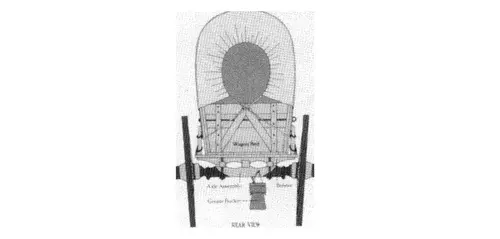
They were pleased to find that the wagon was not a reproduction, but a genuine “prairie schooner,” as the emigrants called them. Made of hardwood, it seemed both sturdy and light. It even had a certain elegance. And from the back, it looked really odd, with its angled wheels somewhat like the legs of an old cowboy, and the canvas cover that reminded you of an old woman’s bonnet.
They began to walk in the ruts that started at the wagon and continued toward the mountains. After a few minutes they could no longer hear any traffic noise from route 26. It was hot, but there was a little wind. It was a beautiful day. Just three or four clouds very high in the sky.
The man and the girl walked side by side and almost in silence. When they had something to say they spoke in an undertone. As if they were in a church, a cemetery, a sacred place. The ruts, very deep at first, became less spectacular as they went on; after they’d walked for a half hour, the ruts were hardly visible because the ground was hard.
Jack stopped for a moment.
“This is like Théo’s trail,” he said. “It’s something that almost doesn’t exist.”
“That’s true,” said the girl. “A strange postcard, a police file, an article in an old newspaper . . .”
“. . . and a trail of light across a woman’s face.”
XXII. The Gatling Gun
XXII
The Gatling Gun
“Farewell, Nebraska! Farewell, vast prairies!” the girl cried out as they drove into Wyoming.
Jack asked if they were far from Fort Hall.
“Far enough,” she said. “Anyway, it isn’t our next stop . . .”
“It isn’t?” he asked.
“No. I have to pay a little visit to Fort Laramie.”
“But . . . that’s an army fort! I thought you hated the military!”
La Grande Sauterelle had declared her loathing of the military several times. She said that of all the armed forces, the group she hated most was the American cavalry. She harboured a special hatred for the American cavalry and for the Seventh Regiment in particular; the Seventh Regiment of the American cavalry was unquestionably the military group that she detested most.
Her eyes would become as black as the stove and they would flash sparks when she talked about Generals Sherman, Custer and Sheridan.