Chapters (35)
- Volkswagen Blues
- Dedication
- I. Jacques Cartier
- II. The Legend of Eldorado
- III. A Phone Call from Sam Peckinpah
- IV. The Ideal Writer
- V. The Thousand Islands
- VI. A Discussion About Etienne Brûlé
- VII. The Secret Life of the Volkswagen Minibus
- VIII. A Very Quiet Place
- IX. The Saddest Song in the World
- X. Al Capone, Auguste Renoir and the Nobel Prize
- XI. Starved Rock
- XII. The Old Man Beside the Mississippi
- XIII. A Wave of Memories
- XIV. The Captain of the Natchez
- XV. The Deep-Sea Diver’s Complex
- XVI. Chop Suey
- XVII. The Middle of America
- XVIII. The Oregon Trail
- XIX. They Died With Their Dreams
- XX. The Bull Rider’s Wife
- XXI. Sheriff Waterman
- XXII. The Gatling Gun
- XXIII. The Champion
- XXIV. The Great Divide
- XXV. A Vagabond
- XXVI. The California Trail
- XXVII. Old French Songs
- XXVIII. An Expedition for Someone to Talk To
- XXIX. The Ghosts of San Francisco
- XXX. Mr. Ferlinghetti
- XXXI. The Girl in the Showcase
- XXXII. Théo
- XXXIII. La Grande Sauterelle
“It’s the same picture,” she said, not understanding why he was so worked up.
“I know, I know, I know,” he said. “But did you see the man sitting in the middle?”
He pointed to the centre of the picture, to a man with a beard and very black curly hair.
“I didn’t notice the first time,” he said, “but . . .”
“Are you telling me that . . . ?”
“Yes, yes, it’s my brother! Isn’t that incredible!”
“Are you sure?”
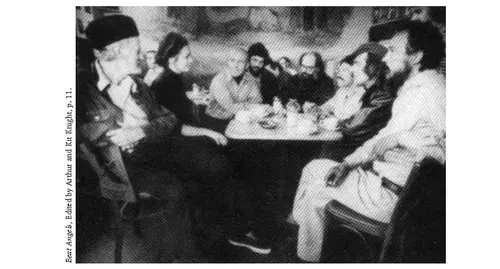
Lawrence Ferlinghetti, Minette Le Blanc, Peter Le Blanc, unidentified man, Allen Ginsberg, Harold Norse, Jack Hirschman and Bob Kaufman, Café Trieste, Grant Avenue and Vallejo, San Francisco, 1977. Photo by Diana Church.
“Absolutely!”
The girl began to get excited, too. “This is amazing!”
She got up, walked around the table, then sat down again.
“He’s sitting at the same table as Mr. Ferlinghetti,” she said. “That must mean that the owner knows him!”
“I suppose so,” said Jack.
“And this picture isn’t very old: it was taken in 1977! This is fantastic.”
Arm in arm, they climbed the stairs and crossed the two rooms on the ground floor to see if Mr. Ferlinghetti was there, but he hadn’t come in. They waited another hour and then, as their excitement had dropped, they were feeling tired. They realized it would be better to come back later. The girl “borrowed” the book and they left. They took a room at the San Remo, a small hotel near the place where they had left the Volkswagen.
In their room, which was even smaller than the ones at the YMCAs, the man kept looking at the picture of his brother.
“One thing bothers me,” he said, “that’s the caption under the picture. They name everybody, but when they get to my brother all they can say is ‘unidentified man.’ ‘A man without an identity.’ It’s a little like sayng ‘a man without importance,’ isn’t it?”
“Not at all,” said the girl. “It just shows that the photographer — who was the photographer, anyway?”
“Her name’s Diana Church.”
“It means she didn’t know your brother, that’s all. The morning she developed the picture she didn’t feel too well; she was feeling a bit rocky because she’d had too much to drink the night before, probably with the people in the picture, and she didn’t have the slightest desire to do any research, so she just wrote ‘unidentified man.’”
“People have no professional standards anymore,” said Jack severely. “What’s the world coming to!” the girl added. The man laid the open book on the bedside table and stepped back several paces.
“There’s something else that bothers me,” he said. “When I stand back and look at the picture, it’s ridiculous but it makes me think of Leonardo’s painting The Last Supper. And my brother . . .”
La Grande Sauterelle drew up and looked over his shoulder. He went on: