Villages
Chapters (20)
- Cover
- Title Page
- Copyright
- Epigraph
- i. Dream On, Dear Owen
- ii. Village Sex—I
- iii. The Husband
- iv. Village Sex—II
- v. How Phyllis Was Won
- vi. Village Sex—III
- vii. On the Way to Middle Falls
- viii. Village Sex—IV
- ix. Convalescence
- x. Village Sex—V
- xi. Developments in Hardware
- xii. Village Sex—VI
- xiii. You Don’t Want to Know
- xiv. Village Wisdom
- Also by John Updike
- About the Author
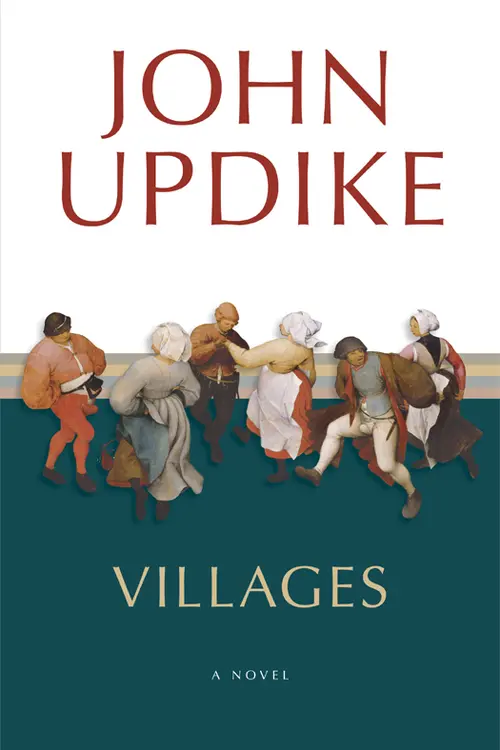
Cover
Title Page
Copyright
Villages is a work of fiction. Names, characters, places and incidents are the products of the author’s imagination or are used fictitiously.
Any resemblance to actual events, locales, or persons, living or dead, is entirely coincidental. The graphics program DigitEyes mentioned herein bears no relation to any actual computer entity of the same name.
2012 Random House Trade Paperback Edition
Copyright © 2004 by John Updike
Published in the United States by Random House Trade Paperbacks, an imprint of The Random House Publishing Group, a division of Random House, Inc., New York.
RANDOM HOUSE TRADE PAPERBACKS and colophon are trademarks of Random House, Inc.
Originally published in hardcover in the United States by Alfred A. Knopf, a division of Random House, Inc., in 2004.
David Updike walked me through MIT, and Charles Gardiner and Ken Schneider kindly scanned the computer parts of this novel. But errors and missteps are all my own. —J.U.
Portions of the first four chapters were previously published in The New Yorker magazine under the titles “Sin: Early Impressions” and “Elsie by Starlight.”
eISBN: 978-0-307-41764-0
Cover design: Gabrielle Bordwin
Cover art: Pieter Bruegel the Elder, The Wedding Dance, c.1566 (detail) (Bridgeman Art Library)
v3.1_r1
Epigraph
Ah, love, let us be true
To one another! for the world, which seems
To lie before us like a land of dreams,
So various, so beautiful, so new,
Hath really neither joy, nor love, nor light,
Nor certitude, nor peace, nor help for pain.…
—MATTHEW ARNOLD,
“Dover Beach”

i. Dream On, Dear Owen
For a long time, his wife has awoken early, at five or five-thirty. By the rhythms of her chemistry, sometimes discordant with Owen’s, Julia wakes full of affection for him, her companion on the bed’s motionless voyage through that night of imperfect sleep. She hugs him and, above his protests that he is still sleeping, declares in a soft but relentless voice how much she loves him, how pleased she is by their marriage. “I’m just so happy with you.”
This after twenty-five years of life together. He is seventy, she sixty-five; her announcement, newsworthy to her, slightly insults him: how could it be otherwise? After all their trials, and the pain they gave others. They waded through; here they are, on the other side. She tugs at him; she twists his head in order to kiss his mouth. But his lips are puffy and numb with sleep, and in his anesthetized state, his nerves misaligned, it feels like an attempt to suffocate him; it rubs him, as people used to say, the wrong way. After a few minutes more of lovestricken fidgeting, while he stubbornly fails to respond, protecting the possibility of returning to his precious dreams, Julia relents and rises from the bed, and Owen, gratefully stretching himself into her vacated side, falls asleep for another hour or two.