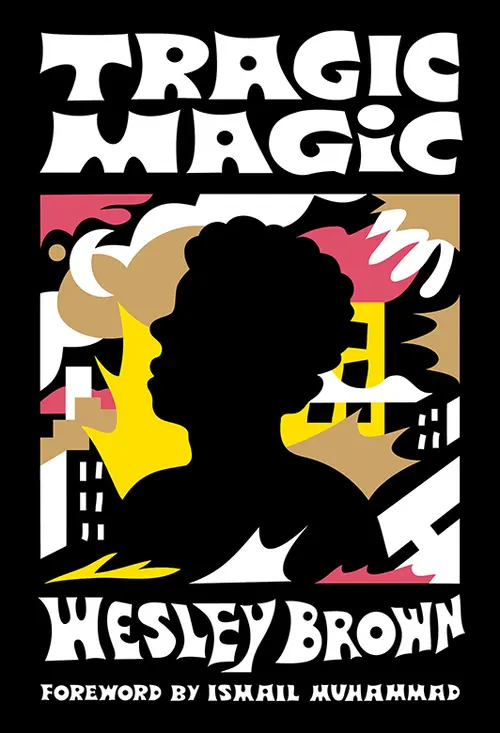
Tragic Magic
Chapters (10)
Cover Page
PRAISE FOR TRAGIC MAGIC
“A prescient ancestor to today’s insurgent, boundary-breaching African American fiction… deserves rediscovery by a new generation of readers curious about where an earlier generation of Black protest came from and how they came through its challenges.”
—Kirkus
“Personal courage, the nature of manhood (and womanhood), the ties of the past and the freedom held out by the future, all emerge as moving motifs… This jaunty prose version of the urban blues deserves an attentive audience.”
—The New York Times
“Tragic Magic is a signifyin dazzler in which Black vernacular does what it does: be dance, battle, and thesis. This sentence-level prestidigitation mirrors the narrative’s tricky syncopation of tension and release, radical past and post-Civil Rights present, acid humor and the woe behind a wolf ticket’s bluster. First published in 1978, Wesley Brown’s remarkable and cinematic satire is still on-time, which is perhaps nearly as tragic as it’s surely magical.”
—Douglas Kearney, author of Starts Spinning
“Tragic Magic is a tremendous affirmation… One hell of a writer.”
—James Baldwin
“Wonderfully wry.”
—Donald Barthelme
“A clearly talented new writer.”
—Publishers Weekly
“An important discovery.”
—Ishmael Reed
“A literary gem.”
—Mat Johnson
Haftitle Page
TRAGIC MAGIC
Title Page
TRAGIC
MAGIC
A NOVEL
WESLEY BROWN
PART OF THE OF THE DIASPORA SERIES
edited by ERICA VITAL-LAZARE

Dedication
For my mother and father
and
Ted Solotaroff
Foreword
FOREWORD
_____
“…A THING NEVER MEANT a thing until it moved.” Melvin Ellington, the protagonist of Wesley Brown’s 1978 novel Tragic Magic arrives at this realization, ironically, during one of the few moments in the novel when he’s at rest, finally lying at his belle Alice’s side. It’s a posture we aren’t used to seeing him in. Magic covers a single day in Melvin’s life as he makes his way to New York City from Pennsylvania, where he served time for refusing to be drafted into the Vietnam War. Thrown off his path as a college student and finding himself marooned in a kind of emotional dead zone—the result of steeling his heart against the depravities of prison life—he walks his old neighborhood haunts like a latter-day Leopold Bloom, if Bloom’s step and thought were infused with the spirit of jazz.