Chapters (67)
- Title Page
- Copyright Notice
- Dedication
- PART ONE
- CHAPTER I
- CHAPTER II
- CHAPTER III
- CHAPTER IV
- CHAPTER V
- CHAPTER VI
- CHAPTER VII
- CHAPTER VIII
- CHAPTER IX
- EXEUNT I
- PART TWO
- CHAPTER I
- CHAPTER II
- CHAPTER III
- CHAPTER IV
- CHAPTER V
- CHAPTER VI
- CHAPTER VII
- CHAPTER VIII
- CHAPTER IX
- CHAPTER X
- CHAPTER XI
- CHAPTER XII
- EXEUNT II
- PART THREE
- CHAPTER I
- CHAPTER II
- CHAPTER III
- CHAPTER IV
- CHAPTER V
- CHAPTER VI
- CHAPTER VII
- CHAPTER VIII
- EXEUNT III
- PART FOUR
- CHAPTER I
- CHAPTER II
- CHAPTER III
- CHAPTER IV
- EXEUNT IV
- PART FIVE
- CHAPTER I
- CHAPTER II
- CHAPTER III
- CHAPTER IV
- CHAPTER V
- CHAPTER VI
- EXEUNT V
- PART SIX
- CHAPTER I
- CHAPTER II
- CHAPTER III
- EXEUNT VI
- ADDENDUM
- APPENDIX I
- APPENDIX II
- APPENDIX III
- APPENDIX IV
- AFTERWORD & ACKNOWLEDGMENTS
- Also by Christopher Paolini
- A Conversation between Brandon Sanderson and Christopher Paolini
- ABOUT THE AUTHOR
- Newsletter Sign-up
The three different continua—the subluminal, the luminal, and superluminal—coexist within the same time and space, overlapping at every point in the universe. The luminal exists in a fluidic membrane that separates the subluminal from the superluminal, acting as an interference medium between them. The membrane is semi-permeable, and has a definite surface on both sides, upon which all EM forces exist.
The membrane itself, and thus the entirety of three-dimensional space, is made up of Transluminal Energy Quanta (TEQs), which are, quite simply, the most fundamental building block of reality. A quantized entity, TEQs possess Planck length of 1, Planck energy of 1, and a mass of 0. Their movements and interactions give rise to every other particle and field.
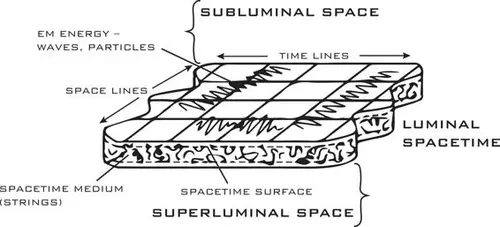
Figure 2: Simplified diagram of spacetime
Taken as a whole, TEQs—and spacetime itself—behave in a quasi-fluidic way. Like a fluid, the luminal membrane exhibits:
- Pressure
- Density and compressibility
- Viscoelasticity
- Surface and surface tension
We will examine each of these in detail later, but for now, it’s worth noting that viscoelasticity is the property that gives rise to gravity and inertia and is what allows for all relative motion. As mass accumulates, it begins to displace the spacetime membrane, which thins beneath the object. This is gravity. Likewise, the membrane resists change, which means it takes time to displace when force is applied. (The viscousness of spacetime results in friction between boundary layers, which is the reason for the Lense–Thirring effect, aka: frame-dragging).
Since subluminal and superluminal space are physically separated by the spacetime membrane, STL mass and FTL mass can occupy the same coordinate points simultaneously, although this arrangement would be short-lived as (a) all matter in superluminal space moves at some speed faster than c, and (b) the shared membrane means that the spacetime displacement from mass, which is to say gravity, has an equal and opposite effect on the opposing realm.
An example to illustrate: in STL space, a planet will press down upon the fabric of spacetime to create the sort of gravity well we are all familiar with. At the same time, that depression will manifest in FTL space as a gravity “hill”—an equal and opposite prominence in the spacetime fabric. And the reverse is also true.
This has a number of consequences. First of which is that mass in one realm of space has a repulsive effect in the other. Stars, planets, and other STL gravitational bodies no longer act as attractors when one transitions to FTL. Quite the opposite.