Chapters (67)
- Title Page
- Copyright Notice
- Dedication
- PART ONE
- CHAPTER I
- CHAPTER II
- CHAPTER III
- CHAPTER IV
- CHAPTER V
- CHAPTER VI
- CHAPTER VII
- CHAPTER VIII
- CHAPTER IX
- EXEUNT I
- PART TWO
- CHAPTER I
- CHAPTER II
- CHAPTER III
- CHAPTER IV
- CHAPTER V
- CHAPTER VI
- CHAPTER VII
- CHAPTER VIII
- CHAPTER IX
- CHAPTER X
- CHAPTER XI
- CHAPTER XII
- EXEUNT II
- PART THREE
- CHAPTER I
- CHAPTER II
- CHAPTER III
- CHAPTER IV
- CHAPTER V
- CHAPTER VI
- CHAPTER VII
- CHAPTER VIII
- EXEUNT III
- PART FOUR
- CHAPTER I
- CHAPTER II
- CHAPTER III
- CHAPTER IV
- EXEUNT IV
- PART FIVE
- CHAPTER I
- CHAPTER II
- CHAPTER III
- CHAPTER IV
- CHAPTER V
- CHAPTER VI
- EXEUNT V
- PART SIX
- CHAPTER I
- CHAPTER II
- CHAPTER III
- EXEUNT VI
- ADDENDUM
- APPENDIX I
- APPENDIX II
- APPENDIX III
- APPENDIX IV
- AFTERWORD & ACKNOWLEDGMENTS
- Also by Christopher Paolini
- A Conversation between Brandon Sanderson and Christopher Paolini
- ABOUT THE AUTHOR
- Newsletter Sign-up
APPENDIX I
SPACETIME & FTL
Excerpt from the Entropic Principia (Revised)
… necessary to outline a brief overview of the fundamentals. Let this serve as a primer and quick reference guide for later, more serious studies.
FTL travel is the defining technology of our modern era. Without it, expansion beyond the Solar System would be impossible, barring centuries-long trips on generational ships or automated seed ships that would grow colonists in situ upon arrival. Even the most powerful fusion drives lack the delta-v to jet between the stars as we do now.
Although long theorized, superluminal travel did not become a practical reality until Ilya Markov codified the unified field theory (UFT) in 2107. Empirical confirmation followed soon afterward, and the first working prototype of an FTL drive was constructed in 2114.
Markov’s brilliance was in recognizing the fluidic nature of spacetime and demonstrating the existence of the different luminal realms, as outlined in the earlier, purely theoretical work of Froning, Meholic, and Gauthier around the turn of the twenty-first century. Prior to that, thinking was constrained by the limitations of general relativity.
Per Einstein’s formulations for special relativity (coupled with Lorentz transformations), no particle with real mass can accelerate to the speed of light. Not only would that require an infinite amount of energy, doing so would break causality, and as later, practical demonstrations have shown, the universe does not break causality on a non-quantum scale.
However, nothing in special relativity prevents a massless particle from always traveling the speed of light (i.e., a photon), nor from always traveling faster than light (i.e., a tachyon). And that is exactly what the math shows. By combining several of the equations of special relativity, the underlying relativistic symmetry between subluminal, luminal, and superluminal particles becomes clear. With regard to the superluminal, substituting relativistic mass for proper mass allows superluminal mass and energy to become definable, non-imaginary properties.
This provides us with our current model of physical space (fig. 1):
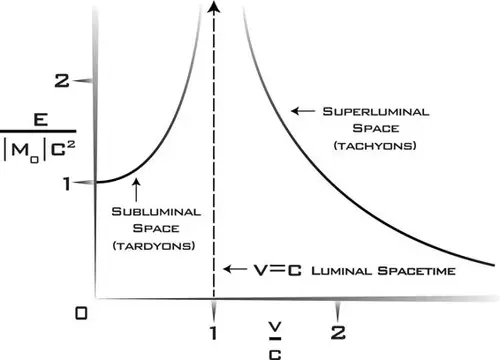
Figure 1: Positive energy vs. velocity
Here the v=c asymptote vertical represents the fluidic spacetime membrane (which has a negligible but non-zero thickness).
By examining this graph, a number of things will become immediately and intuitively clear. First, that just as a subluminal particle can never reach the speed of light c, neither can a superluminal particle. In normal, STL space, expending energy (e.g., shooting propellent out the back of your spaceship) can move you closer to the speed of light. So too in FTL space. However, in FTL space, the speed of light is the slowest possible speed, not the fastest, and you can never quite slow down to it, not as long as you possess mass.