The Way Back
Chapters (26)
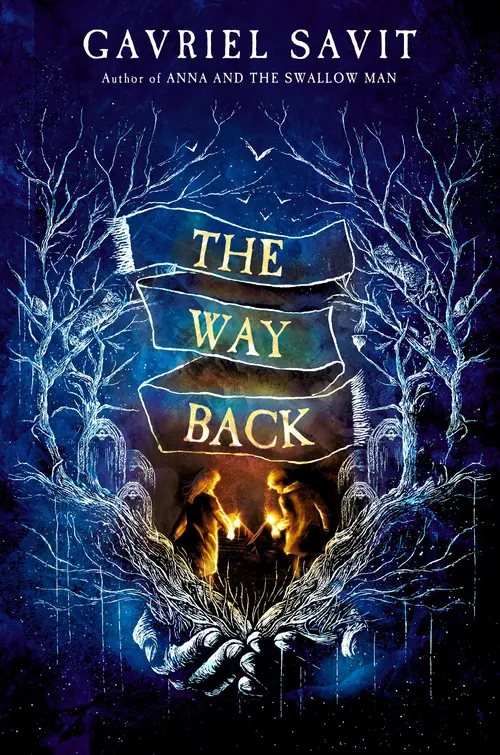
- Cover
- Also by Gavriel Savit
- Dedication
- Chapter One: Two from Tupik
- Chapter Two: Crossing Over
- Chapter Three: Ripples
- Chapter Four: Into the Darkness
- Chapter Five: Rules of Acquisition
- Chapter Six: The Swarming
- Chapter Seven: Zubinsk
- Chapter Eight: Great Souls
- Chapter Nine: The Flight and the Fall
- Chapter Ten: The Next Mourning
- Chapter Eleven: Onward and Inward
- Chapter Twelve: Strange Navigation
- Chapter Thirteen: Three Questions
- Chapter Fourteen: Dantalion
- Chapter Fifteen: The Retreat
- Chapter Sixteen: The Advance
- Chapter Seventeen: To War
- Chapter Eighteen: The Gilgul
- Chapter Nineteen: Back
- THE DANTALION
- ACKNOWLEDGMENTS
- About the Author
- What’s next onyour reading list?
Cover
Also by Gavriel Savit
Anna and the Swallow Man
Dedication
For all of my ancestors and all of my descendants,
Whether they be living today
Or not
Chapter One: Two from Tupik
On a bright summer day in the year eighteen hundred and twelve (by the gentile reckoning), a girl left her mother’s house—the little house where she had been born—and went to the brambles on the far side of the forest to gather the small summer strawberries that grow in the shade.
These were the best kind of berries, tiny and soft, and the girl crouched in the bushes, staining her lips and fingertips red: one for her mouth, one for her apron, and so on and on.
At first the girl was sure that she must be imagining things. She was far from the village here, far from the road, and she alone knew of the berry bush.
Surely no one else would come to this place.
But she was not imagining things.
The column burst out into the clearing like a ball from a musket: men in orderly rows, stepping in time, their buttons and bayonets shining in the sun, and more and more and more men—the young lady had never seen so very many. Now horses came as well, and taller men in splendid uniforms astride them. Mules and wagons and great bronze cannons thundered past the girl in the brambles, and feet and hooves and studded wheels churned the grass into a muddy slaw.
The girl was not foolish; she kept hidden and did not draw attention to herself. But when one particular man reached the clearing, she could not help but rise up to get a better look.
Even in the heat of the summer sun, he wore his long, pale blue coat. The gray stallion beneath him moved dexterously at his urging, as if it were a part of him, and as he loped out into the clearing, it quickly became clear that the entirety of the column—all the men and horses and cannons and shot, all of it—was simply an extension of his body.
This, of course, was the great war emperor Napoleon Bonaparte.
He had come to take the Russian Empire.
He had come to take the world.
An officer on a dappled charger came cantering up to his elbow, and the emperor turned his head. It was in this moment that he caught sight of the girl in the bushes.
His eyes bore into hers, and she locked her lips tight, unwilling to let even the lightest breath pass between them.
The officer was speaking.
The emperor did not look away.
And then he turned back toward the horizon, answered his officer, and spurred on his horse.
And that was that.
The girl made her way home. The sun sank behind the advancing troops.