The Secret of Grey Walls
Chapters (15)
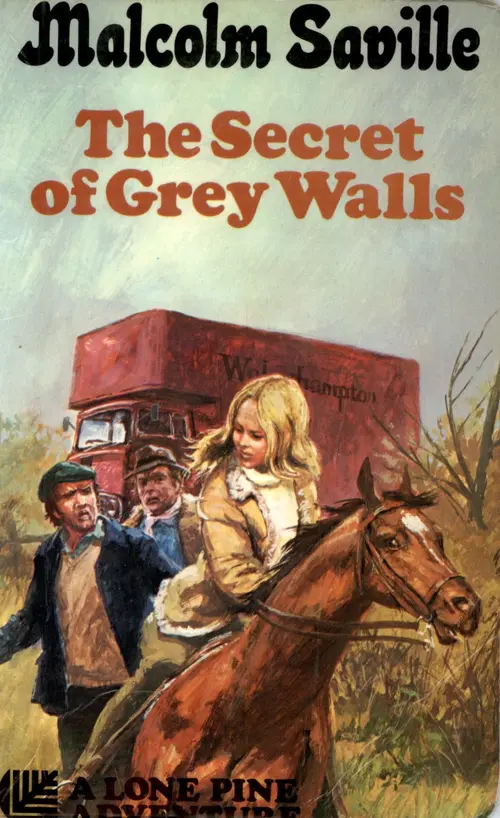
The Secret of Grey Walls
Malcolm Saville
William Collins Sons & Co. Ltd., London and Glasgow. First published in Armada in 1975 by Fontana Paperbacks, 14 St. James's Place, London SW1A 1PS.
This impression 1979. © Malcolm Saville
Printed in Great Britain by Love & Malcomson Ltd., Brighton Road, Redhill, Surrey.
FOR MY WIFE
CONDITIONS OF SALE:
This book is sold subject to the condition that it shall not, by way of trade or otherwise, be lent, re-sold, hired out or otherwise circulated without the publisher's prior consent in any form of binding or cover other than that in which it is published and without a similar condition including this condition being imposed on the subsequent purchaser.
Foreword
Clungunford and Clunbury, Clunton and Clun,
Are the quietest places under the Sun.
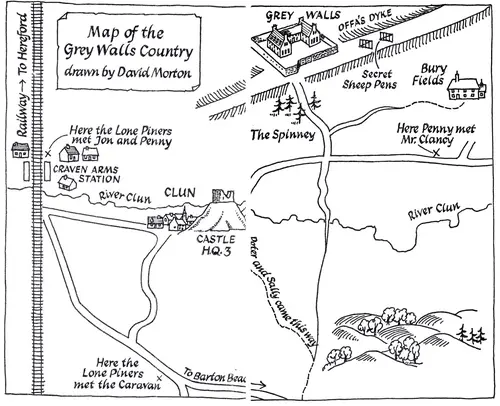
If you can find a map large enough to show the towns and villages in the counties of Shropshire, Hereford and Radnor, and then study it carefully, you may find for yourself the four villages mentioned in the old rhyme. Clun, the last-named, is the scene of this story.
Look for it this way. First find Shrewsbury on your map and then follow the black railway line south in the direction of Ludlow and Hereford until you come to a strangely-named junction called Craven Arms. Look now for a road leaving this little town and running west - this is the road along which all the Lone Piners, except Peter, travelled on that cold December day on which their adventure started - and follow it until you find, as they did, that Clun might well be the quietest place under the sun.
Clun is the largest of the four places named after the little river which rises over the Welsh border and slips down the valley between the wooded hills by the Craven Arms road.
There seems no particular reason why Clun should exist to-day, but it does, and you can go there for yourself. You can stand on the narrow stone bridge where Penny and the others stood while Alan Denton dashed past them on his bicycle on his way to find Clun's policeman. You can climb the grassy hill up which the twins led the two new members of the Club and stand beside the now crumbling ruins of the castle which was built soon after the Norman Conquest. From here, high above the crowded roofs of Clun town, while the sweet wind sings in your ears, you can look west over wild and rolling country into Wales, which is only a few miles distant. All this land was once a forest.
Offa's Dyke wants some finding, but for many miles it still runs as straight as a rule through the heather.