Chapters (24)
- Cover
- Title
- Copyright
- Dedication
- Contents
- Preface
- The Letter
- To the Reader
- Chapter One: A Death in the Family
- Chapter Two: Farewell and a Call to Duty
- Chapter Three: Listen and Learn
- Chapter Four: Planting the Seeds of War
- Chapter Five: A Call to Arms
- Chapter Six: Selecting the Best Riflemen
- Chapter Seven: The Long March to Boston
- Chapter Eight: 1775: The Continental Army—From Defense to Offense
- Chapter Nine: 1775: The Order Is Given
- Chapter Ten: 1775: A Sortie Delayed
- Chapter Eleven: 1775: River-Ready Batteaux?
- Chapter Twelve: 1775: Winter in the Forest Primeval
- Chapter Thirteen: 1775: Quebec—Setting the Stage for Battle
- Chapter Fourteen: 1775-1776: Quebec—The Forlorn Hope
- Postscript
- Acknowledgments
5 Thou preparest a table before me in the presence of mine enemies: thou anointest my head with oil; my cup runneth over.
6 Surely goodness and mercy shall follow me all the days of my life: and I will dwell in the house of the Lord for ever.
3. Though Colonel Benedict Arnold and Ethan Allen had a lifelong dispute over who should be credited with seizing Fort Ticonderoga on 10 May 1775, there is no debate it was Col. Arnold who compiled the inventory of weapons, ammunition, and military stores captured at Ticonderoga. There is also no doubt Arnold discussed removing the military hardware—particularly the heavy artillery—for use by Patriot forces with Generals Montgomery, Schuyler, and Washington.
Every history of the American Revolution credits the remarkable feat Henry Knox achieved in bringing the heavy weaponry from Ticonderoga to Boston during the winter of 1775–76. Knox, using the “Arnold Inventory,” selected sixty cannons, howitzers, and mortars to be transported by leaky barges, teams of draft horses, even crude ox-drawn sleds, on a ten-week, three-hundred-mile trek. The saga of how Knox and his men braved heavy snow and freezing cold while dragging weapons weighing as much as 6,000 pounds [the weight of a “24-pounder” cannon and carriage] across frozen rivers, through swamps, forests, and ascending and descending the Berkshire Mountains on the way to break the Boston stalemate in March of ’76 is the stuff of legend.
Yet, the first time Patriot forces actually used Ticonderoga’s heavy weapons in combat took place in September–October 1775 under the command of Brigadier General Richard Montgomery during the siege to capture Fort St. Johns. He used Ticonderoga weapons again to coerce the British surrender at Montreal and ultimately at Quebec.
4. Better known as “The Plains of Abraham.”
5. Captain Morgan was off by a few minutes. His conversation with Colonel Arnold took place at 3:45 a.m. Sunrise in Quebec on the 14th of November was at 6:29 a.m.
Chapter Fourteen: 1775-1776: Quebec—The Forlorn Hope
Chapter Fourteen
1775–1776: Quebec—
The Forlorn Hope
Forlorn Hope: A body of combatants chosen to lead an assault against an enemy-held position where the risk of casualties is highest.
North Wall of Quebec City, Canada
Saturday, December 23rd, 1775
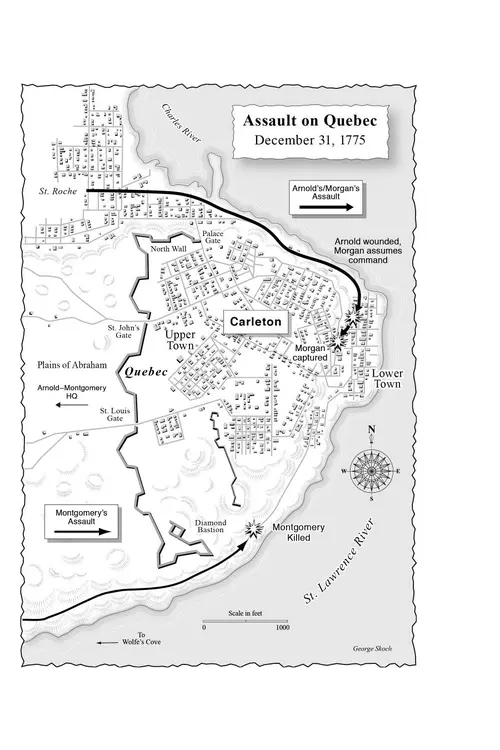
Our attacks on the city walls and Palace Gates area from the St. Charles River are having little effect. On the rare occasions the enemy show themselves, our Riflemen dispatch them, but we sustain losses as well from their cannons and volleys from the walls.
Resistance from the Redcoats inside Quebec is stalwart. Patriot artillery cannot be properly entrenched, inflicts little damage on the city, and is outgunned by superior British artillery pieces and placement.
The severity of our condition is measured with increased cold, infirmity, and death. Then, a smallpox outbreak among Montgomery’s New York troops further depletes our numbers. Every officer is aware that the term of service for nearly all of Arnold’s troops expires at midnight, December 31st.