The Organs of Sense
Chapters (11)
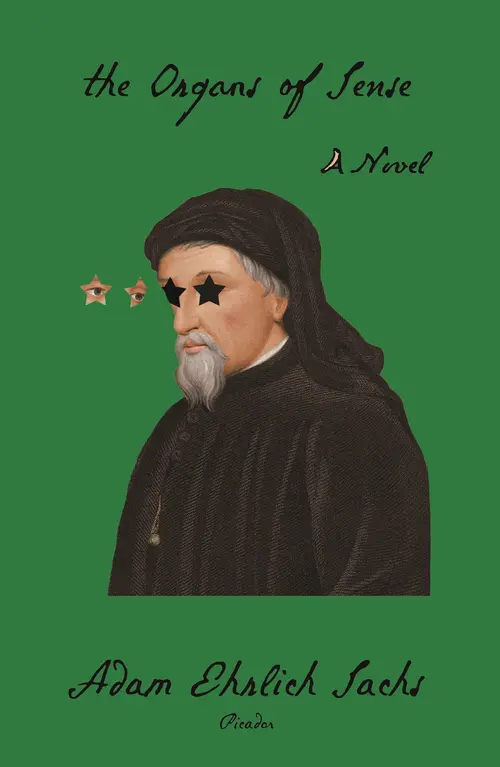
Title Page
Copyright Notice
The author and publisher have provided this e-book to you for your personal use only. You may not make this e-book publicly available in any way. Copyright infringement is against the law. If you believe the copy of this e-book you are reading infringes on the author’s copyright, please notify the publisher at: us.macmillanusa.com/piracy.
Dedication
For my mother
And in memory of my grandfather, Walter Ehrlich
Epigraph
Look out at and look into.
—Giambattista della Porta, Magia naturalis
ONE
IN AN ACCOUNT sent to the Philosophical Transactions but for some reason never published there, or anywhere else, a young G. W. Leibniz, who throughout his life was an assiduous inquirer into miracles and other aberrations of nature, related the odd and troubling encounter he had with a certain astronomer who’d predicted that at noon on the last day of June 1666, the brightest time of day at nearly the brightest time of year, the Moon would pass very briefly, but very precisely, between the Sun and the Earth, casting all of Europe for one instant in absolute darkness, “a darkness without equal in our history, but lasting no longer than four seconds,” the astronomer predicted, according to Leibniz, an eclipse that no other astronomer in Europe was predicting, and which, Leibniz explained, drew his notice in part because the astronomer in question, whose observations of the planets and the fixed stars were supposedly among the most accurate and the most precise ever made, superior to Tycho’s, was blind, and “not merely completely blind,” Leibniz wrote (in my translation from the Latin), “but in fact entirely without eyes.”
There could be no question of his feigning blindness because his sockets, and this much was known, were empty, wrote Leibniz, for whom this encounter seems to have both hastened and brought to a close the sole significant intellectual crisis of a philosophical career otherwise dominated by the sanguine rationalism for which it is now known, and for which, at least since the time of Voltaire, it has periodically been ridiculed.