Chapters (27)
- About The One Impossible Labyrinth
- Title page
- Dedication
- CONTENTS
- Endpapers
- Epigraph
- Previously . . .
- First Test of Worth: Entering the Labyrinth
- The Secret Royal World: The Battlefield, The Bell and The Royal Banker
- A Man Named Jack: Part I Zoe
- Second Test of Worth: The Endless Tunnel
- The Secret Royal World II: Troy, The Royal Redoubt and the Red Horizon Star
- A Man Named Jack: Part II The Schoolyard Fight
- Third Test of Worth: The City-maze
- A Man Named Jack: Part III After the Schoolyard Fight
- Fourth Test of Worth: The Four-sided Maze
- The Secret Royal World III: The New York Obelisk and the D.C. Rendezvous
- A Man Named Jack: Part IV Basra, 1991
- Fifth Test of Worth: The Colossus
- Final Test of Worth: The Throne of the Three of Death
- A Man Named Jack: Part V The World After Omega
- Acknowledgements
- AN INTERVIEW WITH MATTHEW REILLY
- About the Author
- Also by Matthew Reilly
- Copyright page
- Newsletter
As he examined the map, he noted that prominently featured on both of its sides, at nine o’clock and three o’clock, were two famous ancient tree symbols: on the left side, the Kabbalistic–Sephirot Tree of Life, and on the right, the Norse Tree of Death.
He recalled that his mother, Mae, had seen an image of these two sacred trees side by side inside the Vatican’s most secret vault:
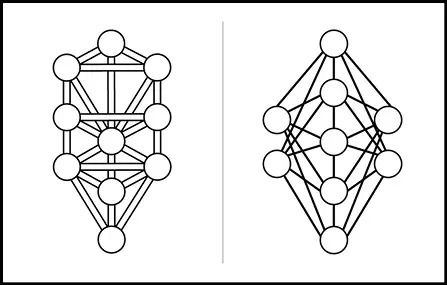
Jack thought about the two ancient images.
With their similar arrays of lines and circles, it was easy to get them confused. But they were different. The Tree of Death used thin lines and nine circles, while the Tree of Life used thick lines and ten circles.
Similar though they were, they also came from very different places in the world.
In the Kabbalistic doctrine, born in the Palestine region, the Tree of Life guided mortals through various stages of enlightenment to ‘Heaven’.
The Tree of Death, on the other hand, hailed from northern Europe where it was known as Yggdrasil, the tree from which the god Odin was hanged. It represented a grim afterlife, or ‘Hell’.
Jack also remembered someone at the Great Games mentioning in the same breath the four legendary kingdoms, the three secret cities and the ‘two sacred trees’. They were important.
‘This is all coming together . . .’ he breathed. ‘Here. Now. In this place.’
He traced his finger around the skull in a clockwise direction, starting in the centre and spiralling around it:
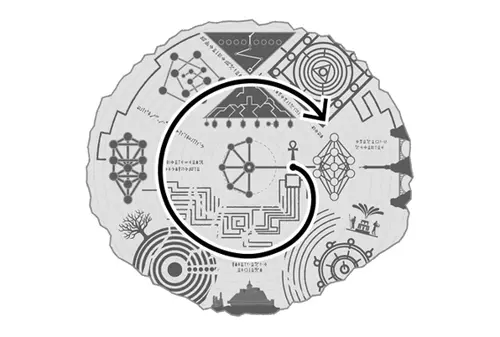
Now that he was looking at it more closely, he even noticed thin jagged lines connecting some of the images around the edge of the skull, reinforcing his theory.
‘You start in the middle and if you keep going around the circle, through the various mazes, passing through the Tree of Life at nine o’clock, you eventually reach the final image, the Tree of Death, over on the right side at three o’clock, where presumably the Throne resides.’
He and Lily swapped looks.
‘A maze of mazes,’ she said. ‘And that closed-off tunnel before was the Emperor’s Route: a short and direct path to the Tree of Death and the throne there. But as you said, it’s been closed off so now everyone has to go the long way round.’
‘Right,’ Jack said. ‘So we’re here, at this box with the six lines branching off it.’
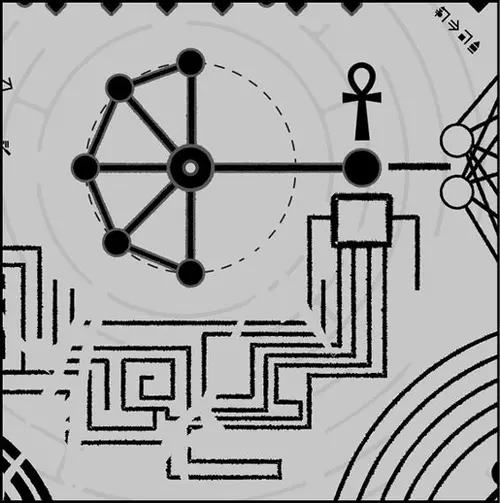
They gazed out at the abyss before them, with the hand-rungs leading across its ceiling to the six doorways and their ledges.
‘These lines on the scalp look like tunnels to me, long ones, complicated ones, endless ones,’ Jack said. ‘But only one reaches the Tree of Life at nine o’clock. So we have to pick the correct one.’
Lily said, ‘Then let’s start using the instructions. The next one is: To find the endless tunnel, take the doorway below the image of Ningizzida. Okay, who or what is Ningizzida?’