Chapters (58)
- Copyright Notice
- Dedication
- I Qualia
- Chapter 1
- Chapter 2
- Chapter 3
- Chapter 4
- Chapter 5
- Chapter 6
- Chapter 7
- Chapter 8
- Chapter 9
- Chapter 10
- Chapter 11
- Chapter 12
- II Umwelt
- Chapter 13
- Chapter 14
- Chapter 15
- Chapter 16
- Chapter 17
- Chapter 18
- Chapter 19
- Chapter 20
- Chapter 21
- Chapter 22
- Chapter 23
- Chapter 24
- III Semiosphere
- Chapter 25
- Chapter 26
- Chapter 27
- Chapter 28
- Chapter 29
- Chapter 30
- Chapter 31
- Chapter 32
- Chapter 33
- Chapter 34
- Chapter 35
- Chapter 36
- IV Autopoiesis
- Chapter 37
- Chapter 38
- Chapter 39
- Chapter 40
- Chapter 41
- Chapter 42
- Chapter 43
- Chapter 44
- Chapter 45
- Chapter 46
- Chapter 47
- Chapter 48
- Epilogue
- Acknowledgments
- A Note About the Author
- Newsletter Sign-up
“We all accept the responsibility for killing other things. And even for killing people. That is what it means to be alive. Killing is what our existence does on this planet. All we have—everything we use to live—is taken from someone else. If you think otherwise, you are nothing but a naïve child.”
“Your view of the world is ugly,” Ha said. And you are ugly, she had wanted to say. But she had not said it: It was hurtful. And untrue. Ha remembered Altantsetseg, floating in the phosphorescent aquamarine of her control tank. That body, roped with muscle, streaked and slashed with scar tissue, writhing to a syncopation of its own. Its terrible beauty.
Trapped. That’s what Altantsetseg was: trapped in this way of looking at everything … as endless conflict. Still fighting the Winter War. It was written on her flesh.
There was more that Altantsetseg wanted to say. Altantsetseg even opened her mouth to speak—but then closed it again. This time, there was no look of contempt. And no look of pleading. There was nothing at all.
Ha dropped over the side, ending the conversation.
Ha had expected to find the symbol she had built here, and Evrim had added to, gone. It was days later. The actions of water, current, and tide should have buried them.
But the symbol was not gone. The bottles she had brought here were supplemented by others—colored and clear, older and more recent. And now there was not only one sign: there were six, arrayed vertically and close together near a weathered volcanic rock exposed by the shifting sand.
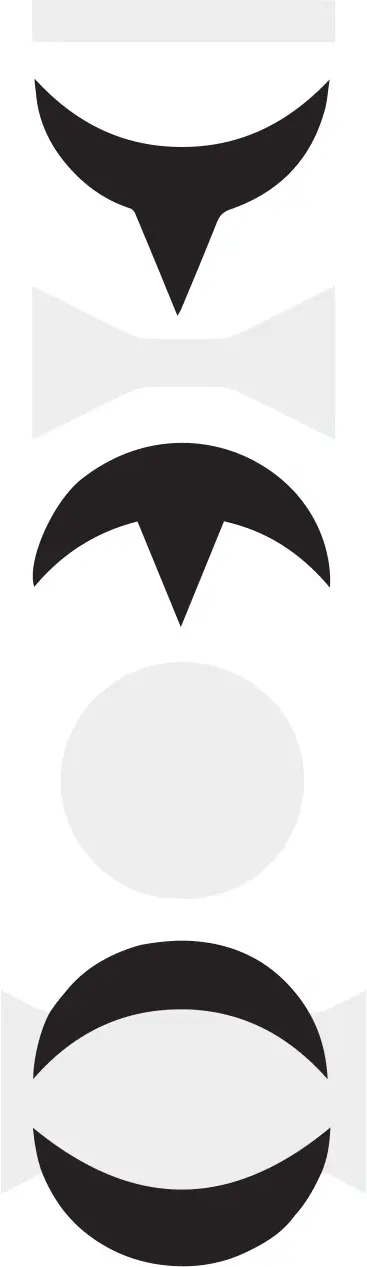
Ha hovered a long time in the clear early morning calm of the inlet’s water. There were too many questions about how the octopuses thought for her to begin trying to arrange these symbols into true relationship with one another—a grammar—but here, written in bottles on the sand, was not a single sign but a sequence. A sentence? I have been spoken to.
Ha surfaced.
“I need that palimpscreen and the stylus.”
Altantsetseg handed them to her wordlessly. Ha noticed one of Altantsetseg’s drones, a silvery ball rotating in a cuff of fan-jets, drifting over the surface of the water.
Descending again to the sand, she sketched on the screen as quickly as she could, her hands shaking:

She held it out in front of her. For a minute she floated there. Then she settled onto her heels and sat down in the sand. Another minute passed.