The Library of Legends
Chapters (52)
- Dedication
- Epigraph
- The Journey West
- Chapter 1
- Chapter 2
- Chapter 3
- Chapter 4
- Chapter 5
- Chapter 6
- Chapter 7
- Chapter 8
- Chapter 9
- Chapter 10
- Chapter 11
- Chapter 12
- Chapter 13
- Chapter 14
- Chapter 15
- Chapter 16
- Chapter 17
- Chapter 18
- Chapter 19
- Chapter 20
- Chapter 21
- Chapter 22
- Chapter 23
- Chapter 24
- Chapter 25
- Chapter 26
- The Journey East
- Chapter 27
- Chapter 28
- Chapter 29
- Chapter 30
- Chapter 31
- Chapter 32
- Chapter 33
- Chapter 34
- Chapter 35
- Chapter 36
- Chapter 37
- Chapter 38
- Chapter 39
- Author’s Notes
- Acknowledgments
- Resources
- P.S. Insights, Interviews & More . . .*
- About the Author
- About the Book
- Read On
- Also by Janie Chang
- About the Publisher
Dedication
To the memory of my father and uncle, who packed up their books and became refugees in their own country, walking more than a thousand miles to safety with their university. The evacuation of Chinese universities during a time of war was emblematic of the Chinese regard for education. It was one of the country’s most remarkable achievements of intellectual and cultural preservation. It’s also a chapter of history almost unknown outside China.
Epigraph
Though the country is broken, hills and streams endure;
And in the city spring comes again to trees and grasses.
But flowers shed fearful tears,
And desolate birds sing the sorrows of parting.
Beacon fires have burned for three months now,
And letters from home are worth ten thousand pieces of gold.
From “Spring View” by Du Fu (AD 712–770)
The Journey West
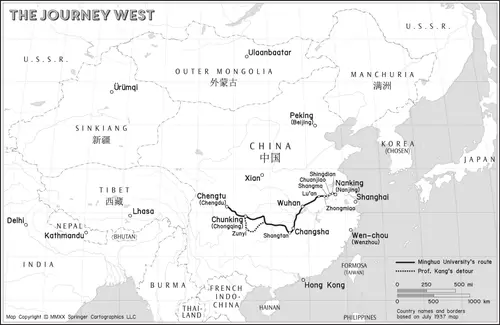
Map by Nick Springer / Springer Cartographics LLC
Chapter 1
September 20, 1937–Nanking, China
The approaching aircraft were too far away for Lian to tell whether they were Chinese or Japanese. A moment later, she didn’t need to guess. The spiraling wail of sirens churned the air. Then the bombs began falling, like beads slipping off a necklace.
She had been on her way to the train station. She’d gotten off the rickshaw to buy a steamed bun for breakfast. Now she stood outside the bakery as though rooted to the pavement, uncertain what to do. The nearest air-raid shelter was two blocks away, across from the railway station, its entrance already besieged. Even if she were willing to abandon her wicker suitcase, she would never reach the shelter in time.
A strong hand gripped her arm and yanked her through the bakery door.
“Get to the back room,” the baker growled. But she shook her head and dashed out, struggling back with the heavy suitcase. She had to save her books.
Inside, the baker and his wife were throwing damp cloths over trays of buns. He pointed to a storage room built against the back of the kitchen, sacks of flour stacked against one wall. The couple joined four small children squeezed together against the sacks. Lian hesitated, then slid her wicker suitcase under a worktable. But before she could run to the storage room, a shrill whistling pierced her eardrums, followed by the sound of explosions. The floor shuddered. Next she heard the sharp, rhythmic report of antiaircraft guns.
There was a roar of sound and then the world went silent.
LIAN HAD LEFT Minghua University early that morning, spending precious coins from her small cache to ride on a rickshaw that jounced its way through congested streets. Rickshaws and handcarts, handbarrows, wagons, and the occasional automobile. Nanking was evacuating. Every vehicle was piled high with trunks, sacks of food, furniture, and people. Invalids and the elderly, mothers holding children. Their expressions ranged from anxious to stoic.