Chapters (33)
- Cover
- Title Page
- Dedication
- CONTENTS
- CHAPTER I
- CHAPTER II
- CHAPTER III
- CHAPTER IV
- CHAPTER V
- CHAPTER VI
- CHAPTER VII
- CHAPTER VIII
- CHAPTER IX
- CHAPTER X
- CHAPTER XI
- CHAPTER XII
- CHAPTER XIII
- CHAPTER XIV
- CHAPTER XV
- CHAPTER XVI
- CHAPTER XVII
- CHAPTER XVIII
- CHAPTER XIX
- CHAPTER XX
- CHAPTER XXI
- CHAPTER XXII
- CHAPTER XXIII
- CHAPTER XXIV
- CHAPTER XXV
- CHAPTER XXVI
- CHAPTER XXVII
- CHAPTER XXVIII
- CHAPTER XXIX
Her brilliant cheeks were a delight to the eye. The snow swirled about her, whitened the crown of her red cap and clung to her shoulders. Have you ever seen snow-crystals gleam, break, dissolve in fair, soft, storm-blown hair? Do you know how a man will pledge his soul that a particular flake will never fade, never cease to rest upon a certain flying strand over a girlish temple? And he loses—his heart and his wager—in a breath! If you fail to understand these things, and are furthermore unfamiliar with the fact that the color in the cheeks of a girl who walks abroad in a driving snowstorm marks the favor of Heaven itself, then I waste time, and you will do well to rap at the door of another inn.
“I’d rather missed you,” I said; “and, really, I should have been over to apologize if I hadn’t been afraid.”
“Sister Theresa is rather fierce,” she declared. “And we’re not allowed to receive gentlemen callers,—it says so in the catalogue.”
“So I imagined. I trust Sister Theresa is improving.”
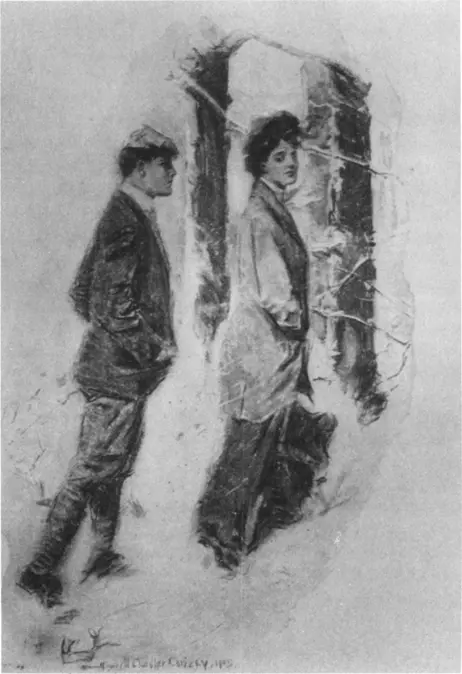
She marched before me, her hands in her pockets. Page 123
“Yes; thank you.”
“And Miss Devereux,—she is quite well, I hope?”
She turned her head as though to listen more carefully, and her step slackened for a moment; then she hurried blithely forward.
“Oh, she’s always well, I believe.”
“You know her, of course.”
“Oh, rather! She gives us music lessons.”
“So Miss Devereux is the music-teacher, is she? Should you call her a popular teacher?”
“The girls call her”—she seemed moved to mirth by the recollection—“Miss Prim and Prosy.”
“Ugh!” I exclaimed sympathetically. “Tall and hungry-looking, with long talons that pound the keys with grim delight. I know the sort.”
“She’s a sight!”—and my guide laughed approvingly. “But we have to take her; she’s part of the treatment.”
“You speak of St. Agatha’s as though it were a sanatorium.”
“Oh, it’s not so bad! I’ve seen worse.”
“Where do most of the students come from,—all what you call Hoosiers?”
“Oh, no! They’re from all over—Cincinnati, Chicago, Cleveland, Indianapolis.”
“What the magazines call the Middle West.”
“I believe that is so. The bishop addressed us once as the flower of the Middle West, and made us really wish he’d come again.”
We were approaching the gate. Her indifference to the storm delighted me. Here, I thought in my admiration, is a real product of the western world. I felt that we had made strides toward such a comradeship as it is proper should exist between a school-girl in her teens and a male neighbor of twenty-seven. I was—going back to English fiction—the young squire walking home with the curate’s pretty young daughter and conversing with fine condescension.