Chapters (5)
The gunmen stopped firing as soon as there was no target—but Bradshaw, his hunting instincts alerted, had already drawn a bead on the sherriff ’s killer and fired. There was an almighty detonation, a brief flash and a large cloud of smoke. The eraserhead hit home, and the gunman disintegrated midstride into a brief chysanthemum of text that scattered across the main street, the meaning of the words billowing out into a blue haze that hung near the ground for a moment or two before evaporating.
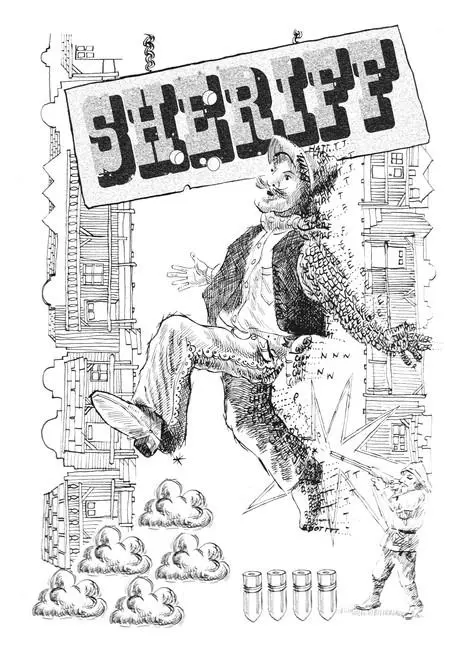
. . . the gunman disintegrated midstride into a brief chysanthemum of text that scattered across the main street. . . .
“What are you doing?” I asked, annoyed at his impetuosity.
“Him or us, Thursday,” replied Bradshaw grimly, pulling the lever down on his Martini-Henry to reload, “him or us.”
“Did you see how much text he was composed of?” I replied angrily. “He was almost a paragraph long. Only featured characters get that kind of description—somewhere there’s going to be a book one character short!”
“But,” replied Bradshaw in an aggrieved tone, “I didn’t know that before I shot him, now did I?”
I shook my head. Perhaps Bradshaw hadn’t noticed the missing button, the sweat stains and the battered shoes, but I had. Erasure of a featured part meant more paperwork than I really wanted to deal with. From Form F36/34 (Discharge of an Eraserhead) and Form B9/32 (Replacement of Featured Part) to Form P13/36 (Narrative Damage Assessment), I could be bogged down for two whole days. I had thought bureaucracy was bad in the real world, but here in the paper world, it was everything.
“So what do we do?” asked Bradshaw. “Ask politely for them to surrender?”
“I’m thinking,” I replied, pulling out my footnoterphone and pressing the button marked CAT. In fiction the commonest form of communication was by footnote, but way out here . . .
“Blast!” I muttered again. “No signal.”
“Nearest repeater station is in The Virginian,” observed Bradshaw as he replaced the spent cartridge and closed the breech before peering outside, “and we can’t bookjump direct from pulp to classic.”
He was right. We had been crossing from book to book for almost six days, and although we could escape in an emergency, such a course of action would give the Minotaur more than enough time to escape. Things weren’t good, but they weren’t bad either—yet.
“Hey!” I yelled from the sheriff ’s office. “We want to talk!”
“Is that a fact?” came a clear voice from outside. “Mr. Johnson says he’s all done talkin’—’less you be in mind to offer amnesty.”
“We can talk about that!” I replied.
There was a beeping noise from my pocket.
“Blast,” I mumbled again, consulting the Narrative Proximity Device. “Bradshaw, we’ve got a story thread inbound from the East, two hundred and fifty yards and closing. Page 74, line 6.”