Chapters (12)
My flax on the sod, which was too small to be hurt at the beginning of the drouth, began to need rain, and reports in all daily papers told that the great heat wave and the drouth in many places were worse than in Tipp county. All over the western and northern part of the state, were localities where it had not rained that season. Potatoes, wheat, oats, flax, and corn, in the western part of the state, had not sprouted, and, it was said, in a part of Butte county, where seed had been sown four inches deep the year before, there had not been enough rain since to make it sprout.
The government had spent several million dollars damming the Belle Fourche river for the purpose of irrigation, and the previous autumn, when it had been completed, the water in it had been run onto the land, to see how it would work, and since had been dry. No snow had fallen in the mountains during the winter, and all the rivers were as dry as the roads; while all the way from the gulf, to Canada, the now protracted drouth was burning everything in its wake.
At Kansas City, where the treacherous Kaw empties its waters into the Missouri, and had for years wrought disaster with its notorious floods, drowning out two and sometimes three crops in a single spring, was nearly dry, and the crops were drying up throughout its valley.
I spent the Fourth of July in Victor, where the people shook their heads gravely and said, "Tipp county will never raise a crop." The crops had dried up in Tipp county the year before. I read that the railroad men who run from Kansas City to Dodge City reported that the pastures through Kansas were so dry along the route, that a louse could be seen crawling a half mile away. In parts of Iowa the farmers commenced to put their stock in pens and fed them hay from about the middle of June, there being no feed in the pastures. Through eastern Nebraska, western Iowa and southern Minnesota, the grasshoppers began to appear by the millions, and proceeded to head the small grain. To save it, the farmers cut and fed it to stock, in pens.
CHAPTER XLII
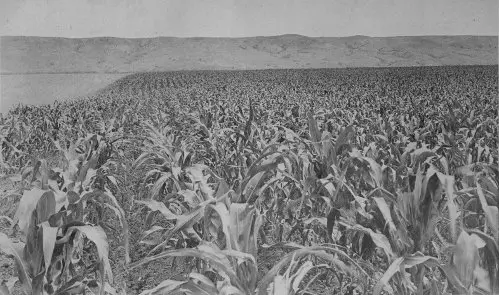
The crops began to wither. (page 289.)