Chapters (11)
Then slowly, but inexorably, and materially, life improved. The bitter, burning needs were alleviated. More and more often we got to eat flour. It was increasingly finely ground, and whiter. Millet was gradually replaced by rice. We came to know granulated sugar. First blue and green, then white cotton fabrics arrived in the yurt. We got to see banknotes, were allowed to carefully touch and even sniff them, and learned that we could get anything in return for them. And we were told how to get the crinkling blue and red notes: by hunting wild animals and birds and delivering the kill to the district. Or by cutting tall, straight trees and rafting them down the river to the district center. Anybody wanting to get rich this way found that he could easily get whatever was needed to bring death to foxes and wolves, to rock partridges and gray partridges, to larch trees and pine trees: a gun, trap, poison, rope, saw, or axe. All these could be had unbelievably cheaply; they cost next to nothing. No doubt, the superpower’s interests lay behind this easy availability, and invariably it was to that superpower that the spoils would go. Some found this situation beautiful, others ugly. Even those who found it beautiful thought: Killing animals—why not if it pays? But killing trees? No, never! So they left that to the Kazakhs, who had long mowed down the larch and pine forests closest to them.
As it turned out, people got rich quickly. But while the animal murderers were dealing in morsels, the tree murderers found themselves with such piles on their plate that they must have lost their senses: Overnight, they seemed to change into different people. Some modest socialist affluence—or, put more modestly, some appetizing whiff of it—had arrived in the remotest corner of the Mongolian state. But this judgment is based on a comparison of the present time with that in which The Blue Sky is set. Compared to the capital, Ulaanbaatar, time in the mountains stands still, dates back quite a few decades; and compared to the industrialized part of the world, even centuries.
This was the cost of the transformation: Gone were the forests. Gone the herds of moufflons, mountain goats, and other animals, and gone the coveys of rock partridges and gray partridges and other birds. The people stood as if changed from small and big children into small and big adults.
Nevertheless, one important point gives me comfort: That corner of the world that is my home, a full two thousand kilometers, an hour of the sun, five days by car, and decades if not millennia of progress removed from the capital Ulaanbaatar, has remained not the Wild, but the Gentle West of the Mongolian empire.
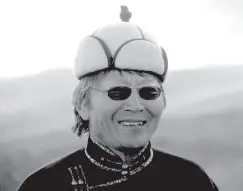
Ernst Meier