River Of Earth
Cover
RIVER OF EARTH
Title
JAMES STILL
River of Earth
with a Foreword by Dean Cadle
The University Press of Kentucky
Copyright
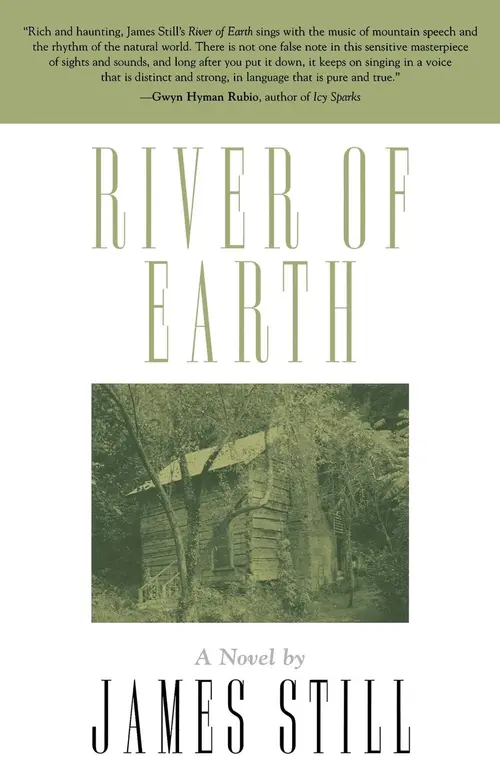
Cover illustration: James Still’s cabin in Hindman, Kentucky.
Courtesy Hindman Settlement School Archives.
Cover design by Jen Huppert
Publication of this volume was made possible in part by a grant from the National Endowment for the Humanities.
Copyright 1940 by James Still
Copyright © 1978 by The University Press of Kentucky
Scholarly publisher for the Commonwealth, serving Bellarmine University, Berea College, Centre College of Kentucky, Eastern Kentucky University, The Filson Historical Society, Georgetown College, Kentucky Historical Society, Kentucky State University, Morehead State University, Murray State University, Northern Kentucky University, Transylvania University, University of Kentucky, University of Louisville, and Western Kentucky University.
All rights reserved.
Editorial and Sales Offices: The University Press of Kentucky
663 South Limestone Street, Lexington, Kentucky 40508-4008
www.kentuckypress.com
ISBN-10: 0-8131-1372-5
ISBN-13: 978-0-8131-1372-2
Library of Congress Catalog Card Number: 77092928
This book is printed on acid-free recycled paper meeting the requirements of the American National Standard for Permanence in Paper for Printed Library Materials.
Manufactured in the United States of America.
 Member of the Association of American University Presses
Dedication
For My Mother and Father
Contents
CONTENTS
Foreword
I
II
III
Foreword
FOREWORD
JAMES STILL completed River of Earth in an ancient log house on a small eastern Kentucky farm, green and flowering, between Wolfpen Creek and Deadmare Branch in Knott County, where he continues to live and write, at ease among a valley of neighbors who often sound as though they have stepped out of his stories.
A descendant of pioneers who settled early in the southern mountains, Still grew up in the Appalachian foothills of northern Alabama. When he moved to eastern Kentucky in 1932, the machine age in the hills was less than thirty years old; and of the millions of people whose lives it had affected perhaps no one, even the coal-mine owners, sincerely believed it was a blessing.
For two hundred years the people of southern Appalachia had been independent and relatively self-sufficient. Each family obtained from the land it owned practically everything needed to feed, clothe, and shelter its members. But within a period of less than twenty years this agricultural society of small farms was virtually destroyed by industrialism. Families sold their farms, or abandoned them, or lost them to mine operators, and flocked to the mushrooming mining camps: three-roomed “shotgun” houses, a commissary, a school, and a church, all of whitewashed board and batten, clustered near a driftmouth.