River Of Earth
Cover
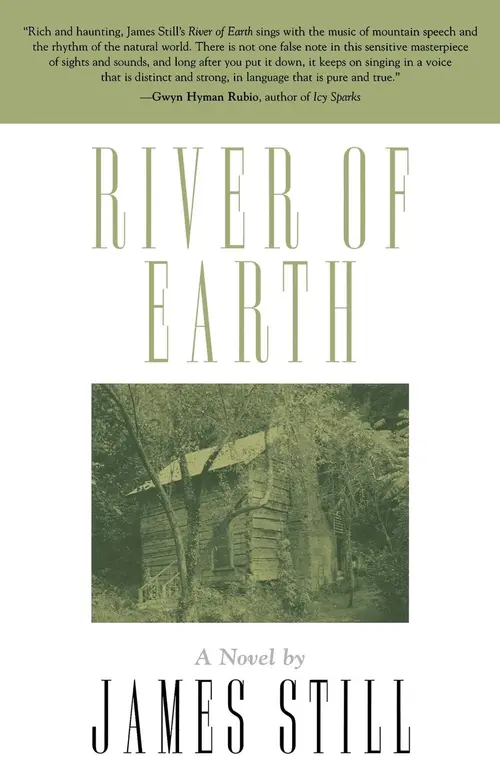
RIVER OF EARTH
Title
JAMES STILL
River of Earth
with a Foreword by Dean Cadle
The University Press of Kentucky
Copyright
Cover illustration: James Still’s cabin in Hindman, Kentucky.
Courtesy Hindman Settlement School Archives.
Cover design by Jen Huppert
Publication of this volume was made possible in part by a grant from the National Endowment for the Humanities.
Copyright 1940 by James Still
Copyright © 1978 by The University Press of Kentucky
Scholarly publisher for the Commonwealth, serving Bellarmine University, Berea College, Centre College of Kentucky, Eastern Kentucky University, The Filson Historical Society, Georgetown College, Kentucky Historical Society, Kentucky State University, Morehead State University, Murray State University, Northern Kentucky University, Transylvania University, University of Kentucky, University of Louisville, and Western Kentucky University.
All rights reserved.
Editorial and Sales Offices: The University Press of Kentucky
663 South Limestone Street, Lexington, Kentucky 40508-4008
www.kentuckypress.com
ISBN-10: 0-8131-1372-5
ISBN-13: 978-0-8131-1372-2
Library of Congress Catalog Card Number: 77092928
This book is printed on acid-free recycled paper meeting the requirements of the American National Standard for Permanence in Paper for Printed Library Materials.
Manufactured in the United States of America.
 Member of the Association of American University Presses
Dedication
For My Mother and Father
Contents
CONTENTS
Foreword
I
II
III
Foreword
FOREWORD
JAMES STILL completed River of Earth in an ancient log house on a small eastern Kentucky farm, green and flowering, between Wolfpen Creek and Deadmare Branch in Knott County, where he continues to live and write, at ease among a valley of neighbors who often sound as though they have stepped out of his stories.
A descendant of pioneers who settled early in the southern mountains, Still grew up in the Appalachian foothills of northern Alabama. When he moved to eastern Kentucky in 1932, the machine age in the hills was less than thirty years old; and of the millions of people whose lives it had affected perhaps no one, even the coal-mine owners, sincerely believed it was a blessing.
For two hundred years the people of southern Appalachia had been independent and relatively self-sufficient. Each family obtained from the land it owned practically everything needed to feed, clothe, and shelter its members. But within a period of less than twenty years this agricultural society of small farms was virtually destroyed by industrialism. Families sold their farms, or abandoned them, or lost them to mine operators, and flocked to the mushrooming mining camps: three-roomed “shotgun” houses, a commissary, a school, and a church, all of whitewashed board and batten, clustered near a driftmouth.
At the height of the coal boom—around 1920—a farmer who seldom had owned a dollar bill could earn from $20 to $50 a day and buy more from the commissary in one week than he could grow on a farm in a year. Then, in the late 1920s the demand for coal decreased. Some mines closed permanently, and those that continued to operate worked from one to three days a week at reduced wages, and then usually only during the spring and summer months to stock coal for the winter demands, forcing the few men who owned land to choose planting and harvesting or digging coal.
The result was a landless, jobless, hungry, perplexed people. Ruined for a way of life they could control, they were betrayed by this new, quicksilver promise that left them idle much of the year.
The sureness with which James Still weaves his patchwork of light, shadow, and colors into this drab, joyless landscape surely creates one of the presences of artistry that we can recognize and appreciate in all the arts but cannot isolate and define. Marjorie Kinnan Rawlings had this quality in mind when she referred to Still’s work as “vital, beautiful, heart-breaking, and heart-warmingly funny,” as did poet Delmore Schwartz who called River of Earth “a symphony,” and the Time reviewer who considered it “a work of art.”
Still’s “secret” lies in his ability to use language so that it performs the functions of both music and painters’ pigments. Whether the individual words are strange or familiar, it is the manner of expression that gives them conviction and demonstrates that Still is a creator as well as a listener, and that he sees and hears with the senses of a poet.
His words can create a picture filled with the brilliance of an impressionist painting:
Morning was bright and rain-fresh. The sharp sunlight fell slantwise upon the worn limestone earth of the hills, and our house squatted weathered and dark on the bald slope. Yellow-bellied sapsuckers drilled their oblong holes in the black birch by the house, now leafing from tight-curled buds.
And a sound: “January was a bell in Lean Neck Valley. The ring of an ax was a mile wide, and all passage over the spewed-up earth was lifted on frosty air and sounded against fields of ice.”
His scenes can be filled with factual knowledge, as in the account of the father removing a cob from a calf’s throat. And he can give an idiomatic translation of the Old Testament that retains the rhythm and power of the original, as in Brother Mobberly’s sermon:
I was borned in a ridgepocket. ... I never seed the sun-ball withouten heisting my chin. My eyes were sot upon the hills from the beginning. Till I come on the Word in this good Book, I used to think a mountain was the standingest object in the sight o’ God. Hit says here they go skipping and hopping like sheep, a-rising and a-falling. These hills are jist dirt waves, washing through eternity. My brethren, they hain’t a valley so low but what hit’ll rise again. They hain’t a hill standing so proud but hit’ll sink to the low ground o’ sorrow. Oh, my children, where air we going on this mighty river of earth, a-borning, begetting, and a-dying—the living and the dead riding the waters? Where air it sweeping us?
Published within a year of each other by the same publisher, River of Earth and The Grapes of Wrath are the only books chronicling the demoralizing Depression years that have continued to gain readers in more affluent ones. The major difference between them is that Steinbeck’s story deals with a calamity that has struck America only once in its lifetime, while Still is writing of the struggles that have plagued the mountain people since the country was settled.
Although the Joads travel halfway across the country and the Baldridge family moves only the few miles separating the coal camps from the farm, both books are equally an odyssey of a people in search of a promised land. With the coming of each spring and each fall Brack Baldridge announces that the mines are going to open soon—this time for good. And the mother’s continual refrain is: “Forever moving yon and back, setting down nowhere for good and all, searching for God knows what. . . . Where air we expecting to draw up to?”
And when the mines close and the crops fail there is little complaining. They simply pack up and move again, accepting, hoping, laughing to make their misfortune bearable.
More than twenty years before the region was labeled a “poverty pocket” and prior to the surprised reactions of experts and government officials to the problems of destitution, as though they had encountered some recent wonder, James Still had presented the heartbreaking account of what it means for a human being to live out his life hungry and cold. His is not a socioeconomist’s collection of figures, causes, and possible cures, but the dramatized plight of human beings accepting poverty without accusations or judgments or rantings against outside institutions.
That fiction for Still obviously is a scenic art is evident in the visual clarity with which he creates scenes and develops characters and in the deceptive ease with which he keeps the author out of the story. Most any section of the novel reads like a mini-play that could be transferred to the stage with a minimum of directives, for the narrative is continually pushed forward by credible action and by dialogue designed more for hearing than for silent reading. And though the reader may insistently remind himself that the story was set down on paper by James Still, he will have to search for overt signs of the author’s presence. It would be ridiculous for a playwright to circulate on stage giving cues and interrupting the action to inform the audience of the thoughts of the actors, Still seems to be saying, so why should I muddy the story for the reader by intruding my directives, commentaries, and evaluations? Using the first person point of view of a young boy as his “center of consciousness,” Still has achieved a fine balance between erasing the author and creating the impression that the story moves of its own volition. And however far in the background he may be, he is there in the form of a magician busy with one hand entertaining the audience with anecdotes, echoes of folklore, and mountain dialogue while with the other hand he is unobtrusively shaping incidents, bridging-in poetic interludes, and disguising signs that direct the story toward his intended climax.
Still is a writer of constricted lives, valid desperations, and victories that seem small reward for all the patience and hurt they exact; but in his most successful scenes he creates a world whose resonances echo beyond the last word to the fullness of the reader’s capacity to understand. His work reflects a compassion, insight, and objectivity remindful of Katherine Anne Porter (“The Jilting of Granny Weatherall,” “The Downward Path to Wisdom”) and of Bernard Malamud (“The Loan,” “The Magic Barrel”).
With each “discovery” and each exploitation of Appalachia, River of Earth assumes new meaning and increasing significance both as a chronicle of change and as a work of art. Read today with the strip-mined region as a map—the scalped hills and gashed mountainsides, the ruined farmlands, the dead streams, the flash waters the earth can’t contain—even the title assumes a prophecy of doom undreamed of by Brother Mobberly.
An emotional response is the one quality above all for which Still works. There are no games, no literary or historical allusions, no puns, no symbolism, sentimentality, didacticism, or redundancy. He gives no motives, airs no theories, states no beliefs. He simply sets down the experiences of a few human beings during a season of change in a certain place. And he does it in a manner that is simple and unposed and with the perception and restraint that denote an imagination as honest, as controlled, as the needle of a compass. And the emotion is present as certainly as the leaf is in the bud. In giving order to “a handful of chaos” Still has created a new and fresh view of a range of mountains seventy million years old and of a people that promise to survive all industrial upheavals.
I
I
THE mines on Little Carr closed in March. Winter had been mild, the snows scant and frost-thin upon the ground. Robins stayed the season through, and sapsuckers came early to drill the black birch beside our house. Though Father had worked in the mines, we did not live in the camps. He owned the scrap of land our house stood upon, a garden patch, and the black birch that was the only tree on all the barren slope above Blackjack. There were three of us children running barefoot over the puncheon floors, and since the year’s beginning Mother carried a fourth balanced on one hip as she worked over the rusty stove in the shedroom. There were eight in the family to cook for. Two of Father’s cousins, Harl and Tibb Logan, came with the closing of the mines and did not go away.
“It’s all we can do to keep bread in the children’s mouths,” Mother told Father. “Even if they are your blood kin, we can’t feed them much longer.” Mother knew the strings of shucky beans dried in the fall would not last until a new garden could be raised. A half-dozen soup bones and some meat rinds were left in the smokehouse; skippers had got into a pork shoulder during the unnaturally warm December, and it had to be thrown away. Mother ate just enough for the baby, picking at her food and chewing it in little bites. Father ate sparingly, cleaning his plate of every crumb. His face was almost as thin as Mother’s. Harl and Tibb fed well, and grumblingly, upon beans and corn pone. They kicked each other under the table, carrying on a secret joke from day to day, and grimacing at us as they ate. We were pained, and felt foolish because we could not join in their laughter. “You’ll have to ask them to go,” Mother told Father. “These lazy louts are taking food out of the baby’s mouth. What we have won’t last forever.” Father did not speak for a long time; then he said simply: “I can’t turn my kin out.” He would say no more. Mother began to feed us between meals, putting less on the table. They would chuckle without saying anything. Sometimes one of them would make a clucking noise in his throat, but none of us laughed, not even Euly. We would look at Father, his chin drooped over his shirt collar, his eyes lowered. And Fletch’s face would be as grave as Father’s. Only the baby’s face would become bird-eyed and bright.
When Uncle Samp, Father’s great-uncle, came for a couple of days and stayed on after the week-end was over, Mother spoke sternly to Father. Father became angry and stamped his foot on the floor. “As long as we’ve got a crust, it’ll never be said I turned my folks from my door,” he said. We children were frightened. We had never seen Father storm like this, or heard him raise his voice at Mother. Father was so angry he took his rifle-gun and went off into the woods for the day, bringing in four squirrels for supper. He had barked them, firing at the tree trunk beside the animals’ heads, and bringing them down without a wound.
Uncle Samp was a large man. His skin was soft and white, with small pink veins webbing his cheeks and nose. There were no powder burns on his face and hands, and no coal dust ground into the heavy wrinkles of his neck. He had a thin gray mustache, over a hand-span in length, wrapped like a loose cord around his ears. He vowed it had not been trimmed in thirty years. It put a spell on us all, Father’s cousins included. We looked at the mustache and felt an itching uneasiness. That night at the table Harl and Tibb ate squirrels’ breasts and laughed, winking at each other as they brushed up brown gravy on pieces of corn pone. Uncle Samp told us what this good eating put him in mind of, and he bellowed, his laughter coming deep out of him. The rio lamp trembled on the table. We laughed, watching his face redden with every gust, watching the mustache hang miraculously over his ears. Suddenly my brother Fletch began to cry over his plate. His shins had been kicked under the table. Mother’s face paled, her eyes becoming hard and dark. She gave the baby to Father and took Fletch into another room. We ate quietly during the rest of the meal, Father looking sternly down the table.
After supper Mother and Father took a lamp and went out to the smokehouse. We followed, finding them bent over the meat box. Father dug into the salt with a plow blade, Mother holding the light above him. He uncovered three curled rinds of pork. We stayed in the smokehouse a long time, feeling contented and together. The room was large, and we jumped around like savages and swung head-down from the rafters.
Father crawled around on his hands and knees with the baby on his back. Mother sat on a sack of black walnuts and watched us. “Hit’s the first time we’ve been alone in two months,” she said. “If we lived in here, there wouldn’t be room for anybody else. And it would be healthier than that leaky shack we stay in.” Father kept crawling with the baby, kicking up his feet like a spoiled nag. Fletch hurt his leg again. He gritted his teeth and showed us the purple spot where he had been kicked. Father rubbed the bruise and made it feel better. “Their hearts are black as Satan,” Mother said. “I’d rather live in this smokehouse than stay down there with them. A big house draws kinfolks like a horse draws nitflies.”
It was late when we went to the house. The sky was overcast and starless. During the night, rain came suddenly, draining through the rotten shingles. Father got up in the dark and pushed the beds about. He bumped against a footboard and wakened me. I heard Uncle Samp snoring in the next room; and low and indistinct through the sound of water on the roof came the quiver of laughter. Harl and Tibb were awake in the next room. They were mightily tickled about something. They laughed in long, choking spasms. The sound came to me as though afar off, and I reckon they had their heads under the covers so as not to waken Uncle Samp. I listened and wondered how it was possible to laugh with all the dark and rain.
Morning was bright and rain-fresh. The sharp sunlight fell slantwise upon the worn limestone earth of the hills, and our house squatted weathered and dark on the bald slope. Yellow-bellied sapsuckers drilled their oblong holes in the black birch by the house, now leafing from tight-curled buds. Fletch and I had climbed into the tree before breakfast, and when Mother called us in we were hungry for our boiled wheat.
We were alone at the table, Harl and Tibb having left at daylight for Blackjack. They had left without their breakfast, and this haste seemed strange to Mother. “This is the first meal they’ve missed,” she said.
Uncle Samp slept on in the next room, his head buried under a quilt to keep the light out of his face. Mother fed the baby at her breast, standing by Father at the table. We ate our wheat without sugar, and when we had finished, Mother said to Father: “We have enough bran for three more pans of bread. If the children eat it by themselves, it might last a week. It won’t last us all more than three meals. Your kin will have to go today.”
Father put his spoon down with a clatter. “My folks eat when we eat,” he said, “and as long as we eat.” The corners of his mouth were drawn tight into his face. His eyes burned, but there was no anger in them. ‘Til get some meal at the store,” he said.
Mother leaned against the wall, clutching the baby. Her voice was like ice. “They won’t let you have it on credit. You’ve tried before. We’ve got to live small. We’ve got to start over again, hand to mouth, the way we began.” She laid her hand upon the air, marking the words with nervous fingers. “We’ve got to tie ourselves up in such a knot nobody else can get in.” Father got his hat and stalked to the door. “We’ve got to do hit today,” she called. But Father was gone, out of the house and over the hill toward Blackjack.
The Story Continues on BooksBarbecue!
Enjoyed this preview? ❤️ Do not stop here!
Read the complete book free online → 🔗
Continue reading now on BooksBarbecue and discover every page!
Love reading? Bookmark BooksBarbecue.com for more amazing books!
Happy Reading!