Chapters (40)
- FOREWORD
- RAILROAD OF DEATH
- REFERENCE LIST:
- Railroad of Death
- PREFACE TO THE THIRD EDITION (1948)
- INTRODUCTION
- PART ONE: SINGAPORE
- CHAPTER 1
- CHAPTER 2
- CHAPTER 3
- CHAPTER 4
- CHAPTER 5
- PART TWO: RAILROAD OF DEATH
- CHAPTER 6
- CHAPTER 7
- CHAPTER 8
- CHAPTER 9
- CHAPTER 10
- CHAPTER 11
- CHAPTER 12
- CHAPTER 13
- PART THREE: BASE CAMPS AND LIBERATION
- CHAPTER 14
- CHAPTER 15
- CHAPTER 16
- CHAPTER 17
- CHAPTER 18
- CHAPTER 19
- CHAPTER 20
- APPENDIX ONE:
- APPENDIX TWO:
- APPENDIX THREE:
- APPENDIX FOUR:
- APPENDIX FIVE:
- APPENDIX SIX:
- APPENDIX SEVEN:
- APPENDIX EIGHT:
- APPENDIX NINE:
- ACKNOWLEDGEMENTS
- And The Dawn Came Up Like Thunder
The main object of the News Service was to maintain a high morale among the P.of.W. when no authorative news was available rumours [?] rife and the morale of the camps fluctuated from day to day sometimes very light at other times very low and it was a great strain not knowing what to believe and what not to believe. In addition contact with the outside world was desirable for several reasons. For one it was always possible that messages might be sent to us in fact after the sinking of a P.O.W. convoy as the result of which a member P.O.W. from our particular camp were liberated, we were surprised that no messages were put out for us. Several of those rescued knew our times of operation
Policy
Prior to taking over the News Service a private set had been operated in Chungkai for a selected few and this caused much hard feeling. From the start we layed down our policy which contained three main points. (1) The news was to be given to all officers and later to be allowed to filter through to the O.R.s. (2) There was to be no censorship of the news in any form either by ourselves or by any outsider person. (3) News was to be given out simultaneously to all officers – no officers to have special privileges. There was one exception to this – should any news of military importance which might affect the camp come through then this would immediately be passed on to the senior Br. Officers. Both Lt. Col. Owtram & Lt. Col Dean were in full agreement with this policy. As a result of our policy no other officer was expected to shoulder any of the responsibility of the wireless set.
Operation
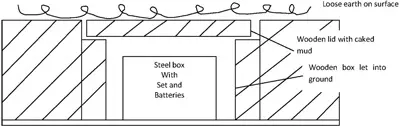
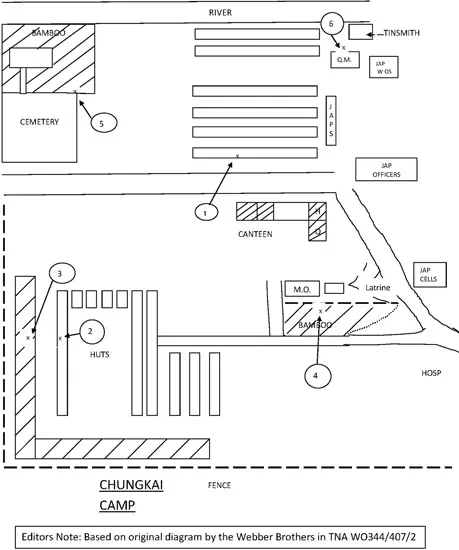
The method of operation was as follows:-at dusk or just after dark a cordon of guards was thrown round the place of operation then the set was uncovered a few minutes before the scheduled time of the news bulletin. The set was operated by Lt. D.H. Webber and the news taken down by Capt M.L. Webber. This was done in complete darkness. The set was then . . . away. The whole operation took less than half an hour. The following day the bulletin was made up from the notes and then issued 24 hrs later. Our place of operation varied from time to time. It first was operated inside our hut but later was moved to various places in the camp where there was a thick natural cover of bamboo, then finally to the Q.M. stores. In Kanburi the set was operated in the kitchen. From all the attached diagrams it will be seen that frequently we chose a place close to Jap quarters as these places were regarded with less suspicion than the more remote parts.
For the major part of the time the set was kept below ground.