Chapters (40)
- FOREWORD
- RAILROAD OF DEATH
- REFERENCE LIST:
- Railroad of Death
- PREFACE TO THE THIRD EDITION (1948)
- INTRODUCTION
- PART ONE: SINGAPORE
- CHAPTER 1
- CHAPTER 2
- CHAPTER 3
- CHAPTER 4
- CHAPTER 5
- PART TWO: RAILROAD OF DEATH
- CHAPTER 6
- CHAPTER 7
- CHAPTER 8
- CHAPTER 9
- CHAPTER 10
- CHAPTER 11
- CHAPTER 12
- CHAPTER 13
- PART THREE: BASE CAMPS AND LIBERATION
- CHAPTER 14
- CHAPTER 15
- CHAPTER 16
- CHAPTER 17
- CHAPTER 18
- CHAPTER 19
- CHAPTER 20
- APPENDIX ONE:
- APPENDIX TWO:
- APPENDIX THREE:
- APPENDIX FOUR:
- APPENDIX FIVE:
- APPENDIX SIX:
- APPENDIX SEVEN:
- APPENDIX EIGHT:
- APPENDIX NINE:
- ACKNOWLEDGEMENTS
- And The Dawn Came Up Like Thunder
Editor’s Note (see opposite)
Reginald Harry Rennison, Signalman, Royal Corp of Signals died 12 September 1943 http://tinyurl.com/q7k3jrm [accessed 5 December 2013]. The Commonwealth War Graves Commission entry also lists his musical qualifications. A website specialising in the history of musicians from Portsmouth, cites an anonymous entry, presumably taken from a Portsmouth newspaper about Rennison ‘1945 May 24th Reports of the death of Reginald Renison in the “hands of the Japanese”, he is a well known Portsmouth pianist and organist.’ See http://www.michaelcooper.org.uk/C/organists.htm [accessed 14 December 2013]
Railroad of Death
John Coast
Dedication
TO
MR. AND MRS. BOON PONG SIRIVEJJABHANDHU
best of our numerous Thai friends
TO
My old Kongsi
HENRY FOWLER, JIM RICHARDSON, GEORGE SULLY
TO
TOM DOUGLAS, THE WEBBER BROTHERS AND OTHERS
who risked their lives daily to get us the Radio News
TO
HUGH DE WARDENER
Doctor
TO
the Memory of
REGINALD RENNISON
Musician
AND TO
ALL FELLOW COOLIES ON THE THAI-BURMA RAILWAY
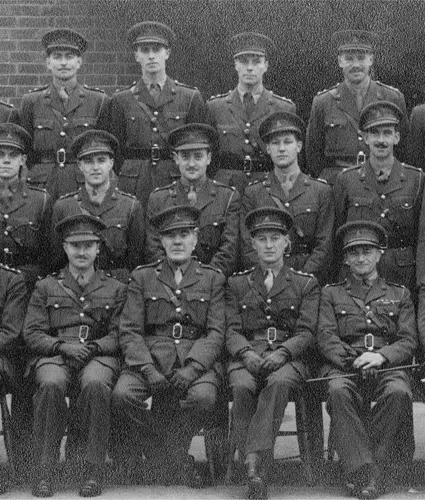
2nd Lieutenant John Coast with the 4th Battalion Royal Norfolk Regiment sometime in 1941 before leaving for the Far East. Coast is in the back row, second from the left. Lieutenant Colonel Knights is in the front row, first on the right right.
[Photograph courtesy of the Trustees of the Royal Norfolk Regimental Museum]
PREFACE TO THE THIRD EDITION (1948)
In defence of the fact that many of the POW names of places on the railway are unrecognisable to the Siamese-language purists, I would say that I have made no attempt at all to be linguistically accurate. The place names, as I’ve spelt them, are merely the way all POW’s heard and spelt these peculiar sounding words when we had actually to live in these places. Should I now change the spelling to please a few foreign residents in Siam, none of my fellow-P.O.W.’s would recognise their own, old camp names: I prefer, therefore, to stick to the wrong, old spellings.
Oddly enough, since this reprint, I’ve been back in Siam for a year and have met many old friends. Boon Pong and his wife, I’m delighted to say, are prospering and living in Bangkok. I actually went back in a large Jeep with Boon Pong to visit Kanburi and Chungkai once again. It was a very peculiar journey, but the amazing thing was that one seemed to experience a most odd sort of home-sickness for the place – especially Chungkai. I hand that over to the psychologists.
The railway still exists: but is in shocking disrepair. The Siamese Government, however, feel reasonably enough that they must first repair the national railways that functioned before the war, and which are also in need of much hard work. After that maybe our railway will be put in order once more. The money, incidentally, which was paid for the sum total of our labour by the Siamese Government, was in the region of a mere £1,125,000. The railway was bought by Siam as a Japanese war asset.