Chapters (32)
- Cover
- Principal Characters
- Chapter 1
- Chapter 2
- Chapter 3
- Chapter 4
- Chapter 5
- Chapter 6
- Chapter 7
- Chapter 8
- Chapter 9
- Chapter 10
- Chapter 11
- Chapter 12
- Chapter 13
- Chapter 14
- Chapter 15
- Chapter 16
- Chapter 17
- Chapter 18
- Chapter 19
- Chapter 20
- Chapter 21
- Chapter 22
- Chapter 23
- Chapter 24
- Chapter 25
- Chapter 26
- Author’s Note
- Next in Series
- About the Author
- Also by Alex Gerlis
Ravensbrück (Chapter 23) was a concentration camp almost exclusively for female prisoners, approximately 40,000 of whom were murdered there.
The murder of the Jewish children described in Chapter 19 is fictional, though it is based on thousands of war crimes of a similar nature. In July 1946, forty-two Jews who’d returned to Kielce from Nazi camps were murdered by local Poles in a now notorious pogrom.
Lord Swalcliffe (Chapter 9 onwards) is loosely based on Frederick Lindemann, Viscount Cherwell. He was Churchill’s scientific adviser and a vocal opponent of the view that the V-1 and V-2 rockets presented a real threat.
The V-1 and V-2 were of course two of the secret weapons the Nazis hoped would win the war for them. Some nine thousand V-1s and a thousand V-2s were used against the British mainland, with around 10,000 people believed killed as a result.
There was a major RAF raid not dissimilar to the one described in Chapter 18 on Peenemünde. The actual raid took place in August 1943.
The towns and cities referred to in the book are all actual places, with the exception of Peascombe St Mary (and Peascombe St Thomas) near Mablethorpe. Where named, places such as hotels, railway stations and airports are real. St Christopher’s hospital is an exception to this.
Deutsche Lufthansa did continue to fly passenger aircraft between Copenhagen and Berlin (and via Oslo) during the war. The hotel that Horatio and Prince stayed at in Berlin, the Excelsior on Askanischer Platz, was one of the largest in Berlin before it was destroyed in an Allied air raid in April 1945.
The engineering company Feuchtwanger and Wolff is fictional, but many similar Jewish-owned businesses were stolen from their owners.
The Grimsby trawler fleet made an enormous contribution to the war effort, including as minesweepers, serving on the convoys and on clandestine missions as described in Chapter 4. Nearly 300 trawler men and 30 trawlers from the port were lost in the war.
Adoptions in the UK were less well regulated before the 1960s, so the informal nature of Henry’s rushed adoption (Chapter 25) would have been feasible in 1943.
I’d like to express my sincere thanks and appreciation to the many people who’ve helped bring about the publication of this book. As ever, to my agent Gordon Wise at Curtis Brown and his colleague Niall Harman. I’m delighted to now be published by Canelo and my thanks there go to Michael Bhaskar, Kit Nevile, Sophie Eminson and all the team. To Jane Selley for her very skilful copyedit and to the many people who helped me with aspects of the book and answered seemingly odd questions as I was writing it. And finally to my family – and especially my wife Sonia – for their encouragement, understanding and love.
Alex Gerlis
London
December 2019
Next in Series
Next in The Richard Prince Thrillers:
Sea of Spies
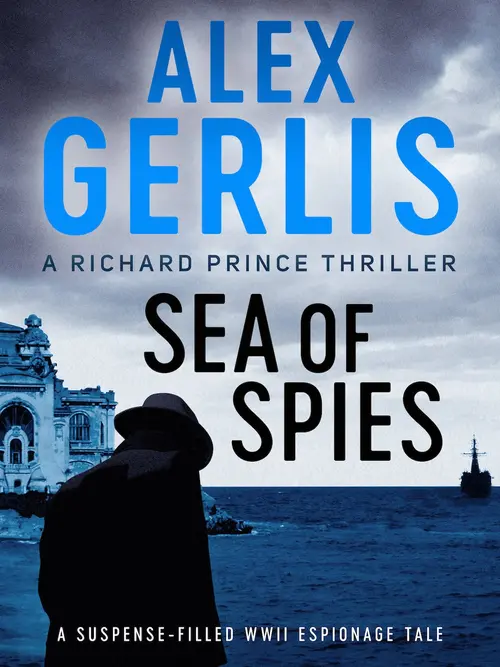
A nest of espionage. A break for the border. A race to survive.
Find out more