Chapters (35)
- Cover
- Praise for Other People’s Money
- Dedication
- Epigraph
- Service of Thanksgiving
- Chapter 1
- Chapter 2
- Chapter 3
- Chapter 4
- Chapter 5
- Chapter 6
- Chapter 7
- Chapter 8
- Chapter 9
- Chapter 10
- Chapter 11
- Chapter 12
- Chapter 13
- Chapter 14
- Chapter 15
- Chapter 16
- Chapter 17
- Chapter 18
- Chapter 19
- Chapter 20
- Chapter 21
- Chapter 22
- Chapter 23
- Chapter 24
- Chapter 25
- The End
- Acknowledgements
- A Note on the Author
- By the Same Author
- Also Available by Justin Cartwright
She has turned down his bed, she shows him the neat sandwiches in the fridge, and indicates the drinks cabinet and wishes him a good night. She has deep furrows between her eyes and heavy eyebrows which almost meet, so that her eyes appear to be in permanent shade, but her smile somehow contains real kindness – he is on the lookout – and a motherly concern for his welfare. For the second time in an hour or so, he finds himself touched by human kindness and weakness. Before her death his own mother’s concern was directed towards dogs. While he was swimming the Cherwell, a heroic pyjama-clad little Leander, like an escapee from a domestic farce – she was involved in dog rescue, as a patron and benefactor of Wandsworth Dogs’ Home. Her car was infiltrated with dog hair and it usually smelled of dogs – wet, scabrous or in season – and always it retained the scent of dried Fray Bentos, the scent of the canine diet that once clung to the rear ends of the dogs and was now embedded in the seats. As a boy he hated travelling in her car. He didn’t know then, but his father’s interests extended beyond the patronage of the ballet and theatre into a lively concern for the careers of young actresses and ballerinas. Fleur was an actress. She hasn’t visited his father all winter, but then perhaps he hasn’t noticed. Estelle, of course, will be thrilled to have him to herself.
He swallows another pill. As he waits for it to take effect, he drinks a long glass of water and tries to read a magazine article about financial services in Liechtenstein. His eyes lose focus and begin to film over. He feels desperate, utterly rudderless, as though his eyes are merely responding to the turmoil inside his head. He puts the magazine down. Who reads this stuff? Actually, Tubal’s puts out similarly meaningless guff, which pretends that their analysts and fund managers – including the disastrous Fortress Lion hedge fund – understand the markets and – worse still – that the markets are inherently rational. Before he walked into investment banking he should have noted what Keynes apparently said: ‘You might just as well read a sheep’s entrails as the Romans did as make predictions about the markets.’
Fortress Lion once appropriated the bell curve and its original, the Gaussian curve, in a prospectus. To lend credibility to their claim that, with the curve, the markets were knowable, they printed the formula for standard normal distribution; he can even see it now, lodged in his troubled mind:
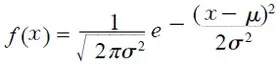
How impressed the clients were to find that algebra (if it was algebra) had removed the uncertainty from markets. The prospectus did not mention that Carl Friedrich Gauss devised his equation in order to analyse astronomical data in 1794 and that later it was used to predict population growth. Professor Kuhn, Nobel Laureate, didn’t mention it either.