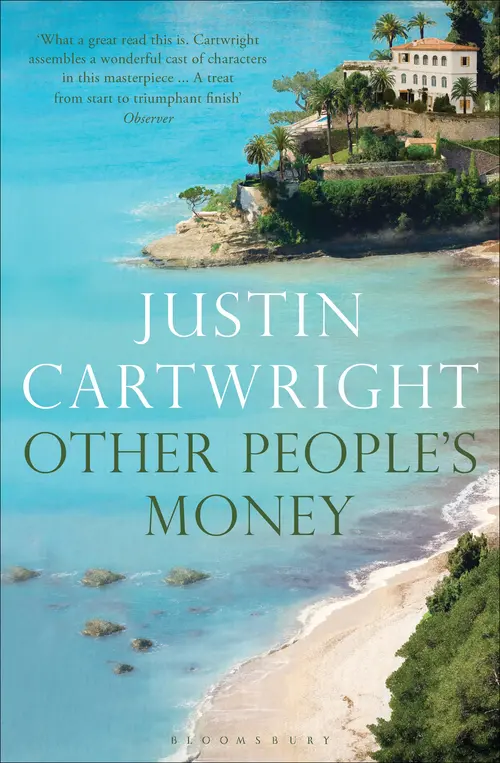
Other People's Money
Cover
Praise for Other People’s Money
Praise for Other People’s Money
Novel of the Year Award, the Spear’s Book Awards 2011
‘Written in cool, word-perfect prose … Other People’s Money is a genuine, startto-finish pleasure: deftly executed and littered with standout lines. Perhaps most striking, though, is Cartwright’s brand of satire, which is unsparing and yet somehow never cruel’
The Lady
‘A literary first – a feel-good novel about the financial crisis. Second, it is a comedy of manners, in which bankers are good and bad – as are journalists, failed actors, drop-outs and postmen … Yet in the end, though other people’s money may have been lost, other things have been gained; life goes on in this delightful novel, as it does in the world that it so gently satirises’
Financial Times
‘I love Justin Cartwright’s novels … Cartwright’s highly spiced mix of “Englishness”, high finance and low cunning, father, sons and twitches on the familial thread is quite as irresistible as his cool and impossibly laconic style’
D.J. Taylor, Literary Review
‘Very little literary fiction has been written about the financial crisis in Britain. And yet the City is of abiding interest. This is one reason why Other People’s Money strikes the reader as both original and familiar … Funny and wise’
Economist
‘While revelling in the topical details, Cartwright has created a surprisingly comic novel told from multiple points of view … Recent events give us little cause to feel warmth for bankers but Cartwright redeems the industry with humour and humanity ****’
Metro
‘This is a serious novel with a light touch … Cartwright makes the reader think and feel, one mark of a good novel. Other People’s Money invites us to reflect on the way we live; and it’s thoroughly enjoyable. What more can you ask for?’
Alan Massie, Scotsman
‘A tale half comic and half cautionary—and all compelling—about the financial crisis … Witty, thoughtful, briskly paced and entertaining – a terrific novel about excess, hubris, class and the age-old (usually one-sided) tussle between art and commerce’
Kirkus (starred review)
‘Brilliant’
Kate Saunders, The Times
‘Simply the best I’ve read all year’
Irish Examiner
Dedication
For Nigel and Maria,
dear friends
Epigraph
When the capital development of a country becomes a by-product of the activities of a casino, the job is likely to be ill done.
– John Maynard Keynes, General Theory of Employment,
Interest and Money, 1936
Matisse’s studio was a world within the world: a place of equilibrium that, for sixty continuous years, produced images of comfort, refuge, and balanced satisfaction. Nowhere in Matisse’s work does one feel a trace of the alienation and conflict which modernism, the mirror of our century, has so often reflected. His paintings are the equivalent to that ideal place, sealed away from the assaults and erosions of history, that Baudelaire imagined in his poem ‘L’Invitation au Voyage’:
Furniture gleaming with the sheen of years
would grace our bedroom;
the rarest flowers, mingling their aromas with faint gusts of amber,
the painted ceilings, the fathomless mirrors, Eastern splendour.
. . . all would speak, in secret, to our souls, in its native language . . .
There, everything is order and beauty, luxury, calm and pleasure . . .*
Robert Hughes, The Shock of the New
* Translation author’s own.
Service of Thanksgiving
SERVICE OF THANKSGIVING
FOR THE LIFE OF SIR HARRY TREVELYAN-TUBAL, CBE, BT.
AT ST PAUL’S CATHEDRAL, IN THE CITY OF LONDON
The Queen and the Duke of Edinburgh were represented by Sir Thomas Carew Knollys, the Prince of Wales was represented by Colonel Lord Maltravers of Deeside, and the Duke of Kent was represented by the Hon. Jonathan Bowes-Griffon at a service of thanksgiving for the life of Sir Harry Trevelyan-Tubal, CBE, Bt.
The Bishop of London, the Right Reverend Crispin Smythe, read the prayers, assisted by the Reverend Kevin Pegley, Vicar of All Hallows in the City of London. The Ambassador of the United States of America, the Hon. Mr S. Fielding Klipspringer, the Ambassador of France, Comte Henri de Mossigny-Mumm, the Lord Mayor of London, Alderman Sir Tristram Tarkington, the Lord Lieutenant of Middlesex, Lieutenant General (Rtd.) Sir Augustus (Bobby) Popham, MC also attended.
Among others, members of the family present were Lady Trevelyan-Tubal (widow), Sir Simon Trevelyan-Tubal (son), Mr Julian Trevelyan-Tubal (son) and Mrs Kimberly Trevelyan-Tubal (daughter-in-law), Lord Andrew Finch-Tubal (cousin), Mr Thierry Lane (cousin), Miss Daisy Trevelyan-Tubal (great-niece), Master Sam and Miss Alice Trevelyan-Tubal (grandchildren), Mrs Simon Cassirer (stepdaughter), Frieda, Grafin von Westerhagen (sister) and Freiherr Fritz-Dietlof, Graf von Westerhagen, the Hon. Charlotte Stammers (niece), Miss Poppy Trevelyan-Tubal (niece), Monsieur Jean-Pierre Loup, with other members of the family.
The Duke and Duchess of Albemarle, the Duke of Chelsea, the Earl and Countess of Mayo, the Earl and Countess of Wendover, the Macallan of that Ilk and Lady Macallan, the Malcolm, Lord of the Western Isles, Sir Frederick Blackwater (representing the Performing Arts Benevolent Fund), the Secretary of State for Business, Innovation and Skills, the Rt. Hon. Oliver Goldstone, QC, MP, Lieutenant General Sir Archibald FitzHealde, KBE (representing the Honourable Company of Pikemen and Musketeers), Mr Adrian Porch, MBE (representing the Fishmongers’ Guild), Sir Dominick Westwood (representing the Royal Opera Company), Mr Ruud Kronwinkel (representing the Koopman Charitable Foundation), Ms Alice Freemantle (representing the Association of Private Bankers) attended.
Among others attending were Mr Nigel Stafford, Mr Bryce Boyd, Ms Estelle Welz, Mr Morné Nagel (on behalf of the Disabled Rugby Footballers’ Trust), Mr Artair MacCleod, Ms Amanda Stapleton, Mrs Arthur Green, Professor Sir Simon Greene (on behalf of the Judaeo-Christian Foundation), Monsieur Paul-Henri Colle (representing the Community of Cap d’Antibes), Ms Shirley Simms, Mr Len Snibble (representing the staff of Tubal and Co.), Ms Tineke Pachod, Mrs Alicia Bruce-Caldesi, Monsieur Franck Dangereux, Ms Inez Duegenheim-Arndt, Ms Lulu Whitbread, Signor Giovanni Paschetto, the Dowager Lady Huntingtower, Comte Hervé de la Marinière.
The Trumpeters of the Household Cavalry performed an arrangement from Purcell’s Trumpet Voluntary, accompanied by the organist Dr Claude Brown, FRCO. Sir Simon Trevelyan-Tubal (son) read extracts from his own work, Mr Julian Trevelyan-Tubal (son) delivered an address and read a poem by W.H. Auden, Miss Poppy Trevelyan-Tubal (niece) read from the work of Hugh Plunkett-Greene, the Bishop of London gave the eulogy. Sir Alfred Brendel played three pieces by Chopin and Anne Sofie von Otter (mezzo-soprano) sang a lied from her songs of Terezin. The Honourable Company of Pikemen and Musketeers mounted guard outside the Cathedral of St Paul’s.
Chapter 1
Chapter 1
At this time of year, Antibes is at its best. The almond blossom is out, the sea loses its darkness, the cold rains have mostly been swept mysteriously away, the mistral has cleared the skies and the geraniums are being planted out. There is a sense that the warm earth-life of Provence is beginning again after the longueurs of the winter.
Behind the tastefully crumbling and slowly fading wall that protects the Villa Tubal from the eyes of idle passers-by and garish tourists, the three gardeners are busy. They are Algerian, with sad, stubbled faces. Sir Harry Trevelyan-Tubal likes to sit in the garden. He particularly likes the scent of the umbrella pines and the mimosa, and the wafts of thyme, which come on the mistral off the hillside behind the house. Good health is often attributed in these parts to the mistral.
Since his stroke, three years ago, he has difficulty writing, but every morning he dictates letters to his son, who is standing in for him at the bank, giving him his instructions and his advice. He also writes to old friends and to important financial and political figures. His secretary, Estelle, types these letters and they are FedExed to their destination. Now, slightly dragging his left leg – some days it is better than others – he walks for the first time this year along the gravelled path between the low box hedges to his spot on the terrace, where his breakfast is laid out on the blue Provençal pottery he favours for informal occasions. On this terrace overlooking the cove and the boathouse beneath, Churchill once painted, watched by the young Harry. Despite the tardiness of his leg, he doesn’t at a distance present a figure of pity. He is elegantly dressed in a light-brown jacket, which has threads of a gold colour woven into it, so that it looks almost vibrant in this clear light; the jacket is paired confidently with plum-coloured trousers and two-tone deck shoes. On his head, partly hiding the thick grey hair, is a panama hat, just sufficiently irregular to indicate to those who care about these things that it is a Montecristi from Lock & Co., who have supplied him with hats for sixty years and more. Nothing in his wardrobe or indeed in the whole villa is vulgar or mass-produced or discordant. In some magical fashion, which doesn’t involve interior designers, the villa has reached this state of grace by increments. The Trevelyan-Tubals are not so much at home with their surroundings as the masters of their surroundings. It’s as if inanimate objects, even landscape, are subject to their will and taste. And in a sense they are: the landscape, which now looks so natural, was created eighty years ago by Sir Harry’s father on a rocky and scrubby peninsula.
Sir Harry’s breakfast has been laid on the table and the sunshade has been perfectly positioned so that the plates are in deep shade. Because Lady Trevelyan-Tubal is at Mulgrave House in Chelsea Square – she’s been in London all winter – Estelle, seventy-one, sits with him. She does not eat, but sips a café au lait cautiously, and keeps her notebook at the ready for his dictation. Once, many years ago, he told her that the way she drank annoyed him, and so she still sips with determined restraint. But she adores him, and has done for more than thirty years. The bank pays her salary and she has her own small house out of sight, behind the clay tennis court and its pavilion. This little house is itself built in the style of a Provençal mas.
Sir Harry allows her to dab his mouth when crumbs from his almond croissant stick to the foam that eating inexplicably causes to gather in the corners of his half-frozen lips. She has also become his interpreter, because not even his wife can really understand him when he speaks. Estelle doesn’t fuss or hurry him.
‘Did Julian reply?’
‘Not yet, Sir Harry. He is still in Paris at a meeting of the trust, and won’t be back until later today. Early evening, probably.’
‘Well, look, Estelle, I think we should get on with it, don’t you?’
He puts his coffee cup down abruptly and it lands on the terrace, smashing, but he appears not to notice. She summons a maid, who is standing some way off, to clear the table.
He begins. She believes she is able to understand every word, although his voice is strangely distant – she used to think of a bird trapped in a chimney – as if the words are reaching his mouth by a back route. Sometimes she is reminded of her brother Lionel’s telephone, made with a length of hosepipe and two baked-bean cans: she had to wait upstairs while he spoke to her from the back garden, his voice faint. He would break off to shout instructions. There are strangled yodelling notes in Sir Harry’s vowels, and a wind-instrument harshness in his consonants, so that the rhythms of speech have been scrambled en route from wherever speech originates. But she is used to it.
‘My dear Julian, the almond blossom is out and the . . .’
He points to the Mediterranean.
‘Shall I put “the sea”, Sir Harry?’
‘Yes, yes of course “the sea”.’
‘“The sea is . . .”?’
‘The sea is calm and as blue as a . . .’
‘“A duck’s egg”?’
‘Duck egg. Julian, may I remind you that it has always been the policy of Tubal and Co. to look after our animals’ (she changes this to ‘customers’) ‘with the greatest possible care, because our livelihood depends upon the silken thread of connection which runs between us and them, and which continues over many lifetimes so that the bank, as I like to say, is in a sense a . . . ?’
‘“A living organism”, Sir Harry?’
‘A living organism, which depends for its very survival on keeping the lifeblood flowing. Our business . . .’
Estelle is happy to see him warming to his theme.
‘Our business is based on the confidence . . .’
‘Of our customers?’
‘Our customers, as my father . . .’
He falters.
‘Sir Ephraim?’
‘As my father, Sir Ephraim, was fond of saying. Too fond.’
He stops now and gazes out to sea where the first yachts of the new season have appeared, looking crisp and clean and hopeful.
‘Too fond. The shit. We are not running a casino.’
Estelle feels deep sadness. He has dried up. The old phrases have escaped in staccato fashion from inside his head and the supply is diminishing. She will tidy them up before sending them. Her sadness is not without an element of self-interest, because for the last thirty-two years she has been the pilot fish to his whale, swimming in his bow-wave, deeply but discreetly in love, and now she can see that the magnificent whale is beached. She doesn’t say it to anyone, but he has more or less been abandoned by the family. Young Simon is in the African jungle and Julian hardly ever visits and Fleur hasn’t been since Christmas. She seems to spend her days in the gym. She obviously finds her husband’s condition difficult to live with.
His eyes are still turned towards the Mediterranean. He sees, she thinks, only blobs of colour, like the Matisse of a view through a window to the port of Collioure, his first purchase in 1952, which hangs in the front hall and which these days he often looks at for hours on end. She knows it cost him £4,900 and is worth some millions now. Twenty million at least. But he has absolutely no interest in the value of his paintings and only sells if he tires of a painter. Nonetheless she is logging them all in her spare time. The world for him has lost its infinite subtlety. His speech suggests that his understanding is not what it was, but she hopes that, in his brain, somewhere behind the portal where the words appear, he is still able to understand and appreciate these subtleties. He once delighted in surprisingly small natural things and events – seasonal changes and moss on the path and birdsong and the bindings of books – as well as the opera, the ballet and a day or two fishing for salmon on the Tay or for trout on his stretch of the upper reaches of the River Test, where the waters are clear and the trout wary. Many of the bank’s clients have enjoyed the box at the opera and the openings of the exhibitions that Sir Harry sponsored. Julian doesn’t like the opera. He thinks it diverts attention from the real aims of the bank, which are the creation of value, and sends out the wrong message, in ways that his father doesn’t begin to understand. Before his stroke, his father had railed against hedge funds, apparently unaware that hedge funds were, for a while, responsible for a sixty per cent growth in their clients’ portfolios. That had made them a whole lot happier than a few nights watching men in tights leaping about at Covent Garden. Under Julian’s regime – until recently – the bank sponsored golf and a whole day at Ascot. Horse racing, of course, appeals to the Gulf States, but now, she has learned, all sponsorships are under review.
Estelle hasn’t told Sir Harry that the box has been sold. He still speaks of going to the opera and of taking a party to Glyndebourne. Estelle has the impression that Fleur is embarrassed to be seen with him, now that he stumbles and sometimes dribbles, and speaks in this strange, trapped-avian voice. She is much younger than Sir Harry, but then she knew that when she left the playwright to marry him.
Estelle looks at him as he stares out to sea. She wonders what he is truly thinking. Somehow, despite the tragedy that has taken him, he seems to retain his ability to be cheerful and also to choose unerringly what to wear. At a distance there is nothing of the invalid about him although close up the skin of his face has a sort of white, fungal bloom. Like an apple stored in a shed. He is too thin, so that as he sits his thighs barely disturb the plum trousers. They look like the trousers on a marionette, lacking substance. Yet he seems serene. Occasionally, as he is dictating his letters to Julian, he becomes agitated. Now he watches a yacht tacking on the bay with approval.
‘We must get the . . .’
He points at the yacht.
‘The boat out?’
‘Yes. Tell . . .’
‘Bryce?’
‘Tell Bryce that I want it out before Christmas.’
‘Easter, I think. I will make a note.’
‘Julian and the children want sail.’
He never forgets Julian’s name and Estelle finds this touching. At that moment one of the house servants, Antoine, walks over. He speaks to Estelle in English, because she has never learned much French.
‘Madame, there is a gentleman at the gate. He wishes to speak with Monsieur Julian.’
‘Who is he?’
‘He is the Russian gentleman who has bought Villa Floriana.’
‘I will speak to him.’
Estelle goes to the front gate. It is their new neighbour, Boris Vladykin, standing there in very large shorts. He is sweating and his breath smells of alcohol.
‘Good morning, Mr Vladykin.’
‘I want speak to Mr Julian.’
His face is broad and sweaty; the spring sunshine is hot.
‘He is not here, but he is coming soon. What do you wish to discuss?’
His English is poor.
‘I want to talk to Mr Julian about boat.’
‘Niobe is in the boatyard at the port for repairs. I don’t know anything more. Goodbye, Mr Vladykin. Mr Julian is coming down next week. He will know.’
She shuts the gate and walks back through the house and out on to the terrace. Vladykin rings the bell again, but she ignores him.
Harry makes a noise, which Estelle interprets.
‘It was Mr Vladykin. I don’t know what he wants. He was wearing those ghastly shorts.’
Harry is disturbed. His face is flushed and his eyes are pained and restless. She wonders what Vladykin wants. She feels a spreading unease. The barbarians are at the gate.
Chapter 2
Chapter 2
Julian Trevelyan-Tubal sits in the back of his car as the driver takes him to Luton Airport. He’s thought about getting rid of the Bentley, but he doesn’t want to cause alarm: the family have always been driven in Bentleys. When people still cared about such things, a Bentley spoke of restraint, where a Rolls-Royce suggested something flashy and unreliable. The argument for selling the Bentley is that the top man should demonstrate that he is in touch with the new financial realities. Also, footballers and hedge-fund managers and property developers now drive sporty little Bentley Coupés and convertibles, and Bentley long ago decided to drop their steady-Eddy image. In a way, he thinks, they are doing just what the banks have been doing. He sits inside the car, an eight-year-old Arnage, feeling as though he is being transported – silently – to his own funeral. He sees Len glancing anxiously at him in the rear-view mirror but he ignores him. Len likes a chat. His opening gambit is usually about the traffic. He has views on most things, deluded but harmless. His father sent him for driver-training at Crewe about twenty years ago and he behaves as though they embalmed him at the same time.
Perhaps the way round this dilemma is to go green: all directors of the bank, including the boss, will drive one of those hybrid cars that run on gas and batteries, demonstrating their commitment to a greener, less wasteful future, and so by proxy to more ethical business practices. Or is the word responsible, rather than ethical? Nobody in the City really gives a monkey’s about green politics, but they know better than to say so publicly. He makes a note to tell his assistant to look into it and to bear in mind the PR benefits; also, they still have one almost viable hedge fund, which has a huge investment in sustainable batteries, and possibly the whole story could be tied in to that. At least it might attract some more investment into the fund. While he worked under his father, he was known for original thinking. His father was far too fastidious to use terms like ‘thinking out of the box’ or ‘pushing the envelope’ – he thinks language should remain in a state of paralysis – but that is what Julian was doing; that was in his carefree role until a few years ago. His father never fully understood the detail of banking: not many important bankers do. You don’t ask the captain of the vessel to stoke the engines, after all. (His imagery, as well as his understanding of banking, was outmoded.) He was close to the top people at Barings when they went down in 1995, but he never learned the lessons: he had no idea what was happening in the engine room.
The Story Continues on BooksBarbecue!
Enjoyed this preview? ❤️ Do not stop here!
Read the complete book free online → 🔗
Continue reading now on BooksBarbecue and discover every page!
Love reading? Bookmark BooksBarbecue.com for more amazing books!
Happy Reading!