No Barriers
Chapters (48)
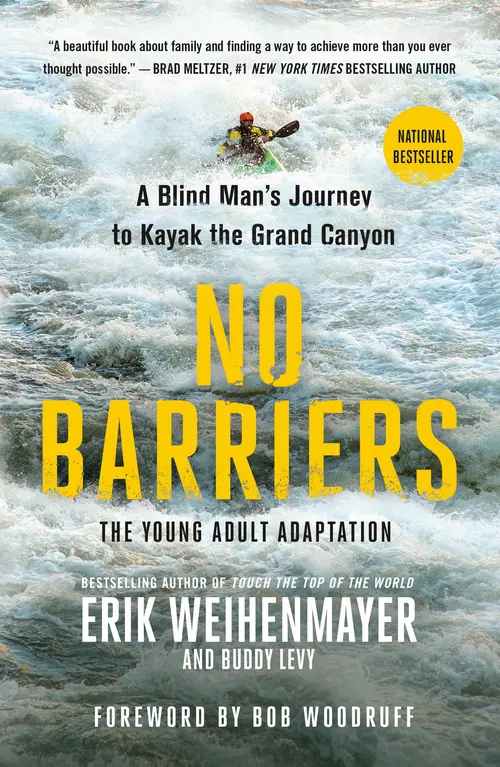
Title Page
Copyright Notice
The author and publisher have provided this e-book to you for your personal use only. You may not make this e-book publicly available in any way. Copyright infringement is against the law. If you believe the copy of this e-book you are reading infringes on the author’s copyright, please notify the publisher at: us.macmillanusa.com/piracy.
Dedication
To my father, Ed, who embodied No Barriers before it had a name
—Erik
This is a true story,
though some names have been changed.
FOREWORD
By Bob Woodruff, ABC News
Chances are that at some point in our lives, we will all be tested. The possibilities are endless, and they read like a long list of what-ifs. Which is why the interesting part of any story is not necessarily the exact nature of the obstacles we meet, but in how we choose to respond.
It was an honor to be asked to write the foreword for No Barriers: A Blind Man’s Journey to Kayak the Grand Canyon because this story and its author embody what it means to meet adversity and not let “the bad thing” define us. In short, to quote my wife, you make a choice to get “bitter or better.”
My own challenging moment came in January 29, 2006, when I was covering the Iraq war outside of Baghdad for ABC News. While standing halfway out of a tank with my cameraman, a 125-mm roadside bomb exploded, leaving me with a traumatic brain injury (TBI) and vastly changing the direction of my life.
The blast shattered my skull, embedding rocks and other debris in my body and shattering my shoulder bone. But none of the other injuries mattered. They would heal. It was the TBI, the signature wound of these wars, that would prove to be my greatest obstacle. I would spend the next few years struggling to put my cognitive abilities back together, returning to my job as a journalist, and working harder than I ever had in my life.
Immediately following the blast, my cameraman, Doug Vogt, and I were flown from Iraq to Germany, then on to National Naval Medical Center in Bethesda where I spent thirty-six days in a coma. When I finally woke up and began to understand the enormity of what I had lost, it was my family and friends who surrounded me, along with the other military families, all on the same journey, experiencing firsthand the devastation and legacy of war up close and at home.
I am a journalist, and although I had understood the probability that I could be killed, I had spent very little time thinking about severe injury. My injury catapulted me into a world I had never seriously considered or contemplated. And from that tragedy, many positive things have resulted. I have been proud to use my story to help others traveling along the same road.