Chapters (92)
- Title Page
- Copyright Page
- I - MUSTA’RIB
- I
- II
- III
- IV
- V
- VI
- VII
- VIII
- IX
- X
- XI
- XII
- XIII
- XIV
- XV
- XVI
- XVII
- XVIII
- XIX
- XX
- XXI
- XXII
- XXIII
- XXIV
- II - CRUCESIGNATI
- I
- II
- III
- IV
- V
- VI
- VII
- VIII
- IX
- X
- XI
- XII
- XIII
- XIV
- XV
- XVI
- XVII
- XVIII
- XIX
- XX
- XXI
- XXII
- XXIII
- XXIV
- XXV
- XXVI
- XXVII
- XXVIII
- XXIX
- XXX
- XXXI
- III - NAVIGATOR
- I
- II
- III
- IV
- V
- VI
- VII
- VIII
- IX
- X
- XI
- XII
- XIII
- XIV
- XV
- XVI
- XVII
- XVIII
- XIX
- XX
- XXI
- XXII
- XXIII
- XXIV
- XXV
- XXVI
- XXVII
- XXVIII
- EPILOGUE
- I
- II
- Afterword
Bacon smiled, a magician with another trick to show. ‘A simple transposition would be too easy. Our puzzle involves numbers as well as letters. Look at the “sentence” again. Nine “words” of five letters, and one of four. What sentence is as regular as that? What we have here is a simple string of letters, of length - how many, Thomas?’
‘I’m not one of your Parisian students,’ Thomas growled.
‘Just answer,’ Joan murmured.
‘Forty-nine, then.’
‘Good. What’s significant about the number forty-nine?’
‘Seven sevens,’ said Saladin immediately.
‘Very good!’ said Bacon.
Thomas looked surprised. Saladin said, ‘Some of the villagers think it’s a lucky number. Seven times seven. That’s how I know.’
‘Seven squared,’ Bacon said. ‘That is surely a clue. So now, if we write out the decoded message again, not in these arbitrary blocks of five or four, but in a grid of seven by seven . . .’
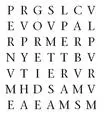
‘It still means nothing to me,’ Joan said.
But Thomas was tracing the letters with a chalky fingertip. ‘But if you read, not across, but down - else why put them in a grid at all? P - E - R . . . Give me that chalk, Roger.’ He wrote out the letters, column by column, as a single line.
PERNVMERVPYTHAGOREIDESVMTESALPETRAMCARBVM SVLPVRVM
‘Look at this string,’ Thomas said, excited. ‘Pythagorei - see it? Surely there is meaning here at last.’
‘Good, good,’ Bacon said. ‘You can imagine the variants I explored before I hit on this correct route through the maze. Now all we have to do is find the breaks between the words . . .’
But Thomas was ahead of him, splitting the line with bold slashes.
PER / NVMERV / PYTHAGOREI / DESVMTE / SALPETRAM / CARBVM / SVLPVRVM
And there, for Saladin, the magic happened, a readable sentence emerging from a clamour of nonsense. He was the first to read it aloud: ‘“By Pythagoras’s number take saltpetre, charcoal, sulphur.”’
‘Almost there,’ said Bacon. ‘Almost there.’
‘But what does it mean?’ Joan said.
‘Well, Pythagoras’s number is obvious. It is six.’
‘It is?’
‘Six is the perfect number,’ said Saladin.
Thomas raised his eyebrows at him. ‘And why is it perfect?’
‘Because if you take the numbers that divide into it evenly . . .’ Saladin took the chalk now, and wrote out, 1,2,3. ‘If you add them up you get six again.’ 1+2+3=6.
Bacon smiled. ‘Once again you surprise us.’
Saladin felt sheepish. ‘Another lucky number for the villagers.’
‘In fact there are many perfect numbers,’ Bacon said. ‘Pythagoras did indeed study them. Twenty-eight is the next one. You see, it is divisible by—’
‘Never mind,’ Joan said hastily. ‘So now we have this: “By one, two, three take saltpetre, charcoal, sulphur.”’
‘Or,’ Bacon said, ‘three, two, one. In fact those proportions aren’t quite correct, but near enough the range that a little trial and error gives you the right product. The value of experimentation,’ he said, smiling.
Saladin was mystified again. ‘What product?’