I remembered that distant morning, after you said I swallowed a heap of sand and now I feel sick.
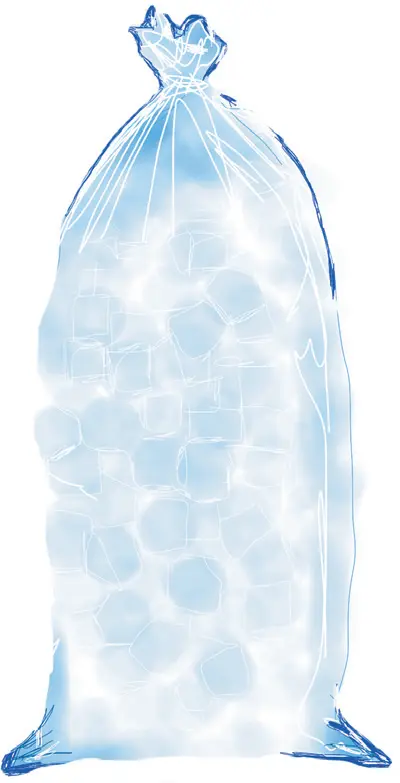

At the gas station. We went in to get coffees and came out with two large bags of ice, we haven’t anywhere to put them, I deposited one by my feet and set the other on my lap. My phone rang, and the voice at the other end asked: “What are you doing?”
“I’m hugging a bag of ice.”
We photographed the ice as it melted. That will be a record of the specificity of the desert, an image of indisputable heat. The camera took a picture every twenty-five seconds. When they are connected later, the images will become a video that speeds up the process of melting. Where does our need to accelerate time come from? From impatience to arrive in the near future into which we have projected our trifling desires. Our need to slow time down would surely be natural. But why this strong desire to speed things up? Why are we always in a hurry to reach the future? The process of the ice melting, which looks rapid in the photographs, is an image of time that can never be restored. But perhaps there is no such thing as time?
We were protecting ourselves from the sun with a large black umbrella.
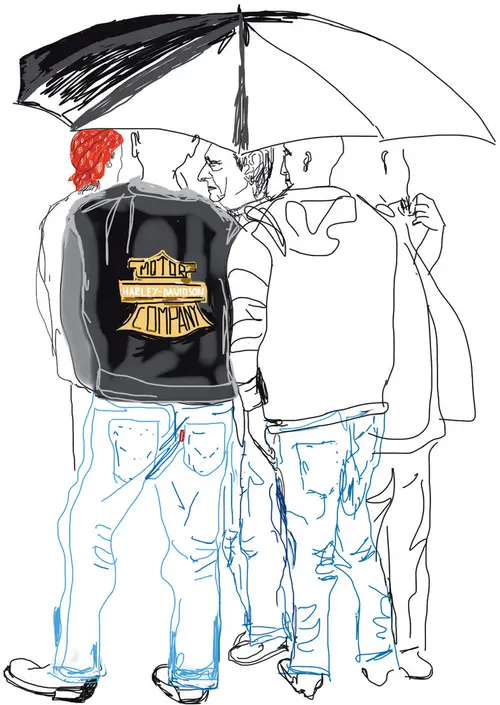
But then some loud bikers rode up to us. At first, blown up in their Harley-Davidson jackets, they looked enormous, and before they spoke to us, you said: “I’ll have a word with them.” That declaration of yours was something new for me. You said that because you thought you would be better at making contact with those guys, who looked threatening. Or maybe you were silencing my strong Slavic accent that might have irritated American patriots? But you haven’t completely lost your accent, either, even after all these years. Or else you think that situations like this are less unusual for you than they are for me, because you spend a lot of time on the road, you sleep in the open, in the mountains, in the desert, and along the way you meet all kinds of human phenomena? Whatever it was, your judgment was obvious: on 18 April 2015, in the American desert, I was more a foreigner than you were. And in fact, I am a foreigner everywhere in the world: as soon as I leave my home, I step into a void.
The bikers asked us to let them shelter from the sun in the shade of our umbrella. The young man who spoke to us had a strong accent. And then they introduced themselves: Germans from Darmstadt, this was the second month they had been traveling through New Mexico, Arizona, and California. One had a completely white mouth, as though he had rubbed his lips with chalk, already totally dehydrated. I confessed that I worked for German television (ARD), and our recognition was followed by pure delight! It’s interesting—seen from Bosnia, Germans are entirely different from us southern people. But here, on a different continent, particularly since I’ve been working with them, I’ve discovered that our similarities are great. They are close worlds, or is that just a deceptive impression by contrast with American difference? Whatever the reason, in Death Valley, we were a small misplaced tribe, under your umbrella.