My Heart
Cover
Praise for Sarajevo Blues
“Semezdin Memedinović charts the collapse of a world with heartbreaking clarity and precision . . . Conveys the same clear-eyed passion for the truth that one finds in the young Hemingway, the Hemingway of our time.”
—PAUL AUSTER, author of 4 3 2 1 and The Brooklyn Follies
“Sarajevo Blues is widely considered here to be the best piece of writing to emerge from the besieged capital since Bosnia’s war erupted in April 1992.”
—The Washington Post
“Mr. Mehmedinović left his native Bosnia in 1996, but his record of the horrifying events he observed there is vividly immediate. In short pieces of prose and poetry the author recaptures the stoicism created by constant danger and the incongruous survival of pre-war habits . . . The mundane and the terrible merged in Sarajevo. Mr. Mehmedinović takes the reader there.”
—PHOEBE LOU ADAMS, The Atlantic
“[The] ability to masterfully delineate even the simplest moments but somehow remain tactfully indifferent is Mehmedinović’s most invaluable attribute . . . It is as if you are being ‘pulled’ into this world, where the vigor of his words and the sharpness of his eye lead the way . . . A memorable literary achievement.”
—Library Journal
MY HEART
Introduction
INTRODUCTION
by Aleksandar Hemon
Some years ago, I visited Semezdin Mehmedinović and his family in their Virginia suburb. One evening, we decided to play some basketball on a nearby court. I don’t remember why or how exactly, but we ended up playing with a deflated ball in complete darkness. We couldn’t see the basket, the ball didn’t bounce, we didn’t have teams or keep score. It was the greatest basketball game I’ve ever played in my life, because I remember myself as being totally present in it. It is precisely this sense of total presence that I desire from literature, and that Semezdin Mehmedinović never fails to generate.
I have long felt a kinship with Mehmedinović’s work, as we share a native language, a love for the city of Sarajevo, and a whole world of literary influences, acquaintances, and references. I consider him to be my favorite living writer in our native language—Bosnian—or, for that matter, in any other language. His book Sarajevo Blues, a collection of poems and prose fragments written during the siege of Sarajevo, is immensely important to me and arguably the greatest book to have emerged from the experience of the Bosnian war.
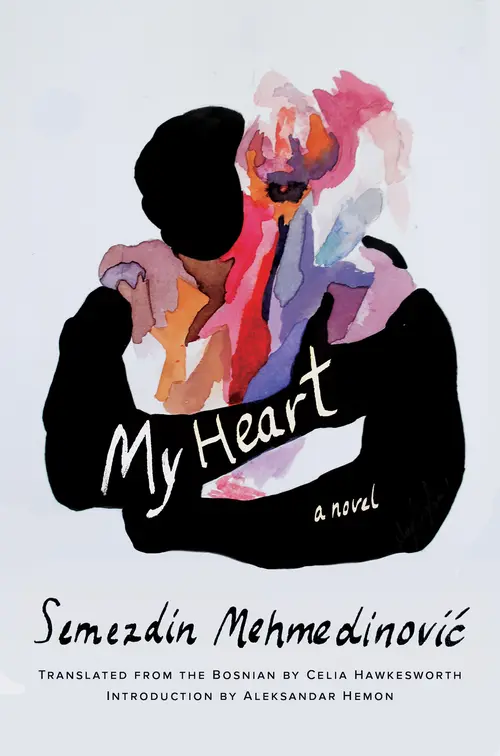
Yet I am still astonished by the impact and the beauty of My Heart, Mehmedinović’s most recent book published in English. I had read in Bosnian each of the three parts that constitute the book, and when I read it again in Celia Hawkesworth’s wonderful translation, I marveled once more at the precision of his observations, his sensitivity to detail, and his incredible ability to be present in the world while observing it.