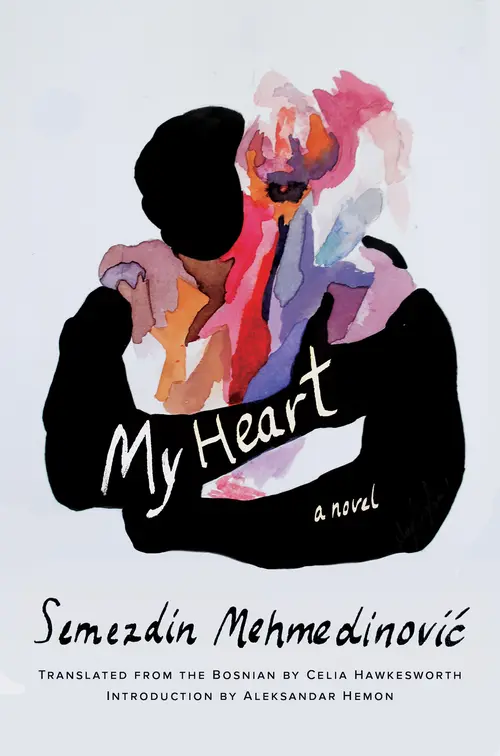
My Heart
Cover
Praise for Sarajevo Blues
“Semezdin Memedinović charts the collapse of a world with heartbreaking clarity and precision . . . Conveys the same clear-eyed passion for the truth that one finds in the young Hemingway, the Hemingway of our time.”
—PAUL AUSTER, author of 4 3 2 1 and The Brooklyn Follies
“Sarajevo Blues is widely considered here to be the best piece of writing to emerge from the besieged capital since Bosnia’s war erupted in April 1992.”
—The Washington Post
“Mr. Mehmedinović left his native Bosnia in 1996, but his record of the horrifying events he observed there is vividly immediate. In short pieces of prose and poetry the author recaptures the stoicism created by constant danger and the incongruous survival of pre-war habits . . . The mundane and the terrible merged in Sarajevo. Mr. Mehmedinović takes the reader there.”
—PHOEBE LOU ADAMS, The Atlantic
“[The] ability to masterfully delineate even the simplest moments but somehow remain tactfully indifferent is Mehmedinović’s most invaluable attribute . . . It is as if you are being ‘pulled’ into this world, where the vigor of his words and the sharpness of his eye lead the way . . . A memorable literary achievement.”
—Library Journal
MY HEART
Introduction
INTRODUCTION
by Aleksandar Hemon
Some years ago, I visited Semezdin Mehmedinović and his family in their Virginia suburb. One evening, we decided to play some basketball on a nearby court. I don’t remember why or how exactly, but we ended up playing with a deflated ball in complete darkness. We couldn’t see the basket, the ball didn’t bounce, we didn’t have teams or keep score. It was the greatest basketball game I’ve ever played in my life, because I remember myself as being totally present in it. It is precisely this sense of total presence that I desire from literature, and that Semezdin Mehmedinović never fails to generate.
I have long felt a kinship with Mehmedinović’s work, as we share a native language, a love for the city of Sarajevo, and a whole world of literary influences, acquaintances, and references. I consider him to be my favorite living writer in our native language—Bosnian—or, for that matter, in any other language. His book Sarajevo Blues, a collection of poems and prose fragments written during the siege of Sarajevo, is immensely important to me and arguably the greatest book to have emerged from the experience of the Bosnian war.
Yet I am still astonished by the impact and the beauty of My Heart, Mehmedinović’s most recent book published in English. I had read in Bosnian each of the three parts that constitute the book, and when I read it again in Celia Hawkesworth’s wonderful translation, I marveled once more at the precision of his observations, his sensitivity to detail, and his incredible ability to be present in the world while observing it.
Each of the three parts of the book—“Me’med,” “Red Bandana,” and “Snowflake”—deals, in a slightly different way, with the bread and butter of art and literature: love and death, and the suddenly enhanced presence of each in Mehmedinović’s life. Each piece is structured as a journey—the writer is unmoored from the harbor of home—that replicates the situation of displacement, internal and external, caused by the war. And on each journey, Mehmedinović generates endless discoveries of what was once familiar and is now strange again, because that is the effect of time and the presence of death, as inseparable as Siamese twins with a shared heart, on a thinking writer.
Mehmedinović’s language is simple, but only because his vision is clear; his sentences are determined and peaceful, as though conditioned by an inner calm rooted in his indelible wandering worldliness—there is a stable center of love inside him, necessary in a world that is inherently unstable. He is the kind of writer who sees just as clearly and calmly under siege as when driving in Virginia. His literature is equally at home, or equally not at home, in any and all places.
Though My Heart is autobiographical in the sense that the person in the book is the person who wrote it, nothing about it is memoiristic or confessional, and certainly never indulgent or self-centered. Experience is refracted in the world, just as the world is refracted in the experience, while the writing is not descriptive but defamiliarizingly reflective and transformative. Mehmedinović generates knowledge—about love, life, death, family, exile, displacement, past, memory—that is not available otherwise, but his need to do so is both personal (if I don’t remember, who will?) and ethical (if I don’t remember, no one will). “We spend a lot of time remembering the past,” he writes in “Snowflake,” “that’s how we check how much of everything we’ve forgotten.”
MY HEART
Me’med
ME’MED
Today, it seems, was the day I was meant to die.
I was getting ready for work, taking a shower, when I felt a dull, metallic pain in my chest and throat, and the taste of cement on my tongue. I stepped out of the shower feeling indescribably tired and wrapped my wet body in a bathrobe. Sanja was just about to leave the apartment to go to work, but then she caught sight of me through the open bathroom door. I told her I wasn’t feeling well, I was going back to bed for a bit, this weariness would soon pass, and she shouldn’t hesitate to go.
She stayed. Wet, my hair dripping, wrapped in the bathrobe, I stretched out on the bed. And I felt increasingly bad. She brought me cold tea, which didn’t help, and then, having no choice, she called 911. After that, she stared out at the street impatiently, looking for the ambulance. I didn’t have the energy to turn onto my other side so as to watch her by the window. I looked at the sofa where she had been sitting. I felt suddenly uneasy because she wasn’t where she had just been. Then I looked at the photograph on the wall above the sofa:
Lhasa. Early morning. A young Buddhist priest had come out through a high wooden door in the wall of a stone building, and was now walking down a narrow cobbled lane, with a wisp of morning mist in front of him. A small white cloud. Like a ghost that the priest in his red robe was following. I let my gaze follow the white cloud above the cobblestones in Tibet.
Behind me, Sanja said: “Here they are.” Then she came back into my field of vision. She opened the door and looked down the corridor, anxiously, occasionally glancing toward me. And then our room was filled with strangers from the emergency services, settling themselves briskly around me on the sofa. I had never experienced such an aggressive assault on my privacy. Quite uninhibited and sure of themselves, they glanced around the room they had come to, glanced at me, admired the floral pattern of the bedspread I was lying on, strangers in my room.
A girl in a blue uniform had just opened my bathrobe, so that I lay before them naked, and asked: “How old are you, sir?”
“Fifty.”
After the initial shock, there was calm.
I looked at everything around me without emotion, and so—without fear. And now that it’s over, I remember the event as though I had seen it from a distance, as though my mind had become separate from my body and had observed what was going on almost with indifference.
The shock didn’t come when the girl in the blue uniform said: “Sir, you’re having a heart attack!”
That’s when I felt calm. Because my mind had overcome my emotions. In films, when people describe a critical moment such as this, the picture is often left without sound, and sometimes it’s even in slow motion. That’s a technical evocation of the mind at work.
The mind behaves like a cold camera lens.
In this case the shock had come at the moment when the ambulance arrived, especially when a bunch of strangers filled my room. This was something that happened to other people, not to me, and it was something I recoiled from, of which I had a natural fear. And here my fear of illness was expressed as fear of doctors and hospitals. I never went to hospitals even as a visitor.
And now the girl in the blue uniform leaned over me on my sofa, and said: “You’re having a heart attack!”
My first thought: She’s wrong, this isn’t my heart. Then I thought: I know this girl from somewhere. I tried to remember where from, but now there were a lot of human hands above me, attaching me to wires, turning me to the left, then to the right, disturbing my train of thought: I couldn’t remember where I had seen the girl before. Through her blue blouse, I saw the outline of her breasts, but didn’t register that as in any way sexual. She was looking at me anxiously, as though accusing me of something.
And one other optical impression: The bodies of all those people around me were unnaturally large, while my body had shrunk. What was it I was feeling? Weariness. Weariness from the pressure in my chest, which was making me breathless, which had become the same as weariness with life. And I thought: So, is that it? So, is this death? At that moment, in fact, I began to see everything not just as a participant but also as an outside observer. And I thought: It’s good, just let it all pass, I’m tired, I want to close my eyes and not remember. I want it all to stop.
All I had lived through up to now was already too much.
On the way to the hospital, lying in the ambulance, my knee crushed by the weight of an oxygen canister, I watched the passing clouds, the green traffic signals that I had noticed up until then only as a driver. Through the back door of the ambulance, after we slowed down for something, I saw a sign on the façade of a brick building with the inscription LIBERATION BOOKS. I had only seen that inscription before on a photograph of Harun’s. And later, when I went with him to look at the books there, we weren’t able to find the shop. He remembered it as being somewhere near the junction of King and Henry Streets. There was no information about the bookshop on the internet. I had searched in vain for it the previous week as well, and now I was looking at the girl in the blue uniform leaning over me to fix my headrest and thinking how ridiculous it would be to ask: “What’s the name of this street?”
As though I’d ever have a chance to find LIBERATION BOOKS! But books have a certain power over us nevertheless. If this weren’t the case, during my dramatic ride to the hospital, I wouldn’t have noticed the inscription LIBERATION BOOKS. Or was my mind turning to anything else, just to forget the pain in my chest? The young man sitting by my feet kept shifting the heavy metal canister that was lying on my legs. He shifted it so that the cold metal lay uncomfortably against the bone of my knee, and for a while that became the dominant pain in my body. This made me silently furious with the young man, who was, perhaps, scraping the oxygen canister against my knees on purpose, intending to deflect my mind away from my heart to a different problem.
Then I turned my attention to the tops of the trees lining the street, the leaves were reddish brown, before they fell. In the autumn, the leaves here take on such dazzling, sunny colors that even on a cloudy day one has the impression of a surplus of light. Was it a sunny morning? Or did the colors in the treetops give me an illusion of sun? I had always been disturbed by the thought of dying in a landscape where deciduous trees grew. There was something unconvincing, something obvious about it.
It was somehow indecent to die in the autumn.
It was kitsch to die in the autumn, along with everything else. With the leaves.
The ambulance stopped in front of the hospital. In the parking lot, the first image I saw from my horizontal position was this: walking between the cars toward the hospital building was a girl in the red hockey shirt of the Washington Capitals. She was looking upward, toward a window, or at a cloud.
I had only ever been in this parking lot once before, when the wife of the poet F. was giving birth to their little daughter. I remember that he had bought a new Toyota Camry that day, and asked me: “Would you like to drive it?” “Sure.” And I drove once around the parking lot. That was ten years ago. I can still remember the smell of the new car.
My oxygen mask began to mist up in the icy November air.
In the hospital entrance, I was met by a choir of smiling medical personnel. On my right, a nurse struggled to find a vein in my arm to take blood. On my left, two girls in green coats were gazing and marveling at the design of the bedspread I was wrapped in. At the same time, I caught sight of Sanja at the end of the corridor, a man (a doctor?) had just come up to her with some papers in his hand, she listened carefully to what he said and then began to cry.
The man was now leaning over me. He felt my pulse with cold fingers, and asked: “How old are you?”
“Fifty.”

I want to go back to my apartment for a moment.
What is the answer to the question “Who am I while strangers are examining my naked body in my own room?” And among them is that girl, whom I know from somewhere. What fills me with unease, and muffled shame, is not the proximity of death, but the realization that my body, at this moment, is an object conveying nothing. My corporality is asexual.
What is more, the ease with which these strangers shift my body through space creates an impression of my own weightlessness. I am what is left of me, my mortal remains, as I lie in my bathrobe, under which I am naked.
All I know about the body I know as a poet, and that is pretty selective, limited to those characteristics in which the body displays its advantages and its strength, and not its weaknesses and shortcomings.
About the diseases of the body, I actually know nothing.
The mind draws logical conclusions on the basis of data accessible to it, and when the attack happened, while I was standing under the shower in the bathroom, I immediately connected the pain in my throat and metallic taste in my mouth with an article I had read in Vanity Fair. It was an account of an attack experienced by the author (Christopher Hitchens, who was later diagnosed with cancer), and in that description he says he felt pain in his chest and neck, and something like “the slow drying of cement” in his chest. (I’m quoting this from memory, but I think those were the words he used to describe his state, which was what I was now experiencing.) And when I came out of the shower and the pain in my chest got worse, I was convinced that I had cancer.
Later, the emergency services arrived, and the girl (a doctor in a blue uniform) leaned over me and said: “Sir, you are having a heart attack!”
And my first thought had been: No, dear. This can’t be my heart. My mind was so firmly convinced that my symptoms were like those in the description of Hitchens’s attack that I favored the account from his article over the official diagnosis. In any case, at one moment I thought: This is comical! I’m dying thinking about Christopher Hitchens!
It was comical: my reality, at such a crucial moment, was being explained by a columnist in Vanity Fair, who didn’t know I existed and so couldn’t know, either, that I was, perhaps, right now ceasing to exist.
“How old are you?”
“Fifty.”
This is a dialogue that has kept being repeated today.
The number of years I had lived represented important information for the doctors. I had the feeling that, in this way, for the first time—in this long life—my time was being accurately measured. This meant that today all my illusions of youth vanished. We rationalize our experience of time, but beyond the givens of the calendar, we are not conscious of it. Because “in spirit” we stay the same. “In spirit” I was the same person I had been in my twenties. That’s how it is, probably, with everyone, it’s a characteristic of our species. That’s how we protect ourselves from death. Western cultures see man in his asymmetry and disharmony, so they separate him into a body that ages and a soul that doesn’t age. Apart, presumably, from Dostoevsky.
Reduced to a body, lying on the operating table, I communicated the whole time with my eyes and through a meager exchange of words with various people who were working on my revival. This was a surprising number of people, those who prepared for the operation and those who participated in it. They all struck up conversations with the dying person, and my impression was that the body (i.e., me) did not offer much information, even on the operating table. Apart from my unpronounceable name, the only piece of information about me was this bedspread with the floral pattern à la Paul Gauguin, in which I was wrapped when I came here, everyone commented on it, interested in the cultural origin of the drawing on canvas, presumably convinced that the bedspread had the same geographical origin as myself.
At one point the surgeon who was operating on me, not knowing how to negotiate my complicated name, brought his face close to mine and explained, slightly alarmed, that he would have to communicate with me in the course of the operation and for that communication he would need a name to call me by. He said: “I’ll call you Me’med. Is that okay?”
As for the bedspread, I don’t know exactly where it came from, other than that it was some South American country. Perhaps from the same country as one of the hospital staff who took such an interest in it. In any case, these people treated my origin with great sensitivity, although they didn’t ask, nor, I presume, did they know where I came from. From my accent they knew only that I was foreign.
Does this mean that we all suffer from a kind of anxiety about dying in a distant, foreign country that is not our own, a world where we are not at home?
This is the first time I see inside my body: on the left of the operating table is a screen on which is projected an image of my cardiac arteries. What I see reminds me of a branching plant. One very thin, almost transparent twig had begun to grow and lengthen. Behind that growth was an unknown, delicate procedure that the doctor applied to my blocked artery, so as to break through the blockage and enable the normal flow of blood. Instantly I felt indescribable relief. The same procedure was applied to the other artery: I watched as the branch grew before my eyes.
And that was it. The pain in my throat and pressure in my chest disappeared. The moment of liberated breathing was so refreshing that all trace of tiredness left my body. This made me want to straighten up, to get off the operating table and walk.
Full of oxygen.
The theater unexpectedly emptied, for a short time I was alone, and I heard a buzzing but didn’t know what was making the sound. A machine? Or a fly in the air?
Then the room filled up with human voices again. None of them took any notice of me. They were discussing the previous night’s episode of the television series Big Bang Theory.
And they were laughing.
An African American girl leaned over me and asked: “Would you like me to bring some water?”
I said: “Yes, please.”
Someone else in the room was describing how he had spent half an hour that morning stuck in an elevator. The person responsible for the elevator had finally appeared, and when he had been freed, he felt, he said, “like a Chilean miner who had just been brought out of the earth into the sun.”
I drank water out of a plastic cup. And I couldn’t remember when I was last so aware of the taste of ordinary, sweet water.
From the operating theater, lying on a narrow stretcher, I was taken by elevator to the ward. I was accompanied by two young people in hospital coats; they weren’t in a hurry to go anywhere, they were talking, laughing, and easily forgot my presence. They could have been lovers. In their company, I felt my primary characteristics returning to my body. When we entered the elevator, it turned out that my height in a horizontal position was such that they had trouble fitting me into the moving box of the elevator. And when the doors closed, I could feel them rubbing against my feet as we moved.
All the people I meet today disappear. They vanish before I have a chance to say goodbye. Those two young lovers who had been chirruping and laughing in the elevator as they took me from the lower to the upper floors, they, too, left without my noticing the moment of their departure.
In my ward, a new nurse settled me in the bed and said: “Lovely bedspread.”
The Story Continues on BooksBarbecue!
Enjoyed this preview? ❤️ Do not stop here!
Read the complete book free online → 🔗
Continue reading now on BooksBarbecue and discover every page!
Love reading? Bookmark BooksBarbecue.com for more amazing books!
Happy Reading!