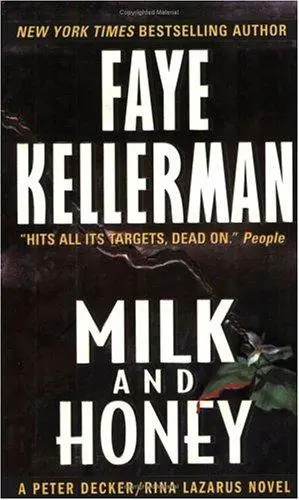
Milk and Honey
Chapters (37)
Cover
Faye Kellerman
Milk and Honey
A Peter Decker/Rina Lazarus Novel

Dedication
To the family—
Jonathan, Mom, and the kids.
And to my breakfast buddies:
Elyse Wolf, Lynn Rohatiner,
Debi Benaron, and Frieda Katz.
1
The flutter of movement was so slight that had Decker not been a pro, he would have missed it. He yanked the wheel to the left and braked. The brown unmarked screeched, bucked, then rebelliously reversed directions in the middle of the empty intersection. Decker began to cruise down the vacant street, hoping for a second look at what had attracted his attention.
The Plymouth’s alignment was off again, this time pulling to the right. If he had a spare minute, he’d check it out himself, haul her onto the lifts and probe her belly. The department mechanics were a joke. Overworked and underpaid, they’d fix one problem, cause another. The guys in the division were always laying odds on what would bust first when the vehicles were returned from service—six-to-one on a leaky radiator, four-to-one on a choked carburetor, three-to-one on the broken air-conditioning system, the odds improving to two-to-one if it was summertime.
Decker ran his fingers through thick ginger hair. The neighborhood was dead. Whatever he’d seen had probably been nothing significant. At one in the morning, the eyes played tricks. In the dark, parked cars looked like giant tortoises, spindly tree boughs became hanging skeletons. Even a well-populated housing development like this one seemed like a ghost town. Rows of tan-colored stucco homes had gelled into a lump of oatmeal, illuminated by moonbeams and blue-white spotlights from corner street lamps.
He slowed the Plymouth to a crawl and threw the headlights on high beam. Perhaps he’d seen nothing more than a cat, the light a reflection in the feline’s eyes. But the radiancy had been less concentrated and more random, a ripple of flashes like silver fingernails running up a piano keyboard. Yet as he peered out the window, he saw nothing unusual.
The planned community was spanking new, the streets still smelling of recent blacktop, the curbside trees nothing more than saplings. It had been one of those compromises between the conservationists and the developers, the construction agreed upon by both parties while satisfying neither. The two groups had been at each other’s throats since the Northeast Valley had been gerrymandered. This project had been hastily erected to smooth ruffled feathers, but the war between the factions was far from over. Too much open land left to fight over.
Decker cranked open the window and repositioned his backside in the seat, trying to stretch. Someday the city would order an unmarked able to accommodate a person of his size, but for now it was knees-to-the-wheel time. The night was mild, the fog had yet to settle in. Visibility was still good.
What the hell had he seen?