Chapters (26)
- Cover
- Title
- Dedication
- FOREWORD
- INTRODUCTION
- CHAPTER ONE
- CHAPTER TWO
- CHAPTER THREE
- CHAPTER FOUR
- MEET YOUR . . .
- MEET YOUR . . .
- MEET YOUR . . .
- MEET YOUR . . .
- MEET YOUR . . .
- MEET YOUR . . .
- MEET YOUR . . .
- MEET YOUR . . .
- MEET YOUR . . .
- MEET YOUR . . .
- CHAPTER FIVE
- CONCLUSION
- SOURCES
- DOGS IN THIS BOOK
- ACKNOWLEDGMENTS
- ABOUT THE AUTHOR
- Chronicle Ebooks
 Excessive barking
- Predatory behavior toward other animals
- Failure to come when called
- Unmanageability on leash when stimulated by other animals
- Emotional “act first, think later” reactions to threats to space, safety, or other resources
- Difficulty with confinement to smaller spaces/indoor living
Family History
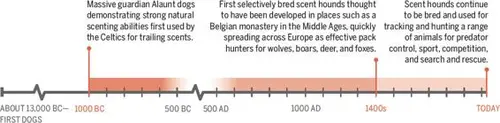
Thousands of years after humans developed the valuable sight-hunting attributes in ancient dogs, scent-tracking abilities in canines were crafted through selective breeding. Where sight hounds had offered speed and visual acuity, they lacked endurance and steady trailing abilities over rough terrain. When the Celtics found that a handful of early Alaunt-type (guardian) dogs proved to be impressive at following a course and had the hardiness for the conditions as well, the world’s first enormous scent hounds emerged.(26)
By the Middle Ages, a small monastery in Belgium, St. Hubert’s, had bred a number of dogs believed to be some of the first medium-sized, heavy-boned, long-eared singing hunters—establishing a foundation for the scent hounds to follow.(26) The popularity of these dogs, valued for their profound olfactory capabilities and resilience under harsh conditions, spread rapidly throughout Europe as large animals (particularly wolves) were hunted widely up until the nineteenth century in France, Belgium, and Germany.

Over the years, scent hounds were increasingly valued and bred for “voice” (the characteristic “baying” vocalization that alerts hunters to their dog’s location), unwavering commitment to the scent trail, and their determination to follow a target over miles of difficult landscape. While hunts usually resulted in cornering, trapping, or treeing the game (chasing the target animal up into a tree and holding it there by “barking up the right tree”), many of these dogs maintained a complete predatory sequence and would eagerly jump in and finish the job when given the chance.(27)
Scent hounds were bred for heart, from heart—the descendants of warriors with a bold perseverance for the pursuit. The range of size and speed (from short and slow Bassets to tall and agile Foxhounds) within this hardy group of large-eared, noisy dogs is the result of man’s effort to breed the ideal hunting dog for different game and conditions. Whether it’s a smaller Beagle or a massive Bloodhound, you are looking at the kind of dog that was made for the rough-and-ready, impulsive, give-it-all-you-got moment.
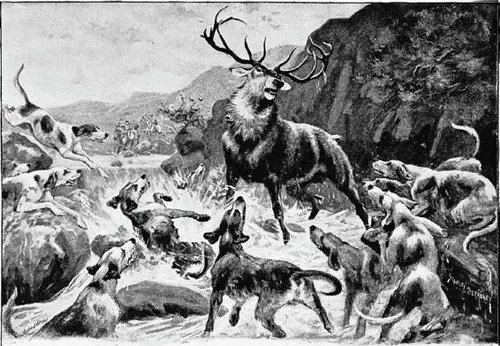
A Year of Sport and Natural History, Shooting, Hunting, Coursing, Falconry And Fishing (1895, Chapman and Hall).
Though she may be content to laze the day away on the porch, a squirrel on a limb or a scent in the breeze may suddenly awaken the memory of those glorious hunts of the past. Her no-holds-barred, emotional, single-minded response to these golden opportunities can be hard to live with at times. But she should be admired for the dog she was intended to be, even when it is a massive inconvenience. This kind of dog wasn’t really made to be a “pet,” even if she is one of the best companions you could ever ask for.