Chapters (26)
- Cover
- Title
- Dedication
- FOREWORD
- INTRODUCTION
- CHAPTER ONE
- CHAPTER TWO
- CHAPTER THREE
- CHAPTER FOUR
- MEET YOUR . . .
- MEET YOUR . . .
- MEET YOUR . . .
- MEET YOUR . . .
- MEET YOUR . . .
- MEET YOUR . . .
- MEET YOUR . . .
- MEET YOUR . . .
- MEET YOUR . . .
- MEET YOUR . . .
- CHAPTER FIVE
- CONCLUSION
- SOURCES
- DOGS IN THIS BOOK
- ACKNOWLEDGMENTS
- ABOUT THE AUTHOR
- Chronicle Ebooks
There appears to be a bit of a paradox within this type of dog. An animal descended from wolves that is passive enough to live peacefully with easy-to-kill baby herd animals, and yet is ferocious enough to hold its own against a Roman soldier? How could this be possible? Amazing as it is, it’s quite simple: genetic diversity. An original guardian dog, bred to protect livestock from predators, represents an incredible and fascinating genetic divergence from the dogs’ predator ancestry through differences in their regulatory DNA (essentially switches that tell genes when to turn on and off, controlling how DNA is expressed).(17) While a proper wolf is a natural hunter with an intact predatory sequence—following through from the initial orient step of the sequence (location of prey) to the end kill-bite (killing), and possibly even dissect/consume (eating the prey)—a true guardian dog lacks this predatory sequence. He is a lemon of a hunter among predators.
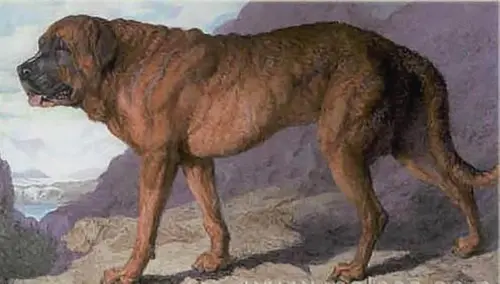
Untitled, Alpine Mastiff, 1815, brought to Britain. Source: The late J.S.Morgan, Esq., Leasowe Castle.
Scientists are still working hard to understand the exact mechanisms by which such a divergence could occur, but many epi-geneticists (scientists studying regulatory DNA) and other researchers believe that the differences in DNA SNPs (single nucleotide polymorphisms) that regulate this expression of genes could be responsible for changes such as this muting of the predatory behavior.(18) In other words, the natural “hunter” may technically still be in the DNA “hardware” of these dogs, but is silenced by the “software.” The result is a natural predator who will not hunt and kill the vulnerable herds and flocks it is charged to protect. Suddenly, these dogs’ reputation as the wonderfully patient and tolerant gentle giants they are makes a whole lot of sense.
This difference was to the agricultural man’s advantage—the guardian’s total lack of engagement in the predatory sequence has been a blessing for humans as we put his other skills to good use. If he were not so distinctly different from his ancestors, our flocks would not have been safe amid these guardians, but would, instead, have been their prey.
How could these good-natured dogs, merrily living among little lambs, possibly be later developed into war dogs and gladiators in blood-sport events? Again, the answer probably lies in the functions and effects of genetic diversity. It’s possible that, by favoring certain dogs historically, shepherds managed to genetically mute the guardian’s predator behavior while strengthening his instinctually territorial and protective behavior. A guardian dog’s incredible perception for potential threats—his concern about dangers to his territory and social members—is the very nature and historical value of this kind of dog. A concentrated manager of threats, he is cautious, deliberate, and capable when facing any opposition; yet he is no longer the traditional predator he once was. The difference is, somehow, in his DNA.