Chapters (26)
- Cover
- Title
- Dedication
- FOREWORD
- INTRODUCTION
- CHAPTER ONE
- CHAPTER TWO
- CHAPTER THREE
- CHAPTER FOUR
- MEET YOUR . . .
- MEET YOUR . . .
- MEET YOUR . . .
- MEET YOUR . . .
- MEET YOUR . . .
- MEET YOUR . . .
- MEET YOUR . . .
- MEET YOUR . . .
- MEET YOUR . . .
- MEET YOUR . . .
- CHAPTER FIVE
- CONCLUSION
- SOURCES
- DOGS IN THIS BOOK
- ACKNOWLEDGMENTS
- ABOUT THE AUTHOR
- Chronicle Ebooks
GOT A THING FOR LITTLE CRITTERS—She can be dangerous to animals she confuses with vermin.
HYPERACTIVE—You may wonder if she’s ADHD due to the amount of energy she has.

You might find yourself seeking professional help for:
 Difficulty following directions
- Dramatic or unmanageable behavior when walking on the leash
- Excessive barking in the house or yard
- Mischief and trouble making, such as digging up your garden or rummaging through the laundry basket; stirring things up with any family member or pet who she can get a rise out of; stealing things and ripping them into unrecognizable pieces
- Predatory behavior toward animals
- Obsessive spinning, tail-chasing, or preoccupation with toys or other targets like the TV
- Competitiveness or bossiness with other dogs in the home
Family History
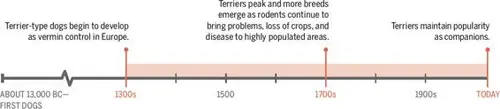
The word “terrier” derives from the French terre, or “earth.” In a nutshell, their name describes everything about their historically designed specialization for unearthing troublesome critters from their hiding places in the ground. Records date back to the fourteenth century of terrier-type dogs used to hunt and kill animals such as rats, foxes, badgers, and other animal “pests” bothering human settlements.(44) These agile, compact, and tenacious hunting dogs were a valuable asset to mankind on ships and in fields. Generally small in size, terriers became the ultimate companion in efforts to smoke out critters from their hiding places when larger hounds would fail.(45)

The Enclosure Movement in England, which began in the thirteenth century but saw rapid rise from the fifteenth to the nineteenth centuries, set the stage for the development of terriers as a critical tool.(46) As the landowning wealthy enclosed large tracts of land into their estates to increase wool production and enter market trade for profit, entire populations of subsistence farmers living off of common lands were displaced into crowded cities. The conditions in these urban industrial areas were primed for infestations of rats that would threaten inhabitants and their food supplies. Having dogs who could effectively locate and eliminate these animals was more than a little useful; it was often a matter of life or death. These amicable little dogs quickly grew in popularity across Western Europe, and developed into many different varieties throughout Ireland, Scotland, Germany, and other countries in the region in the nineteenth century.(47)
In World War I, terriers proved to be an invaluable asset once again, this time to the soldiers fighting and living in trenches on the battlefield. In those trenches, hundreds of rats would come to feed off of waste, food sources, the dead, and even wounded soldiers. Having terriers around to keep the numbers down on these quickly reproducing vermin became critical to human survival.(48) By killing off rats, terriers protected soldiers from disease, starvation, and constant harassment.