Chapters (26)
- Cover
- Title
- Dedication
- FOREWORD
- INTRODUCTION
- CHAPTER ONE
- CHAPTER TWO
- CHAPTER THREE
- CHAPTER FOUR
- MEET YOUR . . .
- MEET YOUR . . .
- MEET YOUR . . .
- MEET YOUR . . .
- MEET YOUR . . .
- MEET YOUR . . .
- MEET YOUR . . .
- MEET YOUR . . .
- MEET YOUR . . .
- MEET YOUR . . .
- CHAPTER FIVE
- CONCLUSION
- SOURCES
- DOGS IN THIS BOOK
- ACKNOWLEDGMENTS
- ABOUT THE AUTHOR
- Chronicle Ebooks
In many ways, gun dogs represent the perfect fit for us as pets, to be sure. They are, however, victims of our increasingly sedentary lifestyles. The changes of the past century—from a largely active and outdoor culture to a primarily indoor and inactive one—have taken a toll on countless relationships between people and their canine companions. Often, our dogs fail to behave in accordance with our wishes only because they are incapable of handling this phenomenal shift. They are deemed unruly, unmanageable, or destructive—all because we neglect their physical and mental activity needs.
If you don’t like a lot of attention, affection, interactions, and play, then a gun dog will get on your nerves. His codependency and super-social nature is not for everyone. But if you are truly active and desire a close working partnership with a lighthearted canine counterpart, you will find great satisfaction in this relationship.
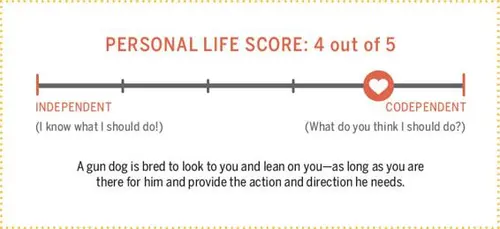
Take it to the limit. Teach him to do extraordinary things. Give him purpose in life—a plate to step up to. He will always have his head in the game if you do.
KEY CONCEPT: Biting
Dogs bite. All dogs bite. Dogs bite lots of different things for lots of different reasons. For them, teeth are more than something to chew food with. Teeth pick things up. Teeth scratch an itch. Teeth are tools. Teeth are everything from hands to a potentially lethal weapon.
Biting another animal socially can also communicate an idea or a point such as “Let’s play” or “Please stop.” It can bring an end to a hunted animal when well placed. It can injure a competitor or be a threat in the heat of an altercation. Biting is not, to say the least, a simple concept.
Biting is one of the many things, however, we continue to oversimplify. We ask a dog’s owner, “Does he bite?” and expect that their answer will clearly tell us if the dog is “good” or “bad.” We should all, if we are going to be honest, answer this kind of question with, “Of course, but it depends on the circumstances.”
Gun dogs present an interesting starting point for this discussion, as many of them have been genetically selected for certain modifications in biting in order to perform their historical duties correctly. On the one hand, most gun dogs have been selected for a kind of exaggerated oral propensity or fixation. Their inclination to bite things—put items in their mouths, pick those items up and carry or pull them—has been deliberately increased so that they could aid in tasks such as pulling nets and retrieving downed game birds to a hunter. On the flip side, these same dogs have also been selected for a diminished bite—a soft mouth—so that they would not damage a bird’s delicate meat by chomping down on it before the delivery.
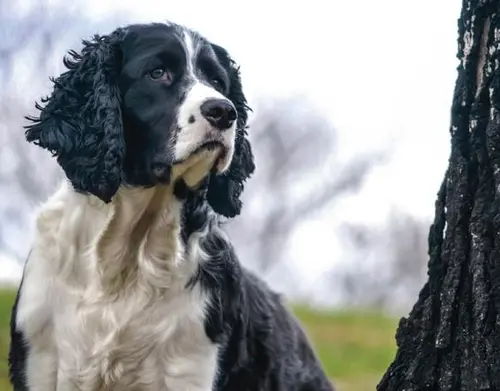
English Springer Spaniel