Lucky's
Chapters (35)
- About Lucky’s
- Title page
- Dedication
- Epigraph
- Chapter 1: 2002
- Chapter 2: 2002
- Chapter 3: 1945
- Chapter 4: 1913–1939
- Chapter 5: 2002
- Chapter 6: 1945
- Chapter 7: 1971
- Chapter 8: 2002
- Chapter 9: 1945–1946
- Chapter 10: 2002
- Chapter 11: 1938–1945
- Chapter 12: 2002
- Chapter 13: 1946
- Chapter 14: 1972
- Chapter 15: 2002
- Chapter 16: 1957
- Chapter 17: 1965
- Chapter 18: 1971
- Chapter 19: 1975
- Chapter 20: 2002
- Chapter 21: 2002
- Chapter 22: 1992
- Chapter 23: 2002
- Chapter 24: 1994
- Chapter 25: 2002
- Chapter 26: 2002
- Author’s Note
- Acknowledgements
- Praise for Lucky’s
- About the author
- Copyright page
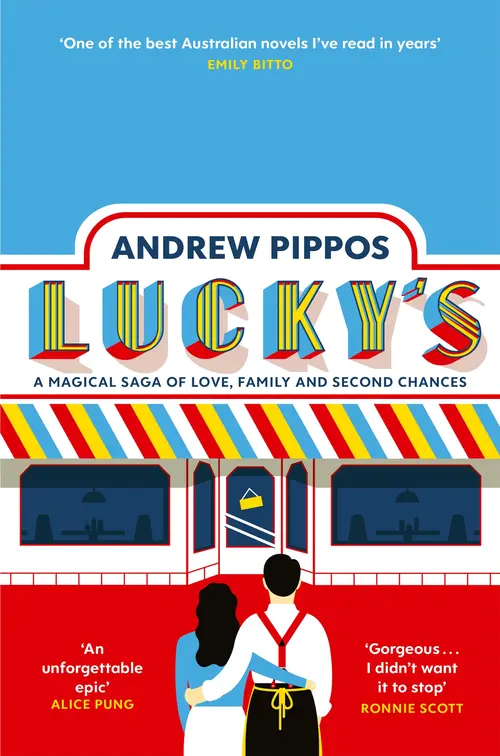
About Lucky’s
About Lucky’s
Lucky’s is a story of family.
It is also about a man called Lucky.
His restaurant chain.
A fire that changed everything.
A New Yorker article which might save a career.
The mystery of a missing father.
An impostor who got the girl.
An unthinkable tragedy.
A roll of the dice.
And a story of love—lost, sought and won again (at last).
Title page

Dedication
For Renee
Epigraph
Thus Don Quixote becomes a knight …
– Simon Leys
Chapter 1: 2002
2002
1.
He still had time to make changes. Not to his nickname, which he could never shake, and not to his appearance, and there was little prospect of changing the flaws in his character, since the time had passed for great internal transformations, but Vasilis ‘Lucky’ Mallios supposed he could fix his own story—to be specific, how it ended.
Lucky sat tucked at his kitchen table, newspaper spread across the surface, stripping rigani from the stalks. The herbs had hung inside a cupboard for a week—not long enough to properly dry—but he couldn’t wait; this old ritual was necessary. It offered a moment’s accord with the past. He placed the stalks to one side and picked through the heap of flower-heads, plucking out grey twigs, as the smell drifted up like the spirit of someone dead. The apartment now otherworldly, dense with human life. He told himself we all have missing people: our dead parents, or the spouse who left too soon, or the lover who betrayed us, the sibling who deserted the family, the friend we never found, the friend who walked away, the child we didn’t have, the person we couldn’t become—the life we should have led. Or the missing person might yet arrive: the child we still could have, the family we were about to find, the lover or destroyer coming to the door. Lucky could briefly accept that his world was incomplete, and he waited for this moment to end before he switched on his television.
That afternoon he had rushed home from the bank appointment and straightaway cut down the rigani from the cupboard near the kitchen window. The expansive new apartment complex opposite looked like a tower with its pockets turned out. Lucky’s own building reminded him of a motor inn.