Lucky's
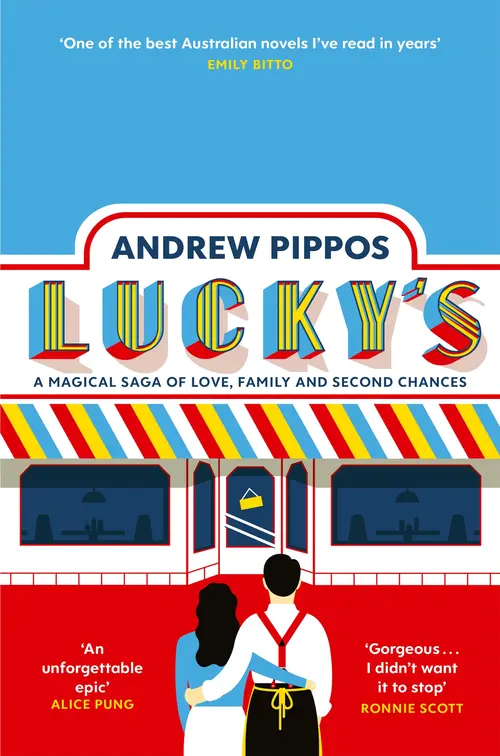
About Lucky’s
About Lucky’s
Lucky’s is a story of family.
It is also about a man called Lucky.
His restaurant chain.
A fire that changed everything.
A New Yorker article which might save a career.
The mystery of a missing father.
An impostor who got the girl.
An unthinkable tragedy.
A roll of the dice.
And a story of love—lost, sought and won again (at last).
Title page

Dedication
For Renee
Epigraph
Thus Don Quixote becomes a knight …
– Simon Leys
Chapter 1: 2002
2002
1.
He still had time to make changes. Not to his nickname, which he could never shake, and not to his appearance, and there was little prospect of changing the flaws in his character, since the time had passed for great internal transformations, but Vasilis ‘Lucky’ Mallios supposed he could fix his own story—to be specific, how it ended.
Lucky sat tucked at his kitchen table, newspaper spread across the surface, stripping rigani from the stalks. The herbs had hung inside a cupboard for a week—not long enough to properly dry—but he couldn’t wait; this old ritual was necessary. It offered a moment’s accord with the past. He placed the stalks to one side and picked through the heap of flower-heads, plucking out grey twigs, as the smell drifted up like the spirit of someone dead. The apartment now otherworldly, dense with human life. He told himself we all have missing people: our dead parents, or the spouse who left too soon, or the lover who betrayed us, the sibling who deserted the family, the friend we never found, the friend who walked away, the child we didn’t have, the person we couldn’t become—the life we should have led. Or the missing person might yet arrive: the child we still could have, the family we were about to find, the lover or destroyer coming to the door. Lucky could briefly accept that his world was incomplete, and he waited for this moment to end before he switched on his television.
That afternoon he had rushed home from the bank appointment and straightaway cut down the rigani from the cupboard near the kitchen window. The expansive new apartment complex opposite looked like a tower with its pockets turned out. Lucky’s own building reminded him of a motor inn.
The Suncorp Bank loan officer had been kind when rejecting his application. The officer cited Lucky’s lack of income in the past twenty-four months, without stating that he was too old anyway to take on substantial debt. He possessed no assets; there was no loan guarantor. The officer said she liked the idea of a person starting over. She couldn’t be more sympathetic. Her parents, on special occasions, used to take the family to Lucky’s former restaurant in Stanmore. She remembered the jukebox, the fat chips, the decor like the set of a TV show. And she acknowledged Lucky’s later history, referring to ‘the tragedy in your life’. If only Suncorp loaned on those grounds. At the end of their interview, Lucky admitted to the loan officer that her bank was the last in a list of lenders he’d approached. ‘What does that tell me?’ he said as he thanked her for the appointment, feigning concession, not wanting to come across sore, but what the final stop on his unsuccessful circuit of loan applications told him was this: the banks in Sydney were too conservative.
The light from his muted television faded and flared in the lounge room. An advertisement for a sports betting company ended and the middle segment of Wheel of Fortune began. They’d finished with the pointless speed rounds. The three contestants today all looked startled. They appeared miscast, thrown together behind the scoreboard. Lucky solved two puzzles before one of them even touched the wheel. Food: Bacon bits. Phrase: To go in pursuit.
Lucky Mallios scooped the rigani into a spiral jar and balled up the newspapers, sending green dust into the air. He got up when the phone rang, his eyes not moving from the television screen. Five beeps and a delay: an international call. ‘Lucky’s!’ he sang down the line.
Chapter 2: 2002
2002
1.
Emily Main stood at the corner in a grade of sunlight she associated with photographs of people at the peak of a mountain. The blue sky tinted the windows of cars as the traffic moved in a series of jolts through the intersection. Emily no longer felt exhausted: the breeze set off a thread of energy. It was the middle of the day. Somewhere in transit between London and Sydney the wheels had buckled on her suitcase, and they produced an abrasive sound when she crossed the road and entered the hotel.
Her flight had circled over Sydney Harbour, over the Lichtenberg figure of the northern suburbs, and from the air she had seen bushfire smoke in the distant south-west, where streams of grey roved into the sky and tabled over the horizon. Isabel, at hotel reception, mentioned the smoke smell that drifted into the city. Brightening suddenly, Isabel said there would be rain soon: at night she heard frogs in her backyard, a sure sign. The hotel’s airy lobby smelled of vanilla candles and appeared to be filled with the style of furniture displayed in the windows of stores across the road: white sofas and leather cushions, tubular lamps, mid-century carving chairs, enormous white seashells on the blue marble coffee tables. The floors were oiled and bare wood, dark as soil, faintly scratched. On the walls were blown-up photographs of native flora, the prints grainy as old fabric. Isabel asked if this was Emily’s first time in Sydney (no, a long time ago), if she required wake-up calls (no), and whether internet access was necessary (yes).
Emily was expecting an email from Michael, her husband, though last week he’d used the term partner when introducing her to someone they bumped into on Chamberlayne Road. Later, when Emily asked him about this description of her, Michael said he’d misspoken, that’s all. There was nothing in it. She didn’t absolutely take issue with the term: what bothered her was everything else Michael had done and said in recent months. The introduction of the term partner suggested to Emily that he somehow felt differently about her status and their marriage, which had indeed shifted (against her will, as though by the orders of a tyrant) into a mostly impassive and practical conjunction. Emily tracked the change back to last June, or thereabouts: the month they began trying to fall pregnant. When they did have sex, it was the kind that involved a minimum of touching. When their time together wasn’t admin-minded, it typically involved drinking. Michael liked wine and beer; Emily cider. He told her: ‘I’ve come to prefer slightly drunk sex.’ Some nights they stayed up late and talked and talked about how to fix their marriage until Emily went to bed so exhausted and stupefied that the next day she barely recalled what they’d said to each other. And yet, she thought, they hadn’t tried couple’s counselling. They hadn’t gone on a proper holiday. She told Michael that most marriages go stale (or whatever the hell had happened), but couples could salvage and thrive again, better than before. Whole shelves of the bookstore charted such recoveries. And here she cited friends and acquaintances who’d overcome what she suspected were the same problems. Michael grew his hair down to his shoulders, which looked very becoming.
‘He’s obviously depressed. He needs to speak to someone,’ she told her friend Liam.
Liam and Emily had known each other since their second year at Goldsmiths, where they both took a class on the Central European novel. She’d already heard of him before that seminar, when a friend in common said Emily ought to meet this clever Irish boy called Liam, since she’d like him, platonically. And she did, right away. After graduation, Emily and Liam (now friends) shared a two-bedroom flat with sloped floors in Ladbroke Grove. Liam convinced the landlord to let him paint the bedrooms dark red. This was the late eighties. They would both remember Ladbroke Grove as a good period, four years long. With a great deal of uncertainty—about his own talent, about losing touch with friends—Liam broke their lease and left London to work as the Berlin correspondent for The Guardian. In his new flat near Oranienplatz he was relentlessly unhappy and drank to excess but never failed to find good stories. Some weekends he’d fly back to London and sleep on Emily’s couch, bringing her German smallgoods and small quantities of excellent acid, which he’d hide inside a tube of toothpaste. Occasionally she’d post him an article she’d written for the Evening Standard or The Independent, or a short story she couldn’t make work.
Liam had been in Berlin for six years when the New Yorker offered him a job as a non-fiction editor, and by that time he’d grown distant to the pleasures of writing and said he’d rather edit other people’s work: he hoped to never again go home at night worrying about a detail or quote he might have screwed up in a story filed that day. Liam went to New York. Probably he’d never leave. Emily married Michael, a social worker, whom she met at a small dinner party in Harlesden.
Now Liam and Emily spoke once a month, if not more often, and they still confided in each other utterly, like they did when they’d sat up late in their kitchen, years ago, smoking cigarettes and drinking strong cardamom coffee. Some friendships stayed viable because they stayed much the same.
Liam said: ‘I’m guessing your husband’s girlfriend is named Sandrine.’
‘Don’t joke about Michael having an affair.’
‘I’m not joking.’
‘Don’t be serious either,’ said Emily.
It turned out the girlfriend’s name was Therese. Even the way Michael said ‘Therese’, as if drugged, made it perfectly clear that they, the lovers, had a meaningful union. In the middle of the night before Emily’s flight from Heathrow to Sydney, Michael had decided to tell his wife of seven years about his affair. Wearing scarf and gloves, he’d woken Emily at 2 am, standing statue-like above her. He spoke a little louder than he needed to. They were never partners in sleep, husband and wife: she went to bed early, he stayed up late.
‘Sorry to wake you,’ Michael said, ‘but there’s something I need to say before you go to Sydney. I’m in love with someone else.’
‘What? Repeat that.’
‘It came as a shock to me, too. Her name is Therese and I’ve known her about six months.’
Emily sat up in bed. ‘You idiot.’
‘We need to talk about this more, but not now. I’ll send you an email tomorrow.’
‘You’re going out in the middle of the night?’
‘I should leave, don’t you think?’
‘You tell me you’re in love with someone else and then rush out the door to fuck her?’
‘Jesus, Emily. My timing is bad, I know that.’
‘Bad timing?’ she said. ‘Bad timing is when you drive over a level crossing and a fucking train kills you.’
Michael left the bedroom door open, the hallway lights on in their Kensal Green flat. For the rest of that morning, Emily lay in bed trying to convince herself of the inalterable actuality of what had happened to her marriage. She stared up at a light fixture in the shape of an armillary sphere until her alarm sounded, then she got out of bed, into the shower, out the door and onto the tube automatically, on a trajectory already assigned. At the terminal she had the terrifying thought she might be pregnant—for a moment her mind seized up and split helically as it had the night before (what felt like five minutes ago) when Michael told her about beloved Therese. At Boots she bought ClearBlue, and in the departure gate bathroom she peed on the strip while a cleaner slopped water over the floor of the next cubicle.
Three minutes later the test came up negative. The previous month a negative result wouldn’t have produced this heavy surge of relief—a bitterly underlined form of relief. The image of one solid line on a stick drenched in piss, Emily thought, said more about the Michael situation than she was presently capable of expressing. Her neck hurt. They called her flight for boarding.
When she took her seat on the plane it seemed wrong that she wasn’t still at home, furious, because she felt thrown into abeyance, cheated out of a full response. Michael would be relieved she was leaving the country. He must have viewed the trip as a convenient break in their routine, the coward, and timed his confession to avoid a proper confrontation. Over the plane’s intercom an air steward announced the current time and temperature in Singapore—Emily’s layover on the way to Sydney—while she swallowed twenty-five milligrams of diazepam and opened a New Yorker magazine and closed it again as the plane shot up in what felt like a sequence of jumps.
Last September, Emily had been made redundant from her subediting job on the features desk of The Independent. No reason was given as to why she’d lost her position instead of some other colleague. No one at the paper had ever faulted her work—or not in her presence. Occasionally her headlines were changed down the line, because she hated puns and some section editors felt differently, but that was no big deal at a broadsheet. She put clean copy to the page. In a five-minute meeting, the managing editor thanked Emily for eight years of service and explained that advertising revenue had been falling. When Emily asked why they didn’t sack someone else, the managing editor said they had to choose someone, and it had to be a full-timer on the subeditors’ desk. When Emily asked again why she was that someone, the editor said Emily was being made redundant yet she wasn’t literally redundant, in a professional sense, but rather out of a job.
In the months after Emily’s departure, she received emails from ex-colleagues, subeditors and reporters, whose messages seemed more probing than well wishing, as if they were worried they might be headed towards a similar fate. To one email she replied: ‘I’m feeling fine. And let’s be honest, half the office will be out of a job in ten years.’
She applied for full-time work she didn’t get. She wrote to production about gaps in their casual roster. During her five months of unemployment Michael did not once mention their rent. He did not suggest a new career. He did find her a fortnight of temping shifts at the social work branch where he was employed as team manager. All day, as Emily discovered, he sat at his desk with a gelid expression on his face, absorbed in email and phone conversations and client interview transcripts. Even with his wife present, Michael ate lunch in front of the computer. Emily was surprised by how little he moved from his desk; it was like sanctuary for him, like an escape, like a parallel life. During lunch hour on her last shift at the social work office, she pitched an article to her dear friend Liam. You probably expected one of these emails, her message began. She’d always wanted to write something for the New Yorker. She intended to write an essay about an obsolete restaurant franchise in Australia, its rise and catastrophic fall. Emily wrote the pitch in fifteen minutes, which was her way of underinvesting in the New Yorker fantasy, and in return she expected a kind rejection email from an old friend.
Liam called her that night. ‘Emily,’ he said, ‘I think this is going to work.’
2.
Her first day in Sydney, the summer light slowly growing out of noon: with the curtains drawn in their recessed track, the dim light in the Darlinghurst hotel room was orange and abject. From the desk, Emily picked up the menu, sticky with fingerprints, and cleared away the tent cards that offered instructions about room service and the minibar. She plugged in her laptop and sat on the bed, removing her clothes while the computer started.
An email from Michael:
Em,
I don’t know how to explain what’s happened in my life. Not being able to express myself is the best expression of how I feel about Therese. Is that a cop-out? She came as a surprise to me, too.
I’ll move out before you get back to London. This month’s rent is all sorted. And good luck, I know this article will turn out well.
Michael
Emily presumed that when Michael wrote, I know this article will turn out well, what he really meant was: Your ideas are mediocre and that mediocrity is one of the reasons I fell in love with someone else. Perhaps he felt galvanised by the end of their marriage. He was already deep in a long retreat from their relationship, the stupid bastard, while she was left to feel—something else. She deleted his email and picked up her blouse, a thirty-sixth birthday gift from Michael, throwing it into the bin. How much of her life would he and Therese spoil? It felt as though the hotel room door was wide open and the two lovers (Emily hated that word) could storm in and take whatever they wanted.
On their first date, Emily and Michael shared dinner and went to a pub, where he told her about his elder brother, whose body he found one afternoon at the family house in Coventry. This catastrophe—this meteorite on the family—occurred after the brother had been through drug rehabilitation and moved home and found a job cleaning the windows of shop fronts in the centre of town. Michael came in from school and found his brother dead of an overdose in the bathroom. And Emily told him about her father, whose suicide she witnessed as a girl. She had a sense of these stories joining, of their histories clicking into place. They had seen the same things. They knew the same sorrows. That night in the pub on St Giles High Street, Emily felt certain that she and Michael would fall in love; that they were already together in grief, and now they would build a happy life together.
In the shower, Emily turned so the water hit between the shoulder blades, almost knitting her together again. She asked herself whether she and Michael had made a terrible mistake going to bed at different times, never doing what she supposed better couples did, always rising with each other. From the start they had kept separate hours. A doctor specialising in sleep problems told them Michael suffered from delayed sleep phase disorder. It’s like you live in different time zones, said the doctor, different countries. Michael was prescribed melatonin and warned it might wear off in six months (it did). But if he and Emily had gone to bed at the same time, one of them reaching for the lamp at 10.30 pm, if they’d done this every night, then she wouldn’t have certain memories, Emily’s happiest, from those Saturdays when she rose early to jog her two-mile route, shutting the front door loudly when she came home, calling his name, then running into the bedroom and jumping onto the bed, stripping off her clothes, laughing.
3.
The restaurant franchise Emily proposed to write about was called Lucky’s. In fifty years, the franchise menu barely changed an item, the decor stayed as fixed as a photograph (the awnings yellow and gold, the floors chequerboard) and the opening hours were long and uniform across the chain. The franchise was named for its founder, Lucky Mallios, a Greek American who’d migrated to Sydney after the war. (In her research, Emily could not anywhere find an explanation of his nickname.) From America the restaurants took their diner-style interior, the novelties of the soda fountain and jukebox, the sundae and milkshake; from Britain they borrowed the greasy spoon menu of main dishes; from post-war Greece they obtained most of their staff. Lucky’s restaurants—also described as cafes—numbered forty-nine outlets at the peak of the business, but they had fallen out of style by the 1990s. What Emily would frame in her story as ‘the death of the franchise’ was a shooting in 1994: an incident commonly known as ‘the Third of April’, in which a gunman killed nine people inside the last Lucky’s restaurant in Sydney.
Liam wanted to run the piece in the annual food issue of the New Yorker, scheduled for the last week in May. ‘Would be great if you found a new angle on the shooting,’ he said. ‘I want to know what happened to the survivors. Focus on the long-term effects of the Third of April.’ One other thing, said Liam. He’d been booked to speak about the magazine at a Melbourne university in February. Why didn’t they plan to be in Australia at the same time, and he could pop up to Sydney for a short visit?
4.
The Story Continues on BooksBarbecue!
Enjoyed this preview? ❤️ Do not stop here!
Read the complete book free online → 🔗
Continue reading now on BooksBarbecue and discover every page!
Love reading? Bookmark BooksBarbecue.com for more amazing books!
Happy Reading!