Chapters (16)
- Cover
- Dedication
- Se pa tout blesi ki geri
- Sa ki bon avèk yon kè, sè ke li pa pote jijman
- Se lè yon sous seche, moun konn valè dlo
- Di m’ sa ou renmen, epi m’ava di ou ki moun ou ye
- Vrè lanmou pa konn danje
- Manman Poul grate, grate jouk li jwenn zo grann li
- Acknowledgments
- Readers Guide
- Beyond the Talented Tenth An Essay by Kaitlyn Greenidge
- Black Motherhood as Literary Creation An Interview with Kaitlyn Greenidge by Liz Button
- Questions for Discussion
- Also by Kaitlyn Greenidge
- About the Author
- Praise for Libertie
4. After such a clear passion for medicine and for following her mother’s path, Libertie changes her mind and decides she does not ever want to become a doctor. Why? What compromises does Cathy Sampson make when she opens the hospital?
5. Discuss the role of the Graces. In what ways do they influence Libertie?
6. Why doesn’t Cathy want Libertie to marry Emmanuel Chase? She says to Libertie, “You chose your body over your mind.” Do you agree with her assessment of Libertie’s decision? What does she fear for her daughter?
7. Emmanuel Chase promises a new life for Libertie, but she confronts a number of secrets about his family’s history once they move to Haiti. How did you end up feeling about Emmanuel?
8. Ella and Libertie have an initially hostile relationship, but over time, their relationship deepens as Libertie comes to understand her. How did you feel about Ella? What about the garment she embroiders— what does this reveal about Ella, about history, and about who tells it?
9. How did you end up feeling about Haiti?
10. What is Ti Me’s role in the novel? What does she teach Libertie?
11. In many ways, this novel is about the relationship between mothers and their children. Discuss Cathy and Libertie’s dynamic, and what Libertie hopes for her own children. Did you feel more drawn to Cathy or to Libertie?
12. Libertie is named by her father “in honor of the bright, shining future he was sure was coming.” How do you feel about Libertie’s future by the close of the novel? How do you feel about her final choice to return to America?
Also by Kaitlyn Greenidge
Also by Kaitlyn Greenidge
We Love You, Charlie Freeman
About the Author
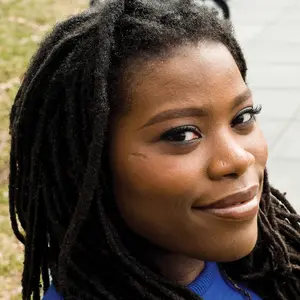
Kaitlyn Greenidge’s debut novel, We Love You, Charlie Freeman, was one of the New York Times Critics’ Top 10 Books of 2016 and a finalist for the Center for Fiction First Novel Prize. She is a contributing writer for the New York Times, and her writing has also appeared in Vogue, Glamour, the Wall Street Journal, and elsewhere. She is the recipient of a Hodder Fellowship from Princeton University’s Lewis Center for the Arts, as well as fellowships from the Whiting Foundation, the National Endowment for the Arts, Substack, and the Radcliffe Institute for Advanced Study.
Praise for Libertie
Praise for Libertie
“Pure brilliance. So much will be written about Kaitlyn Greenidge’s Libertie—how it blends history and magic into a new kind of telling, how it spins the past to draw deft circles around our present—but none of it will measure up to the singular joy of reading this book.” —Mira Jacob, author of Good Talk: A Memoir in Conversations
“Sweeping, engrossing.” —O, The Oprah Magazine
“Libertie is a feat of monumental thematic imagination . . . Greenidge both mines history and transcends time, centering her post-Civil-War New York story around an enduring quest for freedom . . . The sheer force of Greenidge’s vision for [Libertie], for us all, gives us hope that it won’t be long now.” —Margaret Wilkerson Sexton, The New York Times Book Review