Chapters (34)
Sensing that once again the illumination might be playing on a commonly known late-medieval painting, August trolled the Internet for images of fifteenth-century rulers in the Holy Roman Empire. He smiled, stumbling only a few minutes later upon another familiar image. “I think I found a connection,” he said to Xandria.
Xandria looked at the laptop and saw an image labeled The Holy Roman Emperor Sigismund. She gasped, then shut her mouth quickly.
“You recognize this?”
“Yes,” Xandria said. “What’s the connection?”
August flicked the mouse pad, and the Gutenberg illumination came side by side with the painting of Emperor Sigismund. “This is King Solomon,” August said, pointing to the Gutenberg illumination. “Or, at least, it should be King Solomon, since he is the main focus of 2 Chronicles. But there’s a problem with the representation.”
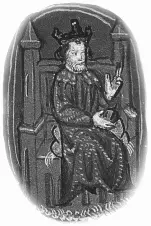
Xandria studied the two images for clues. “The throne?”
“Close,” August said. “Take a look at the crown.” He lassoed the crown portion of the painting with the cursor and enlarged it. “This is not the crown Solomon would have worn. This is a Saxon crown.”
“Just like the white dog.”
“Correct,” August said. “But you have to understand the history to see the implications. The first dukes of Saxony were simultaneously considered kings of the Holy Roman Empire. This continued well into the twelfth century, when Saxony was taken over by the Welfen dynasty.”
“So what does the illumination mean?”
“I think it’s suggesting that the power of the Holy Roman Empire sits on King Solomon’s throne. Odd, to say the least.”
“What’s in his hand?”
“It’s called a globus cruciger. In medieval paintings, it was common to show political leaders holding it. It means, literally, a globe with a cross on top. See, Sigismund is holding one. It shows that he holds the world in his hand, and the cross shows that he has been given the authority by holy rite.”
Xandria compared the two images on the screen. “But the Gutenberg illumination shows the king holding a globus with no cross on top.”
“Well, if both illuminations so far are about Sigismund, they could reasonably imply that his leadership of the Holy Roman Empire was driven by an evil purpose. Jan  — the general of the Orphan army—battled against Sigismund, claiming that he was driving the Holy Roman Empire toward destruction.”

“The Orphan army?”
“Followers of John Huss, the martyr who didn’t exactly see eye-to-eye with the Holy Roman Empire. Some call them Hussites, then Orphans after Huss’s death. But I’m with those who think they didn’t acquire the name Orphans until after their leader, Jan , perished in battle.”
“Fascinating,” Xandria said, tapping her watch as if she were bored. “Only five minutes left.”