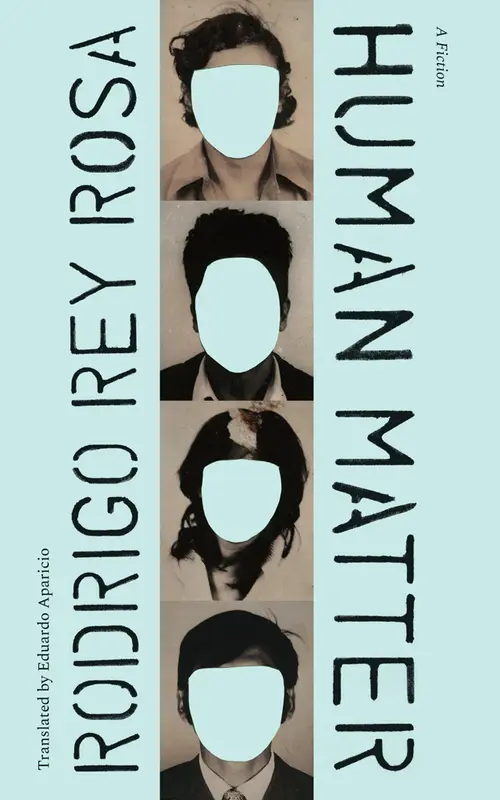
Human Matter
Chapters (20)
- Cover
- Series Page
- Dedication
- Epigraph
- Introduction
- First Notebook: Modo & Modo
- Second Notebook: Black Binding
- Pages Attached to the Second Notebook
- First Sketchbook: Green Cover with Indian Motifs
- Pages Attached to the First Sketchbook
- Third Notebook: White Cover
- Second Sketchbook: Don Quixote
- Fourth Notebook: Red and Blue Stripes on a White Background
- Pages Attached to the Fourth Notebook
- Third Sketchbook: “Scribe”
- Fourth Sketchbook: Leather Cover, No Branding, No Name
- Fifth Sketchbook: Spanish Binding
- Author’s Note
- Postscript
- Translator’s Acknowledgments
Cover

Series Page
Latin American Literature in Translation Series
Other Books in the Series:
The Enlightened Army by David Toscana (2018)
Dedication
For Marta García Salas
Epigraph
Though it may not seem to be,
though it may not want to seem to be,
this is a work of fiction.
Introduction
Introduction
Shortly before I became aware of the existence of the famous Archive that I’ve been wanting to work on, in the very early hours of June 17, 2005, a fire and a series of explosions partially destroyed an ammunition depot belonging to the National Army outside of Guatemala City, where approximately one ton of missiles of various calibers was stored, part of the supplies left over from the domestic war that began in 1960 and ended in 1996. An official from the Human Rights Ombudsman’s Office was assigned to investigate the existence of other ammunition depots that could pose a similar danger. He visited the facilities at La Isla, in the northernmost end of the city, a complex of police buildings that includes the Police Academy, a criminal investigation center, a vast dump of wrecked vehicles, the police canine unit, an abandoned hospital, and the ammunition depot. Mysteriously, the explosive devices (sticks of dynamite, grenades, mortars) that were supposed to be stored there had disappeared the day before the investigation. However, in an adjacent building, which had perhaps operated as a hospital but which according to the investigators at the Ombudsman’s Office was used as a torture center (the windows in almost every room had been sealed with bricks or cinder blocks), the investigator from the Ombudsman’s Office discovered a room full of papers, files, boxes, and bags of police documents. This was true of almost all the rooms and halls on the first and second floors of this building and other adjacent structures.
When the National Police was dismantled following the peace accords signed in 1996, someone ordered the transfer to this site of the Archive from the former National Police headquarters and from other regional police stations, and the eighty million–plus documents presently housed at the Archive—including record books dating from the 1890s—had stayed hidden since then, until July 6, 2005, when the local press reported the unlikely and fortunate discovery.