Chapters (61)
- Title Page
- Copyright Page
- Dedication
- Chapter 1 - Napoleon
- Chapter 2 - April 1805
- Chapter 3
- Chapter 4 - Arthur
- Chapter 5
- Chapter 6 - Napoleon
- Chapter 7 - Paris, September 1805
- Chapter 8 - Strasbourg, 24 September 1805
- Chapter 9 - Ulm, 16 October 1805
- Chapter 10 - Arthur
- Chapter 11
- Chapter 12
- Chapter 13 - Napoleon
- Chapter 14
- Chapter 15 - Austerlitz, 2 December 1805
- Chapter 16 - Arthur
- Chapter 17 - Hastings, February 1806
- Chapter 18 - Dublin, April 1806
- Chapter 19
- Chapter 20 - Napoleon
- Chapter 21 - Bamberg, 7 October 1806
- Chapter 22 - Jena, 13 October 1806
- Chapter 23
- Chapter 24 - Warsaw, January 1807
- Chapter 25 - Eylau, 8 February 1807
- Chapter 26 - Arthur
- Chapter 27
- Chapter 28 - Dublin, April 1807
- Chapter 29
- Chapter 30
- Chapter 31 - Napoleon
- Chapter 32
- Chapter 33
- Chapter 34 - Arthur
- Chapter 35
- Chapter 36
- Chapter 37
- Chapter 38 - Napoleon
- Chapter 39 - Pamplona, February 1808
- Chapter 40
- Chapter 41
- Chapter 42 - Arthur
- Chapter 43 - Mondego Bay, Portugal, 30 July 1808
- Chapter 44
- Chapter 45
- Chapter 46
- Chapter 47 - Napoleon
- Chapter 48
- Chapter 49
- Chapter 50 - Arthur
- Chapter 51
- Chapter 52 - Napoleon
- Chapter 53 - Arthur
- Chapter 54 - Napoleon
- Chapter 55 - Arthur
- Chapter 56
- Chapter 57
- Author’s Note
‘Of course. But I am sure the panel will be persuaded that you cannot be held responsible for the Cintra treaty. Solely responsible, that is. Either all three generals will be condemned or none will.’ Castlereagh shook his hand again. ‘Good luck, Sir Arthur. And goodbye to you, William.’ He turned and strode away to work another section of the crowd.
‘Either all three condemned, or none,’ William echoed. ‘Was that supposed to be a few words of encouragement, do you think?’
Chapter 51
Chapter 51
Arthur was wearing his best uniform when he presented himself before the members of the panel. Sir David Dundas had been appointed president of the inquiry and was assisted by six other generals, all of whom were now seated behind a long table at the end of the Great Hall. Several clerks and secretaries sat at small tables in the wings, organising documents and taking down details of what was said to provide an accurate record of the event. Arthur was shown into the hall and escorted to the single chair set before the inquiry panel. He bowed to each of the members and then took his seat. Dundas was an elderly general and one of the most senior in the army. His gaunt figure topped by a thin face, a long nose and white hair. Dundas had a reputation for being a strict disciplinarian and a stickler for rules and regulations.
‘Sir Arthur,’ he began formally,‘you have been called here to account for your actions in relation to the treaty signed at Cintra. Generals Dalrymple and Burrard have already given their evidence. You will answer all questions truthfully and to the best of your knowledge. Do you understand?’
‘Yes, sir.’
‘Very well then. It is the understanding of this inquiry that you were in command of the army for the duration of the engagement at Vimeiro. Is that so?’
‘Yes, sir.’
‘And yet General Burrard had reached the vicinity of the army the day before.’
‘Yes, sir.’
‘So, in your view, it would have been possible for Burrard to have assumed command of the army in time to fight the subsequent battle.’
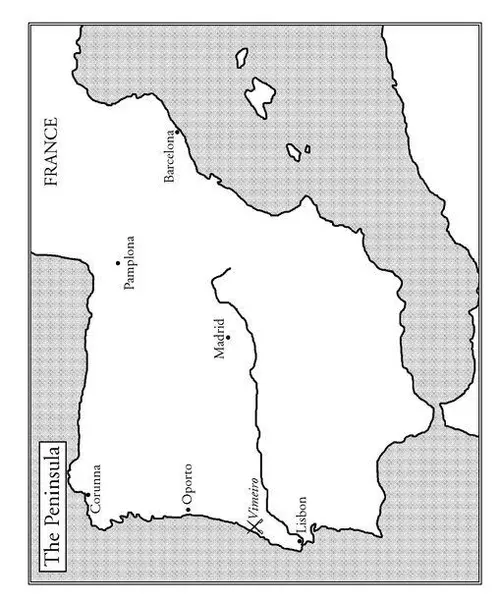
‘It was certainly possible, sir, but not necessary.The army had already won an engagement at Roliça, and it seemed that the enemy was retreating towards Lisbon. Sir Harry arrived in the afternoon and made the decision not to assume command until the next day. There was no expectation of a battle, and had the French not tried to surprise us, Sir Harry would have assumed command of the army in good time.’
‘That may be so, General Wellesley, but let me ask you this. If you had been in Burrard’s place would you have delayed taking command of the army as the senior officer present?’
Arthur paused. There was no way to answer this truthfully that did not undermine Burrard’s position. He drew a sharp breath. ‘No sir, I would not have delayed taking command.’