Faithful
Chapters (29)
- Introduction
- Spring Training WELCOME TO NEXT YEAR
- March 25th
- April/May WHO ARE THESE GUYS?
- April 4th
- April 10th
- April 18th
- April 29th
- May 11th
- May 23rd
- June THE JUNE SWOON
- June 20th
- July TURN THE PAGE
- July 15th
- July 24th
- August THE HOTTEST AUGUST ON RECORD
- August 17th
- September/October HANGIN’ TOUGH
- September 14th
- September 17th
- October 2nd
- The ALDS SOMEBODY GOT-TA PAY
- October 8th
- The ALCS BEYOND THUNDERDOME
- October 19th/ALCS Game 5
- The World Series THE POSSIBLE DREAM
- ACKNOWLEDGMENTS
- BOSTON RED SOX 2004 STATS
- Copyright
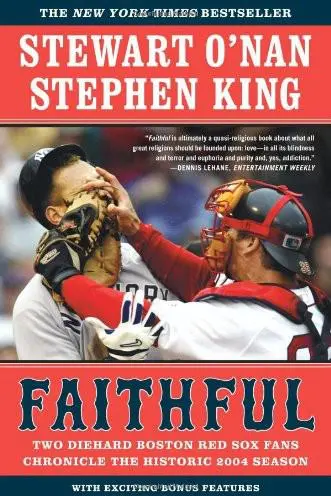
Stewart O’Nan, Stephen King
FAITHFUL
Two Diehard Boston Red Sox Fans Chronicle the Historic 2004 Season
For Victoria Snelgrove,
Red Sox fan
Down by the river,
down by the banks of the River Charles.
That’s where you’ll find me,
along with
muggers, lovers and thieves.
THE STANDELLS
I put a spell on you,
cause you’re mine.
SCREAMIN’ JAY HAWKINS
Introduction
Introduction
I wasn’t always like this. I was born a World Champion, a third-generation Pirates fan, in early 1961.
A few short months before, the Bucs had taken the heavily favored Yankees to Game 7 in Forbes Field. The Yanks seemed to have the series in hand, up 7–4 in the eighth when Bill Virdon hit a simple double-play ball to short. As Tony Kubek charged, the ball took a bad hop off the alabaster plaster, hitting him in the Adam’s apple, and both runners were safe. Two singles later, it was 7–6. The next batter, backup catcher Hal Smith, caught up to a Bobby Shantz fastball and parked it over the left-field wall for a 9–7 lead.
But the Pirates couldn’t close it out, surrendering two in the next frame. With the game tied at nine, second baseman Bill Mazeroski led off the bottom of the ninth. He took the first pitch from Ralph Terry for a ball, and then, as every Pirates and Yankees fan knows, Maz cranked a high fastball over Yogi Berra and everything in left, and the fans stormed the field.
As a longtime Red Sox fan, I appreciate this history even more now, but, as a kid then, my perspective was limited. Living so close to the real-life setting of the legend (our library was right across the parking lot, and we’d walk over and touch the brick wall the ball cleared), I grew up pitying the Yankees as hard-luck losers.
As the ’60s turned into the ’70s, nothing happened to refute this. We won it all again in ’71, beating an Orioles team with four 20-game winners, and made the playoffs nearly every year before succumbing to the Dodgers or the Big Red Machine. Roberto Clemente, tragically, was gone, but his spirit lingered over the Lumber Company, a colorful and monstrous offensive club that included hitters like Willie Stargell, Dave Parker, Al Oliver, Richie Zisk, Rennie Stennett and Manny Sanguillen. Earl Weaver’s O’s and Charlie Finley’s A’s ruled the AL. The bumbling Yankees, like the Brooklyn Dodgers or New York Giants, belonged to a flannel, white-bread past, hopelessly square.
About the time George Steinbrenner took them over, I traded my interest in baseball for cooler high school pursuits: music and cars, girls and cigarettes. I noticed with an offhand disgust that the Yankees had bought the heart of the A’s dynasty to “win” two cheapies, but it didn’t mean much to me. I was too busy messing around to bother with a kid’s game.