Chapters (25)
- Title Page
- Dedication
- Introduction
- I - Into the Wild Blue
- Chapter 1 - Every Man a Tiger
- Chapter 2 - The Big Lie
- Chapter 3 - The Vision of Bill Creech
- II - Shield in the Sky
- Chapter 4 - Mission to Jeddah
- Chapter 5 - CENTCOM Forward
- Chapter 6 - Planning the Storm
- Chapter 7 - Band of Brothers and Sisters
- III - The Thousand-Hour War
- Chapter 8 - Storm!
- Chapter 9 - Hits and Misses
- Chapter 10 - Lost and Found
- Chapter 11 - Punch and Counterpunch
- Chapter 12 - A Day in the War
- Chapter 13 - The Ten Percent War
- Chapter 14 - Shock and Awe
- Chapter 15 - Building Coalitions
- Chapter 16 - Beyond Iraqi Freedom
- Acknowledgements
- BIBLIOGRAPHY
- INDEX
If you want to listen instead of look, then you might go higher, so your satellite has more of the Earth’s surface in its field of view. This is called Medium Earth Orbit, or MEO (anything between LEO and GEO). Hence, the space geeks talk about LEO and MEO, GEO and Molniya. And if you learn to say “anomaly” when something is screwing up, and “effemerius” when you mean speed, altitude, and heading, then you’re well on your way to becoming a true space cadet.
★ As CINCSPACE, I had three jobs.
First, I was CINC NORAD. There, it was my responsibility to maintain the air sovereignty of the United States and Canada. Though watching over sovereignty involved keeping track of what flew over our nations from outside our borders, the real job was to evaluate the indications of a ballistic missile attack on the United States and Canada, in order to advise the President and the Prime Minister, so the President could order the nuclear response that would end the world. NORAD handled this warning and evaluation (rather than, say, CINCSTRAT, who would order the attack, should that come) to keep the evaluator separate from the trigger-puller. Of course, the biggest tip-off would have been the radar and IR satellite detection of an ICBM attack.
Second, I was CINCSPACE. There, I commanded components from Army, Navy, and Air Force (of which Air Force Space Command was the largest).
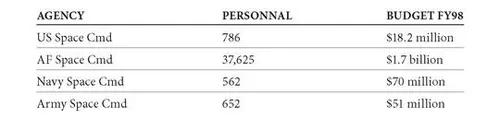
As CINCSPACE, I evaluated and influenced the space programs of the various services. I also validated the requirements documents used by the services to support the funding of their programs and made sure that the service programs coordinated with, and supported, the efforts of the sister services. I provided space services to the regional CINCS through the components. So, for example, I made sure the AFSPACE flyers of the comm satellites positioned their birds to support the needs of a CINC—say, the CINC Korea (technically, the commander combined forces Korea), who had a special need and had been authorized access to the satellite by the JCS and DISA (Defense Information Systems Agency, which handles long-haul communication and tries to make the services’ programs interoperable or joint). I worked with other space agencies, not the least of which was the National Reconnaissance Office (which is responsible for acquiring and operating space vehicles that provide national intelligence, and is headed by an Assistant Secretary of the Air Force). This made sure that the services’ interests were represented in the national community requirements documents. In the past, this had been a big problem, as the NRO mainly responded to the Cold War and did not like to get close to regional conflicts. Though that changed after Desert Storm, I still had problems with the CIA, who wanted the Cold War to remain, so they could do business as usual.