Chapters (25)
- Title Page
- Dedication
- Introduction
- I - Into the Wild Blue
- Chapter 1 - Every Man a Tiger
- Chapter 2 - The Big Lie
- Chapter 3 - The Vision of Bill Creech
- II - Shield in the Sky
- Chapter 4 - Mission to Jeddah
- Chapter 5 - CENTCOM Forward
- Chapter 6 - Planning the Storm
- Chapter 7 - Band of Brothers and Sisters
- III - The Thousand-Hour War
- Chapter 8 - Storm!
- Chapter 9 - Hits and Misses
- Chapter 10 - Lost and Found
- Chapter 11 - Punch and Counterpunch
- Chapter 12 - A Day in the War
- Chapter 13 - The Ten Percent War
- Chapter 14 - Shock and Awe
- Chapter 15 - Building Coalitions
- Chapter 16 - Beyond Iraqi Freedom
- Acknowledgements
- BIBLIOGRAPHY
- INDEX
The Gulf War demonstrated the possibilities available to a nation that decides to revolutionize its military operations. If used effectively, precision weapons, Stealth aircraft, space reconnaissance, and rapid communications would so change military affairs that today’s military leaders would no longer recognize the military in which they served. Certainly, Schwarzkopf, Yeosock, Boomer, Arthur, and I did not fully understand how to exploit these revolutionary capabilities. Yet we perceived the clues and (within our own limitations) tried our best to use the resources available, to free Kuwait as soon as possible, while keeping the loss of life at a minimum.
Since this book is about airpower, what is the future of air, looked at from the light of the coming revolution? The best way to get a handle on that, I think, is to examine how we dealt with the new technologies during the war, and then to use that as an entry into the coming revolution in military affairs. Parts of this story will be familiar, but not from this angle.
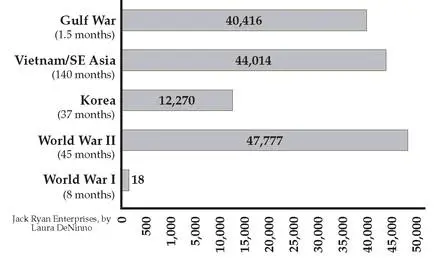
U.S. Bomb Tonnage Used per Month by Conflict
U.S. Aircraft Combat Losses/Sorties by Conflict
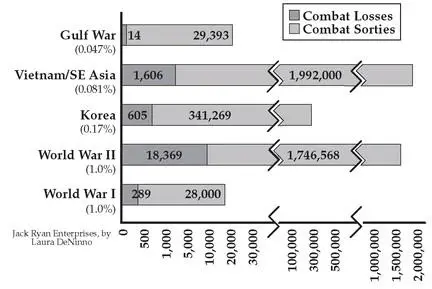
★ The Coalition strategy was simple—to gain control of the air, use airpower to isolate and debilitate the Iraqi Army, and then use ground forces to drive them from Kuwait. The war in Vietnam did not have air superiority as a pressing goal; the result was a drawn-out conflict with thousands of aircraft shot down. I could never forget that lesson. Therefore, the first step, gaining control of the air, was key.
For this, I had advantages no other commander in history had enjoyed. For starters, a U.S. Navy analysis of Iraqi air defenses provided a system-wide understanding of the role of each element that had been designed to protect Iraq from air attack. The point to pay attention to is the system, not the elements. No longer would I have to bomb every enemy airfield, or shoot down every enemy fighter, or destroy every enemy surface-to-air missile site. If I could isolate and destroy the heart and brain of the Iraqi air defenses, then the arms and legs could not function, and attacking them would only use precious resources that would be better used in attacks on other target sets.
The analysis of the system told the air planners what nodes should be attacked, in what sequence, and when the attacks should be repeated. These attacks would be conducted with such ferocity and accuracy that the air defenders would be shocked into a state of awe and helplessness. The tools, Stealth and precision, would exploit the opportunities revealed by the complete knowledge of the Iraqi air defense system.
And so it happened.