Chapters (25)
- Title Page
- Dedication
- Introduction
- I - Into the Wild Blue
- Chapter 1 - Every Man a Tiger
- Chapter 2 - The Big Lie
- Chapter 3 - The Vision of Bill Creech
- II - Shield in the Sky
- Chapter 4 - Mission to Jeddah
- Chapter 5 - CENTCOM Forward
- Chapter 6 - Planning the Storm
- Chapter 7 - Band of Brothers and Sisters
- III - The Thousand-Hour War
- Chapter 8 - Storm!
- Chapter 9 - Hits and Misses
- Chapter 10 - Lost and Found
- Chapter 11 - Punch and Counterpunch
- Chapter 12 - A Day in the War
- Chapter 13 - The Ten Percent War
- Chapter 14 - Shock and Awe
- Chapter 15 - Building Coalitions
- Chapter 16 - Beyond Iraqi Freedom
- Acknowledgements
- BIBLIOGRAPHY
- INDEX
Precision munitions were dropped on the Baghdad Nuclear Weapons Research Center on the first three days of the war, though to what effect it was hard to say, except by counting holes in buildings and bunkers. Later, a mass raid against the Al Qaim nuclear facility failed. The forty F-16s found it defended by large numbers of AAA and SAM sites and obscured by smoke generators, and then the bombs from the first two aircraft raised so much dust that it was impossible for the remaining thirty-eight pilots to identify their aim points. The facility was later hit by a surprise F-117 night attack, which obliterated every assigned target.
But the fox, it turned out, had fled.
After the war, United Nations inspection teams learned that the Iraqis had already removed vital equipment from these locations and buried it in the desert (not a practice recommended for the sensitive, highly calibrated electronic devices used in nuclear research). In other words, from the Iraqi point of view, the cure may have been no better than the disease. If that was the case, then God was once again on the side of the good guys. Either way, the air attacks delayed the Iraqi quest for nuclear weapons for a few more years.
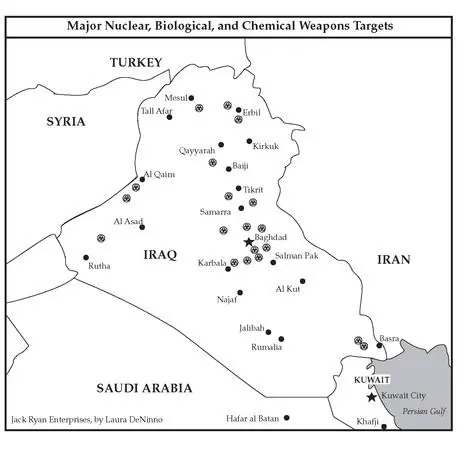
★ In an earlier chapter the problem of preventing biological attack was discussed. There is little to add to that here.
Because production facilities for biological weapons are difficult to identify, intelligence and planning concentrated on storage facilities, usually in air-conditioned concrete earth-covered bunkers. Attacking these sites, however, remained a dilemma, owing to the possible spread of toxic agents in the dust and debris resulting from bomb explosions.
Despite this risk, the cross-shaped bunkers at the Salman Pak Biological Warfare Center were hit on the first night of the war by the same one-two punch that destroyed the presidential Rose Garden bunker. And, as previously mentioned, the resulting explosion was spectacular. Aircrews reported that heat from the secondary explosions went thousands of feet into the air.
In the event, attacking bio-weapons storage may have been just as futile as attacking nuclear production—though for different reasons. After the war, credible reports (from Saddam’s sons-in-law, later murdered) indicated that the Iraqis were just as worried as Americans that biological agents could infect the entire region, and had therefore destroyed their anthrax and botulism spores before the aerial onslaught risked spreading them. If this was true—and Chuck Horner believes it was likely (due to the absence of cases of either disease during the war)—then greater effort should have been aimed at identifying and targeting biological research and production facilities.
★ Though chemical weapons are far from precision munitions, they pose less of a danger to attackers than biological agents, and their effects on an enemy are more immediate. Saddam possessed lots of them. U.S. intelligence sources indicated that large numbers of artillery shells and rockets were available for delivery of nerve and mustard gas.