Chapters (25)
- Title Page
- Dedication
- Introduction
- I - Into the Wild Blue
- Chapter 1 - Every Man a Tiger
- Chapter 2 - The Big Lie
- Chapter 3 - The Vision of Bill Creech
- II - Shield in the Sky
- Chapter 4 - Mission to Jeddah
- Chapter 5 - CENTCOM Forward
- Chapter 6 - Planning the Storm
- Chapter 7 - Band of Brothers and Sisters
- III - The Thousand-Hour War
- Chapter 8 - Storm!
- Chapter 9 - Hits and Misses
- Chapter 10 - Lost and Found
- Chapter 11 - Punch and Counterpunch
- Chapter 12 - A Day in the War
- Chapter 13 - The Ten Percent War
- Chapter 14 - Shock and Awe
- Chapter 15 - Building Coalitions
- Chapter 16 - Beyond Iraqi Freedom
- Acknowledgements
- BIBLIOGRAPHY
- INDEX
Our tankers, AWACS, and fighters flying the air defense combat Air Patrols and training sorties had been flying near the Iraq border every day and night since August 6 (and the RSAF had been doing that alone before we got there). These flights had been carefully increased over the past weeks, so Iraqi radar operators looking across into Saudi Arabia would not be alarmed at the large numbers of radar returns. What they didn’t see were hundreds of aircraft, primarily tankers and bomb-laden fighters, orbiting farther back from the border at altitudes below the Iraqi radar’s line of sight over the horizon.
The first wave of these were deep-penetrating aircraft—F-111s, F-15Es, Tornadoes, F-16s, A-6s, and more F-117s. These had the range and large bomb loads needed to hit Iraqi command-and-control bunkers, Scud launch pads and storage areas, telecommunications and radio facilities, and airfields. They were complemented by F-15Cs, F-14s, and air defense Tornadoes, which would orbit above Iraqi airfields, waiting for Saddam’s Air Force to rise to the defense of its country.
Also prowling over Iraq were a host of vital support aircraft—EF-111s to electronically blind Iraqi radar, Wild Weasels and Navy A-7s, equipped with high-speed radiation missiles to physically blind surface-to-air missile radar, and Special Operations helicopters, waiting near Baghdad to conduct pickup of downed aircrew. Throughout the night and next day, RF-4, U-2, RF-5, and TARPS-configured Navy/Marine aircraft flew reconnaissance and provided battle damage assessment of our opening strikes.
Backing up all of this were countless KC-135, KC-10, KC-130, and A-6 refueling tankers orbiting ever closer to the Iraqi border as the first wave of fuel-thirsty fighters and bombers returned from deep inside Iraq.
While airpower was striking the heart of Iraq, its army in the KTO did not go unnoticed. Waves of B-52s from England, Spain, and Diego Garcia began an unceasing avalanche of flaming iron upon the Republican Guard and other Iraqi troops. The rising sun brought another form of terror, as deadly A-10s dove down with their Maverick missiles, 30mm guns and bombs on tanks, armored personnel carriers, trucks, artillery, supply depots, and air defense SAMs and AAA guns.
Worse was to come, from thousands of other aircraft—versatile F-16s, often quickly turned around at KKMC airport, switching in moments from deep striker to hits on Iraqi Army targets minutes north of the border; F/A-18s from the Navy and Marine Corps; allied Jaguars, Mirages, A-4s, F-5s, and F-16s; and waves of bombers and fighters from Incirlik Air Base in Turkey.59
Number of Fighter, Attack, and Bomber Aircraft
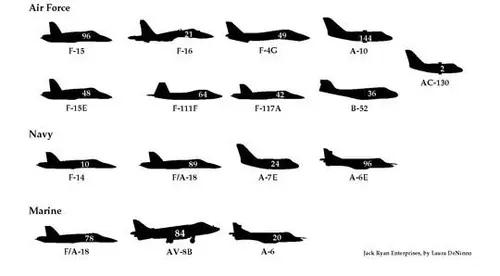
All of these aircraft were waiting for the moment they would start the massive rush across the border that would open the aerial pounding of Iraq, which would go on unabated for the next 1,000 hours. What you don’t know can hurt you.