Chapters (25)
- Title Page
- Dedication
- Introduction
- I - Into the Wild Blue
- Chapter 1 - Every Man a Tiger
- Chapter 2 - The Big Lie
- Chapter 3 - The Vision of Bill Creech
- II - Shield in the Sky
- Chapter 4 - Mission to Jeddah
- Chapter 5 - CENTCOM Forward
- Chapter 6 - Planning the Storm
- Chapter 7 - Band of Brothers and Sisters
- III - The Thousand-Hour War
- Chapter 8 - Storm!
- Chapter 9 - Hits and Misses
- Chapter 10 - Lost and Found
- Chapter 11 - Punch and Counterpunch
- Chapter 12 - A Day in the War
- Chapter 13 - The Ten Percent War
- Chapter 14 - Shock and Awe
- Chapter 15 - Building Coalitions
- Chapter 16 - Beyond Iraqi Freedom
- Acknowledgements
- BIBLIOGRAPHY
- INDEX
Why “preparation” instead of just bombing the Iraqis into the Stone Age? Because “preparation of the battlefield” has special doctrinal meaning to the U.S. Army. If a battlefield is well prepared, few U.S. soldiers have to die. Ergo, the more thoroughly the Air Force can prepare the battlefield, the happier Norman Schwarzkopf would be.
Airmen are too often perceived as fighting some war other than the land commanders’ war. This war would be different. It would be the CINC’s war. Though it would primarily be an air campaign, to sell that campaign, Horner had to get the approval of General Schwarzkopf the land commander, before he got it from General Schwarzkopf the CINC.
The CINC bought this idea, and even thought it was his. (By the by, if the Air Force actually achieved this goal, they would clearly demonstrate airpower’s decisive effect on the battlefield—perhaps for the first time. Did matters unfold that way? We shall see.)
• PHASE IV—THE GROUND WAR.
How long would the campaign take?
The truth was, no one knew, and so estimates changed and varied. When the air staff ran the original ATO through the computer, the estimate was about a week. This seemed ridiculously hopeful to Buster Glosson, and so the time grew to three weeks. By November, it was thought that the planned Phase I would be pretty well achieved in less than a week (five to six days); Phase II in two days; Phase III in two weeks; and Phase IV would take up to three weeks. Later still, in a December briefing, Horner told Secretary Cheney that the computer models showed the war lasting from one to three weeks, but that he himself thought it would last at least six weeks. (This guess actually proved substantially correct.)
As it turned out, Phase I took from ten minutes to three days, depending on how success is measured. Phase II happened during Phase I. Phase III took five-plus weeks. And Phase IV took four-plus days.
War Duration in Days: December Estimate Versus Reality

The numbers of days do not total. For example, the thirty-eight days of Phase III include strikes conducted during the three days of Phase I. The message is that the impact of airpower on the enemy was underestimated, and the ability of airpower to destroy a deployed enemy was overestimated. The airman is always too optimistic, while the landman is too pessimistic.
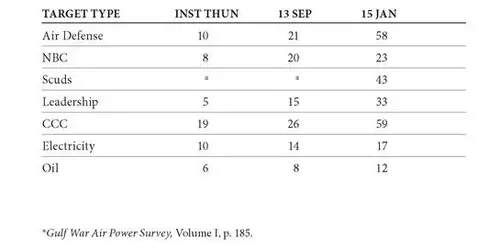
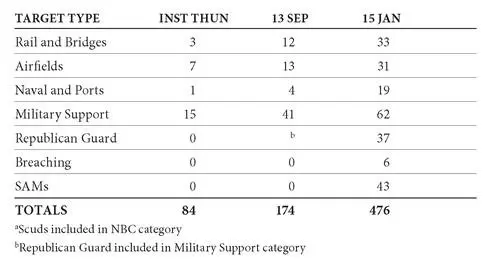
★ Finally, it would be useful to compare the changes that took place in the air campaign from John Warden’s INSTANT THUNDER, to the September iteration of Buster Glosson’s briefing, and then to the ATO when the war started. Here are some numbers:*
Target Growth by Category