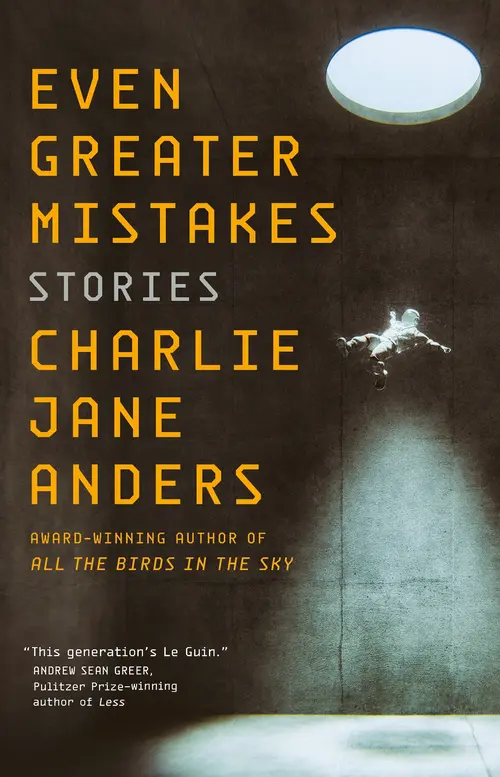
Even Greater Mistakes
Chapters (28)
- Copyright Notice
- Dedication
- INTRODUCTION
- I sat in a darkened theater and listened to LeVar Burton—LeVar Burton!—reading “As Good as New” to a rapt audience, and I nearly melted into a fondue of imposter syndrome. Every one of my words seemed too feeble, too unworthy, to be spoken in Burton’s honeyed voice, but the more I listened, the more I got swept up in his recitation and felt my story taking on a whole new life. I consider it a legit miracle I didn’t split into two people.
- Daniel H. Wilson and John Joseph Adams asked me to contribute to an anthology of video game stories called Press Start to Play, and I spent several weeks working on a tale about the last surviving video game designers, trying to create a game in a dystopian hellworld. I had to keep excusing myself from the bar at World Fantasy because I had an overdue story to finish. At last I turned in “The Deliverables”—and realized that I loathed it. “The Deliverables” was everything I didn’t want my writing to be anymore: superficially funny, smugly dull. Worst of all, that story wasn’t about anything, and you could tell I’d forced myself to finish it.
- Alyssa wouldn’t quit my head. I had handed in my second genre novel, The City in the Middle of the Night, which ends with a smuggler named Alyssa getting her first glimpse of the eponymous metropolis. (Here’s a good place to tell you that if you don’t want spoilers for City in the Middle, you’d best flip to the next story now. Though I’m sure you could read “If You Take My Meaning” first and then treat the book as an extended prequel, and that would be just fine.) The final image of Alyssa’s shining eyes felt like the perfect place to leave things in the book, but I kept wondering what would happen next. What would that vision drive Alyssa to do? “If You Take My Meaning” tied up a few other loose ends, but also raised some brand-new questions which were fun to explore.
- I have done trigonometry exactly once since high school, and that was when I was writing “The Time Travel Club.” I had become obsessed with a weird question: If you could travel in time, wouldn’t you also be relocated in space? Since the Earth is constantly in motion, and the universe is expanding, you couldn’t jump forward five minutes and still be in the same place as before, right? I contacted Dr. Dave Goldberg (the writer of io9’s “Ask a Physicist” column), and he responded by talking about quantum foam and special relativity. Eventually, Dr. Dave helped me figure out a set of rules for my time travel—but then I had to do a ton of math to calculate how far you’d move through space for every second you traveled in time. I was up at two a.m. crunching numbers.
- Like many of the other stories in this book, “Six Months, Three Days” started out with a concept: What if two people both saw the future, but they saw it very differently? Doug sees only one future, which can’t be changed, while Judy sees many different futures and can choose to steer herself toward the one she wants. This premise opened up fun ideas around fate and free will, but I didn’t want to write a treatise about abstract concepts. To turn this into a story about relationships and people, I needed to dig deeper and think about the scariness of falling in love—especially when you know a relationship might not last. I also tapped into one of my biggest obsessions: the fact that we all go through life knowing that horrible loss and devastation awaits us in the future, no matter what we do. “Six Months” morphed into a story about two people who love each other despite knowing too much. This was the first story where I felt like I captured real, raw emotion on the page, after years and years of trying.
- WisCon is my favorite convention for many reasons—but a major one is that I always come home from Madison feeling fired up creatively, after so many inspiring conversations, auctions, karaoke sessions, and dance parties. “Love Might Be Too Strong a Word” came out of a bunch of WisCon arguments about queerness and gender in science fiction, which kept fizzing in my brain afterward.
- “Fairy Werewolf vs. Vampire Zombie” is a little bit Vampire Diaries fanfic, I’ll be honest. I was (and am) obsessed with the CW’s soap opera about vampires, witches, and werewolves, and all of its spin-offs. I started thinking about what would happen if someone got turned into a vampire and a zombie at the same time. Which type of undead curse would win out? (This was before the Buffy the Vampire Slayer comic introduced zompires.) But also, what if a werewolf bit a fairy? These are the kinds of important questions that serious grown-ups like me spend our time thinking about. This story has many of my favorite things: an obnoxious narrator, karaoke, romance, karaoke, duels to the death, and karaoke. In spite of the aforementioned romance, the central relationship in this story is a friendship between two very different women.
- Years after I wrote “Love Might Be Too Strong a Word,” I was at WisCon again and I ran into Kelly Link. I talked her ear off about this story I was in the middle of writing, a story about a woman who is haunted by her own ghost. (Meaning that in the future, after she’s died, her ghost somehow travels back in time and haunts her.) I had about three-quarters of the story but was having a hard time coming up with an ending. Kelly thought for a moment, and then generously made some suggestions that led to the ending you see here. This story’s protagonist, Gloria, is one of the angriest characters I’ve ever written—which is why she’s a comedian—and this story turned into an exploration of how depression and anger feed on each other in an endless spiral. (And just a heads up: this story does deal with depression somewhat intensely, though with a lot of humor.) In the pages and pages of notes for this story, I wrote, “There are a lot of things Gloria would do, if she wasn’t there watching herself do them.”
- I wrote a ton of first-person stories about queer life in San Francisco back in the day—full of trans people, genderqueer artists, pranksters, poly drama, and gentrification. The first of those stories featured a version of the Cacophony Society and starred a genderfluid artist who’s in love with their best friend. Another story featured a trans woman who starts dating someone who speaks only in adverbs. For a while, I thought about turning them into a linked story collection, and I wrote “My Breath Is a Rudder” to be one of the final stories of the bunch. Most of those stories take place in the present, but “My Breath Is a Rudder” takes place in the near future, because I wanted the story collection to move forward in time as it went. My original plan was for that story cycle to end in a far-future, drowned San Francisco—and eventually I got to write that story, which appears later in this collection. I abandoned the idea of the linked queer story cycle but decided that “My Breath Is a Rudder” stands just fine on its own.
- I didn’t intend for “Power Couple” to be a science fiction story at first. I wrote the first third of the story thinking of it as a “realist” work of literary fiction, in which the only technology would be stuff that already exists. But the deeper I got into this story of two young people who are torn between their relationship and their careers, the more it became obvious what should happen next, from a character standpoint: they should take turns going into suspended animation.
- I wrote four novels that never got published, before All the Birds in the Sky. There was a comic portal fantasy, there was a coming-of-age story set at the start of Bill Clinton’s presidency, and there was an urban fantasy about witch hunters. And there was Rock Manning. I started writing a version of Rock Manning at the start of the Iraq War—it was a meditation on violence, slapstick comedy, and the relationship between the two. The part of us that lets us laugh at someone else’s pratfall might also be what allows us to tolerate horrific violence against people who aren’t part of our in-group.
- After I wrote “My Breath Is a Rudder,” I always meant to go back and write another queer first-person story that takes place after San Francisco is claimed by the ocean. Enter Jonathan Strahan, who asked me to contribute to a post–climate change anthology called Drowned Worlds. I had a lot of fun imagining the San Francisco archipelago, using a map that Brian Stokle and Burrito Justice had created of the city following two hundred feet of sea level rise.
- I wrote the first half of “Captain Roger in Heaven” to read at a spoken word event organized by superstar blogger Greta Christina. The second half turned out to be a lot trickier, and I wrote a bunch of different endings that didn’t quite work. I couldn’t crack the ending until I figured out what this story was really about: superficially, it’s about sex and death, and the inevitability that any community will go from being loosey-goosey to having Rules and Structure. But I realized that the key to the story was the character of Tanya, the cult leader whom I’d been thinking of as a quasi-villain. Once I stopped and thought about Tanya more carefully, and saw her perspective, I groped my way toward the realization that she was a tragic figure who won an empire by throwing away a chance at real love. Content warnings: sexual assault, torture, religious extremism, mental health issues.
- “Clover” is another quasi-sequel to one of my novels (just like “If You Take My Meaning”). The good news is there are no spoilers for All the Birds in the Sky in “Clover,” and you don’t need to have read the book to appreciate any of it. After All the Birds in the Sky was published, I started hearing from readers that I’d left a loose end: What happened to Berkley the cat? I learned the hard way that you should never leave the fate of an adorable creature unresolved.
- The venerable literary magazine ZYZZYVA was one of the first high-profile places to publish my fiction, way back in 2002. So when publisher Oscar Villalon and editor Laura Cogan asked me to contribute to a special Bay Area issue, I was delighted. “This Is Why We Can’t Have Nasty Things” isn’t really speculative fiction—instead, it’s a return to the first-person queer stories about San Francisco that I used to write, one of which had appeared in ZYZZYVA back in the day. All those old themes about queer artists and gentrification felt even bigger in 2019 than they did in the early 2000s, especially with so many queer landmarks shuttering. I didn’t have to try too hard to imagine being present at the last night at a local watering hole that’s about to be gone forever. Heads up: there’s a brief mention of sexual assault.
- I was stoked when John Joseph Adams asked me to contribute to Cosmic Powers, a book of fun space opera stories in the vein of Guardians of the Galaxy, because I adore silliness in space more than anything. I wasn’t sure what to write, until I thought about my deep and enduring love of Harry Harrison’s Stainless Steel Rat books, which tell the story of “Slippery” Jim diGriz, interstellar rogue. To give my two con artists, Kango and Sharon, a decent sandbox to play in, I had to whip up a whole universe. My master document, explaining the economics and politics of this galaxy, ended up being pretty long and detailed just to set up some throwaway jokes (and to make sure there were meaningful stakes). Kango and Sharon were created by a culture of amoral libertines who delight in perverse pleasures, and their battle for the right to define their own identities resonated with me. I wrote a second Kango and Sharon story, “Cake Baby,” which you can read at Lightspeed magazine, and I have notes for a few others. If you’d like to read more about these two rogues and their friend Jara, please let me know!
- Sometimes you get crushed by a fear so all-encompassing, the only thing you can do is write it down and share it with the world. Back in January 2017, I couldn’t sleep. We were a couple weeks away from the inauguration of our forty-fifth president, and I was having nightmares and panic attacks about surviving as a trans person in this new era. I decided to channel all my anxiety, rage, and nausea into a story that would give voice to my worst fears about my body becoming illegal—I couldn’t work on anything else until I finished writing.
- Bookstores are my favorite places to hang out. Browsing through shelves and shelf-talkers never fails to cheer me up, even when the world is bleak AF—everything about a bookshop lets you know that you’re in a place where stories are celebrated, and you can never run out of discoveries. So when Victor LaValle and John Joseph Adams asked me to contribute to A People’s Future of the United States, an anthology of stories set in a future USA, I knew I wanted to write about a bookseller struggling to hold things together.
- One thing has brought me not just solace but actual delight, during the ugliest of times: the flourishing of the trans/non-binary community. I’ve seen more and more people transitioning and coming out—and where there used to be just a handful of us writing speculative fiction, there are now many incredible voices. (Just check out the Transcendent series of anthologies, or Meanwhile, Elsewhere.) There’s never been a better moment for speculative fiction about gender-nonconforming people, and I’ve felt so privileged to be able to add a few droplets to this wave.
- ACKNOWLEDGMENTS
- Also by Charlie Jane Anders
- Praise for Even Greater Mistakes
- ABOUT THE AUTHOR
- Newsletter Sign-up
- COPYRIGHT ACKNOWLEDGMENTS
Copyright Notice
The author and publisher have provided this e-book to you without Digital Rights Management software (DRM) applied so that you can enjoy reading it on your personal devices. This e-book is for your personal use only. You may not print or post this e-book, or make this e-book publicly available in any way. You may not copy, reproduce, or upload this e-book, other than to read it on one of your personal devices.
Copyright infringement is against the law. If you believe the copy of this e-book you are reading infringes on the author’s copyright, please notify the publisher at: us.macmillanusa.com/piracy.
Dedication
For D. G. K. Goldberg—
the Queen of the Country Where They Sleep Till Noon
INTRODUCTION
I swore I would never write a novel.
My first allegiance, my deepest loyalty, was to short fiction—the only species of confabulation that grants you total freedom to mess around. I was a natural short story writer who loved to explore a concept to the fullest in a few thousand words and then flit to the next tiny epic. Novels felt like such a serious commitment that I would never dare to try such headlong flights of fancy in them, and I had way more fun soaring (and occasionally crashing) through world after world, one story at a time.
After all, writing short fiction was the reason I’d bailed out of my first journalism career.
Years ago, I was working a soul-crushing job at a local newspaper, where I spent most of my time in a cubicle, freaking out into a telephone. My boss was an easygoing sadist who encouraged me to tell potential sources that I would lose my job if I didn’t get a decent scoop soon. (He assured me I wouldn’t be lying if I said that.)
I got home from work feeling both drained and freaked out, with no mental energy left for my own writing projects.
Every day at lunchtime, I haunted a newsstand with shelves full of science fiction digests, literary magazines, and other fiction mags. I read every kind of yarn there was and reveled in all the changes a skilled writer could take me through in just a few pages, and I daydreamed about seeing my name on one of those covers.
Then I discovered something that changed my life: a thudding great hardcover that listed every market that published science fiction and fantasy short stories, along with advice on how to break in. I sat in my cubicle, when I was supposed to be calling people and telling them about my precarious employment situation, and pored furtively over the introduction, which promised, “You can get rich writing science fiction and fantasy these days.” I immediately quit the newspaper, took a much lower-stress day job, and started cranking out strange yarns with stars in my eyes.