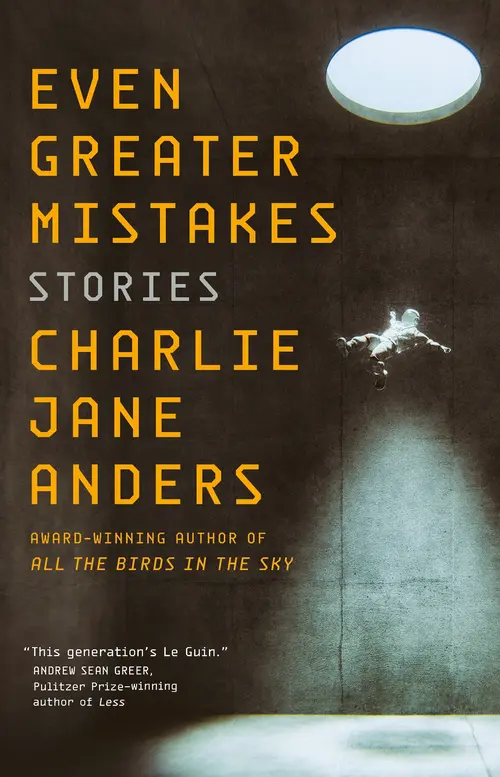
Even Greater Mistakes
Copyright Notice
The author and publisher have provided this e-book to you without Digital Rights Management software (DRM) applied so that you can enjoy reading it on your personal devices. This e-book is for your personal use only. You may not print or post this e-book, or make this e-book publicly available in any way. You may not copy, reproduce, or upload this e-book, other than to read it on one of your personal devices.
Copyright infringement is against the law. If you believe the copy of this e-book you are reading infringes on the author’s copyright, please notify the publisher at: us.macmillanusa.com/piracy.
Dedication
For D. G. K. Goldberg—
the Queen of the Country Where They Sleep Till Noon
INTRODUCTION
I swore I would never write a novel.
My first allegiance, my deepest loyalty, was to short fiction—the only species of confabulation that grants you total freedom to mess around. I was a natural short story writer who loved to explore a concept to the fullest in a few thousand words and then flit to the next tiny epic. Novels felt like such a serious commitment that I would never dare to try such headlong flights of fancy in them, and I had way more fun soaring (and occasionally crashing) through world after world, one story at a time.
After all, writing short fiction was the reason I’d bailed out of my first journalism career.
Years ago, I was working a soul-crushing job at a local newspaper, where I spent most of my time in a cubicle, freaking out into a telephone. My boss was an easygoing sadist who encouraged me to tell potential sources that I would lose my job if I didn’t get a decent scoop soon. (He assured me I wouldn’t be lying if I said that.)
I got home from work feeling both drained and freaked out, with no mental energy left for my own writing projects.
Every day at lunchtime, I haunted a newsstand with shelves full of science fiction digests, literary magazines, and other fiction mags. I read every kind of yarn there was and reveled in all the changes a skilled writer could take me through in just a few pages, and I daydreamed about seeing my name on one of those covers.
Then I discovered something that changed my life: a thudding great hardcover that listed every market that published science fiction and fantasy short stories, along with advice on how to break in. I sat in my cubicle, when I was supposed to be calling people and telling them about my precarious employment situation, and pored furtively over the introduction, which promised, “You can get rich writing science fiction and fantasy these days.” I immediately quit the newspaper, took a much lower-stress day job, and started cranking out strange yarns with stars in my eyes.
In my first decade of writing short fiction, I racked up over six hundred rejections and published ninety-three stories, mostly in small markets that no longer exist. Not to mention, a few dozen of my stories never found a home. Every day, when I finished work in my lower-stress day job, I walked to the nearest Caribou Coffee, where I guzzled turtle mocha (the drink of champions!) and wrote the sickest fever-dreams I could imagine, full of space theologians, lesbian dung beetles, and disposable genitalia.
I toiled alone on those first ninety-three short stories, but I was always surrounded by friends and fellow travelers. I talked pretty much every day to my best friend and mentor, the late horror writer D. G. K. Goldberg: comparing notes, trading critiques, and commiserating over the latest form letter. I also joined a ton of writers’ groups, read at open mics, haunted convention bars, and lurked on forums like SFF.net. The whole process of writing and selling short fiction became a shared experience, and whenever I made it into print, I got to bond with everyone else whose name appeared in the same TOC, or table of contents—we were “TOC-mates.”
My rejections were a badge of honor. I kept a document with a careful record of where every story had already gone and which markets I hadn’t tried lately, and I also noted which editors had written a personal response. At the bottom of that document, I wrote, “Rejections should be welcomed. There is nothing more joyful and optimistic than the act of putting a story in the mail, especially if that story has already come back once or twice.” (Or, more often, a dozen times.)
Online, a bunch of us parsed rejection letters like the entrails of a freshly slaughtered goose. One magazine allegedly used various shades of paper stock, depending on how good your story was. Another editor was rumored to use different Word macros, and you could tell how much he’d liked your story by whether his response employed the word “sadly.”
I made all kinds of bargains in my head with the universe: I would give up turtle mochas, I would stop jaywalking, if I could just get one story into a pro market—let alone one of the “year’s best” anthologies. And my ultimate dream? Was that I would have a honking big book like the one you’re looking at right now, made up of nothing but my own stories.
Writing short stories gave me tons of practice with beginnings and endings, not to mention world-building and character creation—but they also let me work with scores of editors, who collectively mentored and shaped me. I owe a huge debt to the crew at Strange Horizons, who published two of those ninety-three stories but also gave me feedback on countless others. Sometimes an editor would take the time to talk through why a story wasn’t working, or offered me advice on how to remove some of my inevitable clutter and deadweight.
Not all of these interactions were fantastic, for sure. One lit-mag editor spent an hour on the phone giving me genuinely helpful thoughts about my story—mixed with transphobic observations about my main character.
Another lit-mag editor responded to a submission by saying that he only liked one sentence of my story. Would I take that one sentence, which was about a minor supporting character, and build a whole new story around it? I elected to think of this as a fun challenge, so eventually I produced a whole new story that contained that one sentence. The editor wrote back and said that he now liked two sentences: the one he’d originally liked, plus a new one. He asked me to write a third story from scratch, using those two sentences. After some hesitation, I went ahead and did so, and luckily, the third time was the charm.
At some point, I started reading slush for a few different magazines, and that was also invaluable training in how to think like the editors I was sending my work to. I found out the hard way that when you have hundreds of submissions to get through, you make a lot of snap judgments after the first couple pages, and it’s on the writer to give the editor (and reader) a reason to keep reading. In one case, I volunteered for a magazine that had several crates full of unread subs, and I dug out a story that I had sent them a few years earlier. I reread my own piece, saw that it was completely wrong for the magazine, and had the dubious pleasure of sending myself a rejection letter.
Short stories are dangerous: tiny sparks of pure narrative fire that burn hotter because they snuff out sooner. Small, self-contained adventures gave me the freedom to fail—to push my limits, to experiment with styles and ideas that I wasn’t sure I could pull off. And fail I did, over and over. I wrote scores of short pieces before I managed to turn out one that fired on all cylinders. The wonderful thing is, if you blow it with something short, you’ve only wasted a week or three of writing time. And if someone reads your story in a magazine and hates it, there’ll be another story, by another author, on the next page.
That’s the other thing I love: the flexibility. My stories have been published in a variety of genres, ranging from extremely highfalutin to the very lowest of the falutins. Plus, shorts can worm their way in anywhere. I’ve published fiction in:
- indie culture magazines that mostly published essays and articles;
- zines that were piled up in coffee shops and record stores;
- an Arizona adult newspaper (the kind that’s mostly sex worker ads), which published non-smutty science fiction on its inside back page;
- humor magazines and books that mostly ran essays, cartoons and spoofs;
- small-press anthologies of horror, erotica, queer lit, and political rants;
- an anthology edited by my friend Daphne Gottlieb, entitled Fucking Daphne—full of metafictions about people having sex with a fictional character named Daphne Gottlieb;
- glossy food magazines that were mostly recipes and articles about cuisine trends; and
- journalistic outlets like Slate, Technology Review, and Wired.
Many of my stories were written, in part, so I’d have something to read aloud at spoken-word events, music festivals, beauty salons, and Pride stages. Also, some people were printing fiction on bags of fancy mail-order coffee beans, but I’m afraid they never accepted one of my microfictions.
It’s one thing to pick up a fiction digest and read a bunch of short stories, but I always loved the idea that someone could be reading potty humor or kitchen advice or a serious article about politics and then turn the page and stumble on a little dollop of unreal writing. Fiction shines even brighter in mixed company.
Journalism taught me to be punchy and concise, and to turn a jumble of facts and self-serving statements into a true story. Erotica showed me how to establish characters quickly and find the emotional “hook” of a particular moment as soon as possible, because the sex wouldn’t be fun if we didn’t care about the characters. Literary fiction made me pay more attention to my use of language and to the small moments that make the big moments work. A hummingbird fickleness when it came to genre kept me growing as a short story writer.
These days, most of my stories start with “What if?” and end up with a different question: “Who am I to you?” My usual way into a story is to think of a zany scenario that I’ve never seen before, like “What if the world ended, and the last surviving person found a genie in a bottle?” I keep poking until this becomes a story about people, and then I strive to figure out who those people are, but also what they mean to each other. And how that meaning can shift from the first page to the last.
As you might have figured, I broke my vow and wrote some novels. But my early loyalty to shorter forms paid off, because the practice of producing a couple hundred tales increased my control and helped me get better at sticking the landing. Conversely, when I did write a bunch of novels, they strengthened my world-building muscles and forced me to spend more time developing the inner life of my characters.
The stories in this book reflect that whole journey: the rejections, the slush reading, the genre hopping—though only a handful of them were among my first ninety-three published works. In terms of style and genre, they’re all over the place, ranging from gonzo comedy to quiet introspection. They all share that commitment I mentioned, to try to entertain from the very first sentence and give you a reason to keep reading past the first page. A whole book of short stories can be overwhelming, like imaginative speed dating. You have to keep starting over and meeting a new set of characters each time, and what if they just want to talk about stewed eggplant for the whole five minutes? So my fervent hope is that my long apprenticeship gave me the ability to serve up some reasonably fun dates.
After all, I never want to go back to cold-calling strangers and begging them to save me from unemployment.
I sat in a darkened theater and listened to LeVar Burton—LeVar Burton!—reading “As Good as New” to a rapt audience, and I nearly melted into a fondue of imposter syndrome. Every one of my words seemed too feeble, too unworthy, to be spoken in Burton’s honeyed voice, but the more I listened, the more I got swept up in his recitation and felt my story taking on a whole new life. I consider it a legit miracle I didn’t split into two people.
“As Good as New” started with a neat idea about a genie who survives the apocalypse, but the whole shebang only clicked when I added another layer: Marisol’s dilemma about medicine versus theatre, and her creative growth as a playwright. I love stories where people untangle a personal dilemma in the middle of struggling with bigger questions, because the contrasts of scale make the huge stuff feel even huger. This story’s theme of clichés helping to destroy the world feels even more relevant now than it did several years ago.
AS GOOD AS NEW
Marisol got into an intense relationship with the people on The Facts of Life, to the point where Tootie and Mrs. Garrett became her imaginary best friends and she shared every last thought with them. She told Tootie about the rash she got from wearing the same bra every day for two years, and she had a long talk with Mrs. Garrett about her regrets that she hadn’t said a proper good-bye to her best friend, Julie, and her on-again, off-again boyfriend, Rod, before they died along with everybody else.
The panic room had pretty much every TV show ever made on its massive hard drive, with multiple backup systems and a failproof generator, so there was nothing stopping Marisol from marathoning The Facts of Life for sixteen hours a day, starting over again with season one when she got to the end of the bedraggled final season. She also watched Mad Men and The West Wing. The media server also had tons of video of live theatre, but Marisol didn’t watch that because it made her feel guilty. Not survivor guilt, failed playwright guilt.
Her last proper conversation with a living human had been an argument with Julie about Marisol’s decision to go to medical school instead of trying to write more plays. (“Fuck doctors, man,” Julie had spat. “People are going to die no matter what you do. Theatre is important.”) Marisol had hung up on Julie and gone back to the pre-med books, staring at the exposed musculature and blood vessels as if they were costume designs for a skeleton theatre troupe.
The quakes always happened at the worst moment, just when Jo or Blair was about to reveal something heartfelt and serious. The whole panic room would shake, throwing Marisol against the padded walls or ceiling over and over again. A reminder that the rest of the world was probably dead. At first, these quakes were constant, then they happened a few times a day. Then once a day, then a few times a week. Then a few times a month. Marisol knew that once a month or two passed without the world going sideways, she would have to go out and investigate. She would have to leave her friends at the Eastland School and venture into a bleak world.
Sometimes Marisol thought she had a duty to stay in the panic room, since she was personally keeping the human race alive. But then she thought: What if there was someone else living, and they needed help? Marisol was pre-med, she might be able to do something. What if there was a reproductively viable person, and Marisol could help them repopulate the species?
The panic room had nice blue leather walls and a carpeted floor that felt nice to walk on, and enough gourmet frozen dinners to last Marisol a few lifetimes. She only had the pair of shoes she’d brought in there with her, and it would seem weird to wear shoes after two barefoot years. The real world was in here, in the panic room—out there was nothing but an afterimage of a bad trip.
Marisol was an award-winning playwright, but that hadn’t saved her from the end of the world. She was taking pre-med classes and trying to get a scholarship to med school so she could give cancer screenings to poor women in her native Taos, but that didn’t save her either. Nor did the fact that she believed in God every other day.
What actually saved Marisol from the end of the world was the fact that she took a job cleaning Burton Henstridge’s mansion to help her through school, and she’d happened to be scrubbing his fancy Japanese toilet when the quakes had started—within easy reach of Burton’s state-of-the-art panic room. (She had found the hidden opening mechanism some weeks earlier, while cleaning the porcelain cat figurines.) Burton himself was in Bulgaria, scouting a new location for a nanofabrication facility, and had died instantly.
When Marisol let herself think about all the people she could never talk to again, she got so choked up she wanted to punch someone in the eye until they saw stars forever. She experienced grief in the form of freak-outs that left her unable to breathe or think, and then she popped in another Facts of Life. As she watched, she chewed her nails until she was in danger of gnawing off her fingertips.
The door to the panic room wouldn’t actually open, when Marisol finally decided it had been a couple months since the last quake and it was time to go the hell out there. She had to kick the door a few dozen times, until she dislodged enough of the debris blocking it to stagger out into the wasteland. The cold slapped her in the face and extremities, extra bitter after two years at room temperature. Burton’s house was gone. The panic room was just a cube half-buried in the ruins, covered in some yellowy insulation that looked like it would burn your fingers.
Everything out there was white, like snow or paper, except powdery and brittle, ashen. She had a Geiger counter from the panic room, which read zero. She couldn’t figure out what the hell had happened to the world, for a long time, until it hit her—this was fungus. Some kind of newly made, highly corrosive fungus that had rushed over everything like a tidal wave and consumed every last bit of organic material, then died. It had come in wave after wave, with incredible violence, until it had exhausted the last of its food supply and crushed everything to dust. She gleaned this from the consistency of the crud that had coated every bit of rubble, but also from the putrid sweet-and-sour smell that she could not stop smelling once she noticed it. She kept imagining that she saw the white powder starting to move, out of the corner of her eye, advancing toward her, but when she turned around there was nothing.
“The fungus would have all died out when there was nothing left for it to feed on,” Marisol said aloud. “There’s no way it could still be active.” She tried to pretend some other person, an expert or something, had said that, and thus it was authoritative. The fungus was dead. It couldn’t hurt her now.
Because if the fungus wasn’t dead, then she was screwed—even if it didn’t kill her, it would destroy the panic room and its contents. She hadn’t been able to seal the room properly behind her without locking herself out.
“Hello?” Marisol kept yelling, out of practice at even trying to project her voice. “Anybody there? Anybody?”
She couldn’t even make sense of the landscape. It was just blinding white, as far as she could see, with bits of blanched stonework jutting out. No way to discern streets or houses or cars or anything, because it had all been corroded or devoured.
She was about to go back to the panic room and hope it was still untouched, so she could eat another frozen lamb vindaloo and watch season three of Mad Men. Then she spotted something, a dot of color, a long way off in the pale ruins.
The bottle was a deep oaky green, like smoked glass, with a cork in it. About twenty yards away, perched in one of the endless piles of white debris. Somehow, it had avoided being consumed or rusted or broken in the endless waves of fungal devastation. This green bottle looked as though someone had just put it down a second ago—in fact, Marisol’s first response was to yell “Hello?” even louder than before.
When there was no answer, she picked up the bottle. In her hands, it felt bumpy, like an embossed label had been worn away, and there didn’t seem to be any liquid inside. She couldn’t see its contents, if any. She removed the cork.
The Story Continues on BooksBarbecue!
Enjoyed this preview? ❤️ Do not stop here!
Read the complete book free online → 🔗
Continue reading now on BooksBarbecue and discover every page!
Love reading? Bookmark BooksBarbecue.com for more amazing books!
Happy Reading!