Chapters (50)
- A TOM DOHERTY ASSOCIATES BOOK NEW YORK
- Dedication
- Acknowledgments:
- Table of Contents
- Epigraph
- JOURNAL OF JULIUS GABRIEL
- PROLOGUE
- Chapter 1
- Chapter 2
- JOURNAL OF JULIUS GABRIEL
- Chapter 3
- JOURNAL OF JULIUS GABRIEL
- Chapter 4
- JOURNAL OF JULIUS GABRIEL
- Chapter 5
- Chapter 6
- Chapter 7
- JOURNAL OF JULIUS GABRIEL
- Chapter 8
- Chapter 9
- JOURNAL OF JULIUS GABRIEL
- Chapter 10
- Chapter 11
- Chapter 12
- Chapter 13
- Chapter 14
- JOURNAL OF JULIUS GABRIEL
- Chapter 15
- Chapter 16
- Chapter 17
- JOURNAL OF JULIUS GABRIEL
- Chapter 18
- JOURNAL OF JULIUS GABRIEL
- Chapter 19
- JOURNAL OF JULIUS GABRIEL
- Chapter 20
- Chapter 21
- JOURNAL OF JULIUS GABRIEL
- Chapter 22
- Chapter 23
- Chapter 24
- Chapter 25
- Chapter 26
- Chapter 27
- Chapter 28
- Chapter 29
- EPILOGUE
- Coming soon
- Permissions and Credits
- About the Author
The exterior of the Great Pyramid is as mind-boggling as its interior. Having previously discussed the temple’s measurements in relationship to the value pi, precession, and the dimensions of the Earth, I’ll proceed to the structure’s four limestone-block sides. As incredible as it may seem, each side spans 755 feet, the pyramid coming within a mere eight inches of being a perfect square. Each side is also aligned to true north, east, south, and west, facts that make a greater impact when one realizes the Great Pyramid is constructed of 2,300,000 stone blocks, each weighing between 2.5 and 15 tons. (In the smallest of the three Giza pyramids lies a single stone weighing 320 tons. As I record these words in the year 2000, there are only three cranes in the entire world that could lift such a monumental weight off the ground.) Yet, as was the case in Tiahuanaco and Stonehenge, no machinery was used to move these incredible weights, which had to be transported from a distant quarry, then placed in position, oftentimes hundreds of feet off the ground.
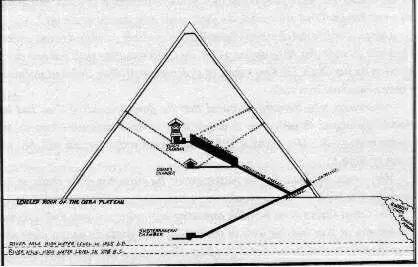
Most onlookers gazing upon the Great Pyramid do not realize that the structure’s sides were originally finished with highly polished casing stones, each of these 144,000 blocks weighing 20,000 pounds. Only remnants of these casing stones remain today, the majority having been destroyed after a massive earthquake in AD 1301, yet we know the limestone blocks had been cut with such precision and skill that the blade of a knife could not be inserted between them. One can only imagine what the Great Pyramid must have looked like thousands of years ago—a six-million-ton structure covering 13 acres—shimmering under the Egyptian sun like glass.
While the exterior of the pyramid is a wondrous sight to behold, it is the interior of this mysterious structure that may conceal its true purpose.
The Great Pyramid contains several passageways leading to two barren rooms, innocuously named the King’s Chamber and the Queen’s Chamber. The true purpose of these rooms is still unknown. A concealed doorway along the northern face leads one down a narrow passage connecting to a corridor ascending straight into the heart of the pyramid. After a brief climb, one can either enter a claustrophobic, 130-foot-long horizontal tunnel leading to the Queen’s Chamber, or continue ascending still farther by way of the Grand Gallery, an impressive vaultlike corridor that leads up to the King’s Chamber.