Devil in the Darkness
Chapters (25)
Cover
Title Page
Archie Roy
DEVIL IN THE DARKNESS
with a new introduction by
GREG GBUR
VALANCOURT BOOKS
Copyright Page
Devil in the Darkness by Archie Roy
First published by John Long, London, 1978
This edition first published 2016
Copyright © 1978 by Archie Roy
Introduction copyright © 2016 by Greg Gbur
This edition copyright © 2016 by The Estate of Archie Roy
All rights reserved. In accordance with the U.S. Copyright Act of 1976, the copying, scanning, uploading, and/or electronic sharing of any part of this book without the permission of the publisher constitutes unlawful piracy and theft of the author’s intellectual property. If you would like to use material from the book (other than for review purposes), prior written permission must be obtained by contacting the publisher.
Published by Valancourt Books, Richmond, Virginia
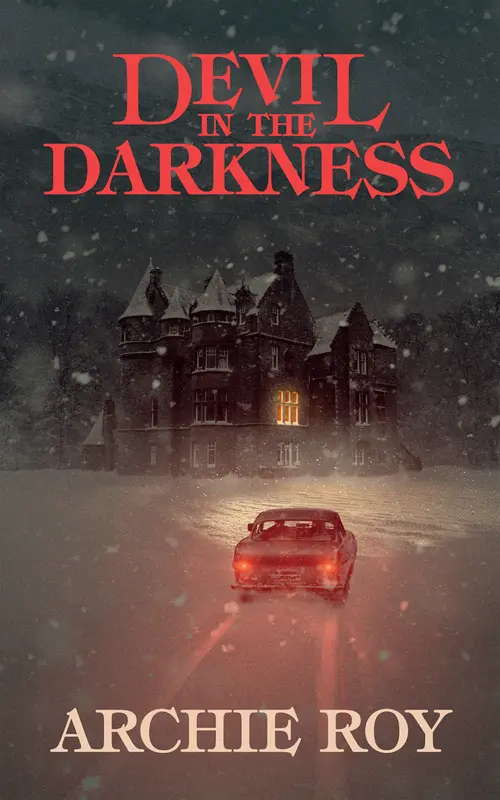
Front cover image of Kinlochmoidart House by Ian Roy
Introduction by Greg Gbur
Introduction
One of the challenges in writing a haunted house story – or, more generally, an ‘Old Dark House’ story whose horror may or may not be supernatural – is getting the characters into the house in the first place, and then keeping them there. Who would plausibly be willing to stay in a house where their lives or their very souls are endangered?
Looking at such fiction written over the years, three options are used quite commonly. The first of these is simply to have people take up residence in a house, not knowing that it has a supernatural threat inside. Novels such as 1977’s The Amityville Horror (originally billed as ‘a true story’) and Michael McDowell’s 1981 novel The Elementals, and movies such as 1982’s Poltergeist take this approach. Often the unhappy homeowners are even stuck in the house once they learn its nature, either by financial necessity or, in the case of Poltergeist, by having one of their family members taken. In this framing, the reader is usually kept in the dark as much as the residents of the house, allowing the terror to build slowly through the story.
The second option for getting people into a haunted house and keeping them there it to force them to, usually via weather. The obvious example here is The Shining (1977) by Stephen King, in which the Torrance family is snowed in at the Overlook Hotel for the winter as dark forces inexorably drive Jack Torrance violently insane. Another example is the original ‘Old Dark House’ story, J. B. Priestley’s 1927 novel Benighted, where Philip and Margaret Waverton are driven into a spooky mansion by a furious storm and flood. Trapping people in the house adds a nice touch of claustrophobia to what is hopefully an already tense tale.